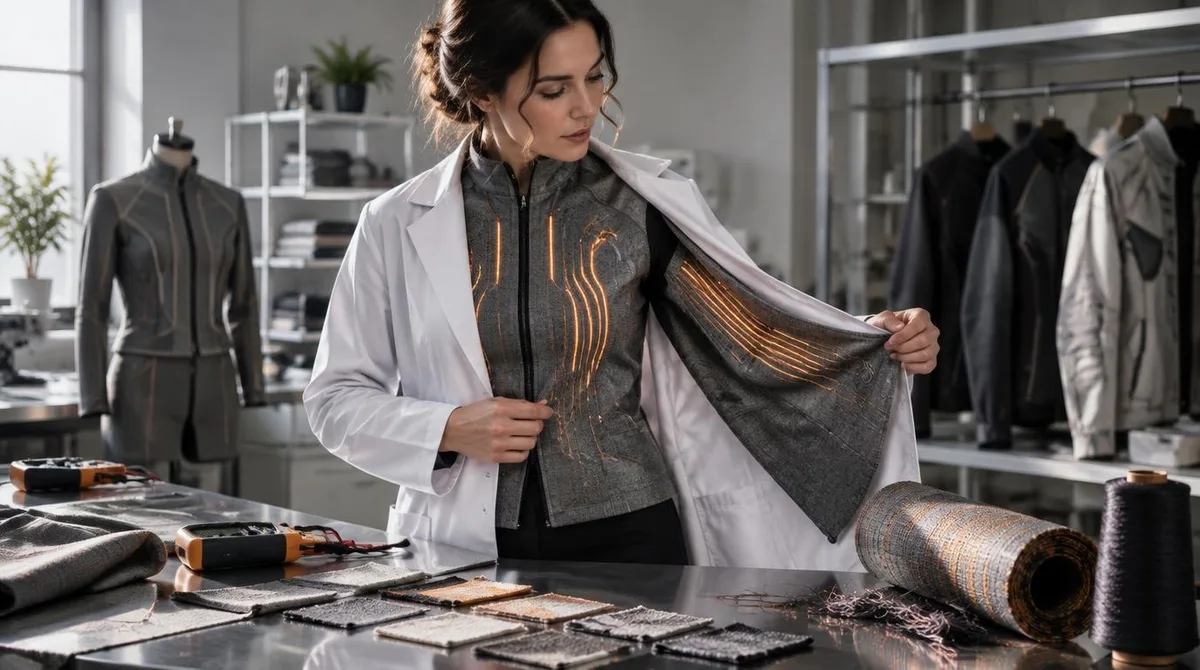
Smart fashion sits at every stage between laboratory prototype and everyday garment, and the honest answer to "how it works" is that very little of it has finished the journey. A jacket with heating filaments, a shirt that reads heart rate, a yarn that changes color: each one is a different distance from the closet, and the distance is measurable. The industry borrows a grading idea, the technology readiness level, to describe exactly where a material or garment sits on that path.
The shorthand matters because fashion has a habit of presenting a working demo as a shipped product. A runway piece lit with electroluminescent thread proves the thread conducts. It does not prove the thread survives thirty wash cycles, a folding machine, or a supply chain that prices garments to the cent. Readiness language separates those two claims, and this piece walks through what each stage actually demands.
First, though, a definition. "Smart" clothing usually means one of three things: sensing (the garment collects data from the body or the environment), actuating (it changes state, warming, cooling, stiffening, lighting), or connecting (it talks to a phone or a network). Many pieces do one of these well. Almost none do all three cheaply, durably, and invisibly, which is what a normal garment buyer implicitly expects.
What does "smart" actually mean in a garment?
Strip away the marketing and a smart garment is an electronic system wearing a textile costume. Conductive yarns replace wires. Flexible sensors replace rigid boards. A battery or energy-harvesting layer replaces the wall plug. Every one of those substitutions trades a problem electronics solved decades ago for a problem textiles has not: electronics like to be rigid, dry, cool, and stationary, while clothing is flexed, laundered, sweaty, and in constant motion.
That mismatch explains most of the gap between demo and product. A sensor can read a heartbeat accurately on a laboratory bench, taped flat, at room temperature. The same sensor sewn into a rib-knit band must keep contact through stretch, moisture, and body shape variation, then survive a wash at forty degrees. The sensing technology may be mature; the integration into a washable knit is not. Readiness grading exists precisely to catch that difference, because the two failures live at different points on the path.
How do technology readiness levels grade a garment?
A technology readiness level, often shortened to TRL, is a graded scale that describes how far a technology has progressed from basic principles to proven use in its real setting. The best-known versions run from the very early end, where a concept exists only on paper or in a petri dish, through laboratory validation, to a controlled relevant environment, then to a working prototype tested in real operating conditions, and finally to a technology proven through actual deployment. Different agencies and industries publish their own variants, but the shape is consistent: each step up demands proof in an environment one step closer to real life.
Applied to fashion, the scale reads like this. A conductive fiber spun in a materials lab sits at the bottom. The same fiber knitted into a test swatch that survives repeated flexing moves up. A sensor shirt trialed by a sports team, with engineers on hand and spare units available, sits in the middle ranges. A garment sold at retail, washed by strangers, and still working a year later occupies the top. The scale is deliberately unromantic. It asks what has been demonstrated, by whom, and under what conditions.
The useful discipline here is measurability. As Southern New Hampshire University explains in its guide to SMART goals, a goal is only measurable if you can tell whether you have actually achieved it, a framing that originated with George T. Doran's 1981 paper in Management Review, as Wikipedia's summary of the SMART criteria recounts. A wearable claim such as "tracks activity accurately" fails that test until someone defines the metric, the conditions, and the threshold. Readiness levels force exactly that definition onto technology claims that fashion marketing prefers to leave soft.
Why does the gap between demo and drawer stay so wide?
Three frictions keep wearable and textile technology in the middle of the scale longer than their inventors would like.
- Laundering and wear. A garment is a machine that is deliberately abused. Electronics rated for a thousand bend cycles meet a sleeve that bends thousands of times per day of normal wear. Any claim of durability has to specify cycles, temperatures, and detergents, or it is not a claim.
- Power. Sensing is cheap; transmitting and computing are not. A battery adds weight, stiffness, and a charging ritual most clothing cannot absorb. Until the energy budget shrinks, many functions stay tethered to a detachable module, which is itself a compromise on fit and feel.
- Data and value. A shirt that collects data raises the question of what the data is worth and to whom. Privacy expectations, app maintenance, and the cost of supporting software long after a garment is sold all sit outside the textile mill's traditional competence.
There is also a quieter economic friction. Fashion margins are thin and fashion calendars are fast. A component that adds cost to a garment must either raise the price a shopper will accept or disappear. Technologies that pass the technical hurdles still fail the price test, and they drop back down the scale in commercial terms even though the science was never the problem.
Which parts of smart fashion are actually close to ready?
The general pattern across the industry is uneven, and the unevenness is the story. Technologies that ask nothing of the wearer and nothing of the wash cycle have climbed furthest. Item-level identification tags, which carry no battery and no sensing, have moved from warehouse experiment to routine stockroom infrastructure, a shift covered in detail in Why RFID Took Over the Stockroom, and What It Replaced. Passive, cheap, invisible: that profile travels well up a readiness scale.
Fit and measurement technologies have climbed a different route, through the data side rather than the garment. Body scanning, for instance, matured as a capture technology long before apparel companies built workflows around it, a lag explored in Body Scanning Gave Apparel Real Population Data, and Brands Still Barely Use It. The lesson generalizes: a technology's readiness is judged per application, not per invention. The scanner can be proven while the business process around it remains experimental.
Garments that sense or actuate on the body sit lower, for the laundering, power, and data reasons above. The everyday objects that have quietly absorbed the most technology, from temperature-regulating fibers to connected mirrors, tend to be the ones where the electronics stay out of the wash, a selection surveyed in The Gadgets Quietly Changing Getting Dressed. And a whole category of "smart" now lives entirely off the body, as image files rather than fabric, which raises its own questions about what wearing even means, taken up in Digital Wardrobes: What Virtual Clothing Actually Is, and What Wearing Means Online.
What this means for anyone evaluating a smart garment
Our analysis, reading the pattern rather than any single announcement: the readiness framing gives a buyer three questions worth asking before any purchase or coverage claim. What exactly does the garment do, stated as a measurable outcome rather than an adjective? Under what conditions has that been demonstrated, and by whom, the manufacturer's own lab or an independent party? And what happens to the function after laundering, after the battery ages, and after the company that maintains the app loses interest?
A useful parallel comes from management practice. The SMART framework, with its insistence on specific, measurable, achievable, relevant, and time-bound objectives, spread because it made vague ambitions falsifiable. Research summarized on Wikipedia notes the framework's effectiveness varies by context, and a Michigan State University Extension study reported there found people who wrote goals and action steps achieved them far more often than those who did not, while broader reviews of physical-activity goal setting show mixed results. The honest conclusion for goal setting and for wearables is the same: structure and measurement help, but they do not guarantee the outcome, and context decides a great deal.
What the evidence supports is modest and worth stating plainly. Readiness scales are a shared vocabulary for asking how proven something is, and most consumer-facing smart fashion asks to be judged at the middle of that scale, not the top. The technologies nearest the closet are the passive, low-power, wash-safe ones. The technologies that promise the most, sensing the body and acting on it, remain the furthest out, and will stay there until laundering, power, and data economics each clear their own level. What remains unknown is the timeline, because no readiness framework predicts when a level will be cleared, only whether it has been.