Upcycling clothes means taking a garment you would otherwise discard and rebuilding it into something you will actually wear again — a repair, a resize, or a full rework. Unlike recycling, which breaks fabric down into raw material, upcycling keeps the garment intact, so it costs less energy and preserves the cloth itself. The ten projects below are ordered from a beginner's afternoon to a weekend deconstruction job.
The case for starting with your own closet is simple. According to the Farmers' Almanac, citing an Environmental Protection Agency study on solid waste generation, the average American produces about 4.5 pounds of solid waste every day, and most of it still ends up in landfill even after curbside recycling. Clothing that gets repaired or rebuilt never enters that stream at all. The practice also sits inside a larger idea: the Upcycle My Stuff guide defines upcycling as adding value to something that would otherwise be thrown away, recycled, or abandoned — and notes it sits above recycling in the reduce, reuse, recycle hierarchy because it requires no industrial processing.
What counts as upcycling, and what does not?
Upcycling is any transformation that raises a discarded item's value without breaking it down into raw material. Turning a worn flannel into cleaning rags is the lowest-value version; rebuilding the same shirt into a fitted panel garment is the high end. What excludes it: melting fiber into new yarn, which is recycling, not upcycling. Repsol's explainer draws the same line — recycling runs an industrial process to recover raw material, while upcycling is creative reuse that keeps the object's form and adds unique character.
The practical test for a wardrobe piece: if the finished garment is something you would reach for again, the project earned its place. If it becomes a rag or a dust cloth, that is reuse, useful but not upcycling in the strict sense. We covered a connected angle in Garment Cost Breakdown: How a Garment's Cost Breaks Down From Fiber to Rack.
Which projects suit a total beginner?
Three projects need no sewing machine and almost no skill. Each one changes how a garment looks or lasts without touching its structure.
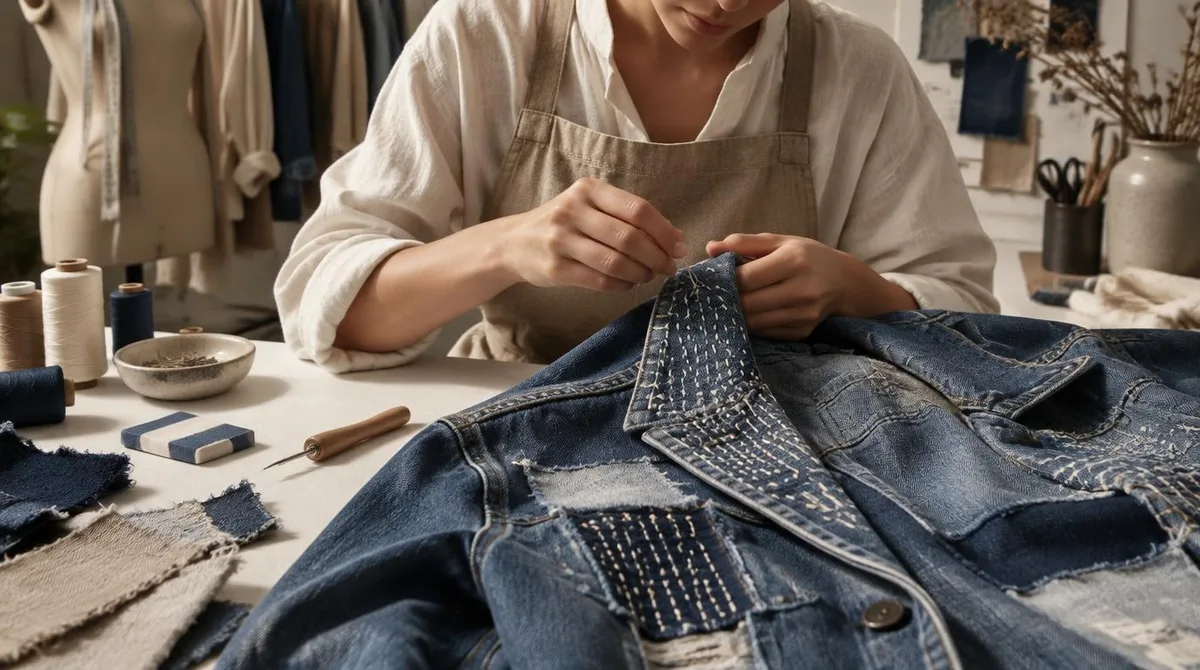
- Visible mending on a worn seam or elbow. Stitch over the worn area with contrasting thread — sashiko-style running stitches work well on denim and cotton. The repair is meant to be seen, which removes the pressure of invisibility. Tools: a needle, thread, and an embroidery hoop if the fabric puckers.
- Natural fading and re-dyeing. A faded black tee or a stained shirt can be re-dyed a darker shade with a fiber-appropriate dye. Check the care label first — the federal rules that govern what appears on a clothing care label also tell you the fiber content, which determines the dye type.
- Button and hardware swaps. Replacing missing or mismatched buttons, or a broken zip pull, restores a garment in under an hour. Keep the original hardware if you plan to resell.
What can you do with a sewing machine at home?
Once a machine enters the picture, the projects shift from surface repair to structural change. These four cover most wardrobe staples.
- Taking in or letting out a waistband. Trousers and skirts with generous seam allowances can be resized inward; letting out works only where the seam allowance has fabric to give. Press the new seam flat and topstitch for durability.
- Shortening sleeves and hems. The most common resize. Measure twice on the body, cut once, and finish the new raw edge with a hem or a bias-bound edge so it survives washing — fabric behaves differently after laundering, as any explainer on why fabric shrinks after washing makes clear.
- Converting a button-front shirt into a fitted layer. Add back darts, narrow the side seams, and shorten the placket. A boxy men's cut becomes a wearable overshirt with about an hour of pinning and stitching.
- Cropping and re-hemming a knit. Knits need a stretch-compatible stitch — a narrow zigzag or a twin needle — so the new hem does not pop when the fabric stretches.
When is full deconstruction worth the effort?
Deconstruction means taking a garment apart at the seams and building something new from the pieces. It is the highest-skill, highest-reward end of upcycling, and it works best on large-format fabric: jeans, work shirts, and heavy outerwear yield the most usable cloth. The The ReUse People, a salvage organization that has diverted building materials from landfill since 1993, frames the principle the same way for houses as for clothes — the item is transformed into something of higher value through craftsmanship rather than broken down.
- Jeans into a tote or a panel garment. Cut the legs along the seams, keep the thickest denim for handles and straps, and use the back pockets as-is. Denim's weight means no lining is needed.
- Two shirts into one. Combine the intact halves of two damaged shirts — a contrast-sleeve shirt is the classic result. Match fabric weights so the garment hangs evenly.
What this means for a long-life wardrobe
Our analysis: the projects that pay off are the ones that change fit or restore function, not the ones that only change appearance. A resized trouser gets worn weekly; a tie-dyed tee gets worn twice. Start with visible mending to build confidence, move to resizing on a cheap thrifted garment before touching a piece you love, and save deconstruction for heavy fabric you have in quantity. Every project above uses cloth you already own, which is the quiet economic argument — the fabric, cut, and construction were paid for once, and rebuilding keeps them in rotation instead of in a bin. For the commercial side of that equation, see how a garment's cost breaks down from fiber to rack, and why the most sustainable fabric is often the one already hanging in the closet. For related coverage, see How Federal Rules Dictate Every Word on a Clothing Care Label.
One caution from the broader upcycling literature: some materials are not worth reworking. The Farmers' Almanac guide warns against reusing pressure-treated wood for anything near edible soil because the chemicals can leach — a reminder that the base material's condition decides whether a project is worth doing at all. Worn-out elastic, delaminated coatings, and moth-damaged wool fall into the same category for clothes.