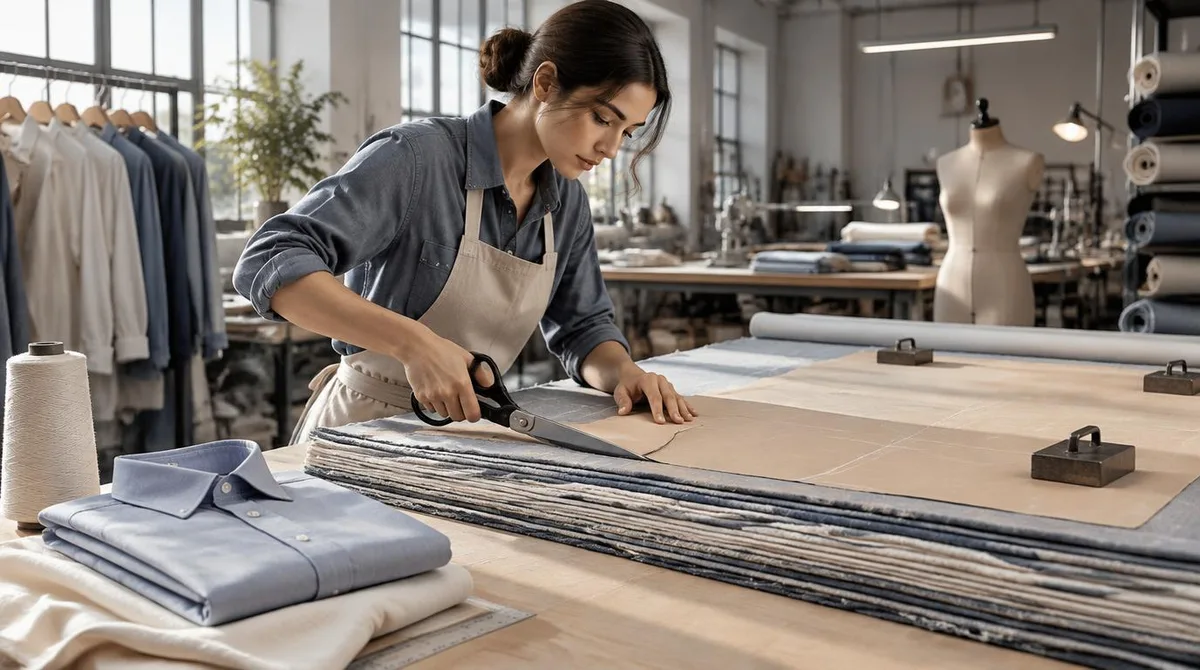
A garment's retail price is a stack. Fiber sits at the bottom, then spinning, weaving or knitting, dyeing, cutting, sewing, finishing, freight, duties, wholesale margin, and retail markup. Each layer adds cost, and the top layers — margins and the cost of running a store — usually outweigh the fabric itself. The exact split varies by garment, factory, and brand, so no single percentage applies across the rack.
What can be said with confidence is the order of the stack and what each layer buys. Textile Industry defines a garment as fabric cut to a body-shaped pattern and sewn part by part, with labeling, ironing, and decorative processes completing it — three core sections, cutting, sewing, and finishing, with supporting departments around them. That sequence is also the cost sequence. Money is added at every handoff.
This walkthrough uses a basic garment — a plain woven shirt or a simple knit tee — as the worked example, because basics expose the mechanics most clearly. There is little design drama to hide behind. The question is purely: where does each dollar go, and why. For readers tracking how specification changes alter familiar items, the Style News desk covers those quiet shifts as they happen.
What goes into a garment before the fabric is even cut?
More than fabric. Online Clothing Study lists the full material set for a trouser as an example: fabric, pocketing lining, fusible interlining, sewing thread, zippers, buttons, hook-and-bar closures, labels, price tags, and packaging. Each of those is a separate purchase, often from a separate supplier, and each carries its own margin.
Thread is the quiet one. A shirt may hold several hundred meters of it, and specialty thread — core-spun, high-tenacity — costs more per spool than the commodity kind. Interlinings, the fusible sheets that give a collar its body, are bought by the meter and fused under heat and pressure. Labels and tags look trivial and are, per unit. But they are mandatory, and the care label in particular follows rules that leave no room for improvisation, as covered in How Federal Rules Dictate Every Word on a Clothing Care Label. Readers following this should also see How Federal Rules Dictate Every Word on a Clothing Care Label.
Trims matter more on some garments than others. A basic tee needs thread and a neck tape. A jacket needs zippers, snap hardware, pocketing, and drawcords. The trim bill can approach the fabric bill on hardware-heavy styles, which is one reason two garments of similar size and fabric can carry very different factory costs.
How does fiber become priced fabric?
Fabric is usually the largest single material cost, and it is priced before anyone cuts anything. The chain runs: fiber, spun into yarn; yarn woven on a loom or knitted on a circular machine; the resulting greige goods — unfinished, undyed cloth — sent to dye and finish. Each conversion step adds cost, because each one is a separate facility with its own machinery, energy use, and margin.
Fabric is typically sold by weight. Grams per square meter, or GSM, is the standard measure, and the number does real work: it changes how a garment drapes, wears, and costs, as explained in How Fabric Weight Is Measured, and Why a GSM Number Changes What You Get. Heavier cloth consumes more fiber per square meter, so it costs more before a single seam is sewn.
Dyeing and finishing add another layer. Dye lots, colorfastness testing, and mechanical finishes — softening, sanforizing, anti-pilling — all cost money at the mill. A mill's technical datasheet will state what finish a fabric carries; that specification, not the color, is often what a buyer is actually paying for.
What does cut-and-sew labor actually cost?
Cutting and sewing are where the garment industry concentrates its workforce. The readymade garment trade is globalized, with developed countries sourcing mainly from Asian countries where manufacturing costs are low and the workforce is skilled, according to Online Clothing Study, which also notes the industry is a main source of economic development and jobs for millions of people in those countries.
Labor cost per garment is a function of minutes, not wages alone. A factory prices an operation — attach collar, set sleeve, close side seam — by the standard time it takes a trained operator. Total sewing minutes multiplied by the fully loaded labor rate, plus factory overhead and the contractor's margin, produce the cut-make-trim price a brand negotiates. A simple tee might involve a handful of operations; a tailored shirt many dozens. Minutes, more than geography, explain the spread.
Efficiency compounds. A factory running a familiar block — a pattern family it sews every day — loses fewer minutes to learning curves and changeovers. That is one reason brands repeat proven styles, and why a factory move can signal real changes to cost and consistency, as covered in What a Factory Move Announcement Actually Tells a Repeat Buyer. This connects to our earlier piece, What a Factory Move Announcement Actually Tells a Repeat Buyer.
Where do freight, duties, and margins sit in the stack?
Once finished and packed, the garment starts accumulating non-manufacturing cost. Freight moves it from factory to distribution center, by sea container for most basics — slow and cheap per unit — or by air when a delivery date slips. Duties and customs charges depend on the garment's classification and the trade route, and they are paid before the goods reach a warehouse.
Then come the two margin layers. The brand sells to a wholesaler or retail partner at a price that covers its own material, labor, overhead, and development costs plus a margin. The retailer then marks the wholesale price up again to set the ticket price, because the store carries its own rent, staff, inventory risk, and markdown losses. For a directly operated brand the two layers merge, but the store economics remain.
Markdowns are part of the calculation from the start. Retailers price knowing some units will sell below ticket, so the full-price markup has to absorb the planned discount. A garment that never sells through at full price still has to have paid for itself somewhere in the system.
What this means for how a price reads
The stack explains a familiar puzzle: why the fabric in a garment rarely justifies its ticket. Fabric and trims are one layer among ten, and the layers above — labor, freight, duties, two margins, markdown risk — are where most of the retail price is created. It also explains why small specification changes travel far. A heavier fabric, a better zipper, or a longer seam finish each cost cents at the factory and are invisible at the rack, yet they change how long the garment lasts.
For a reader judging whether a piece earns its place in a wardrobe, the useful questions follow the stack. What is the fabric weight and composition? What does the care label demand? Is the construction proportionate to the price — or is the price mostly store rent and margin? None of these questions requires a factory visit. They require knowing what each layer of the stack is for.
What remains unknown is the precise split for any given garment. Brands do not publish cost sheets, and the same item can carry different margins in different channels. The structure above is durable; the percentages are not, and any specific figure should be treated as a claim about one supply chain, not the industry.