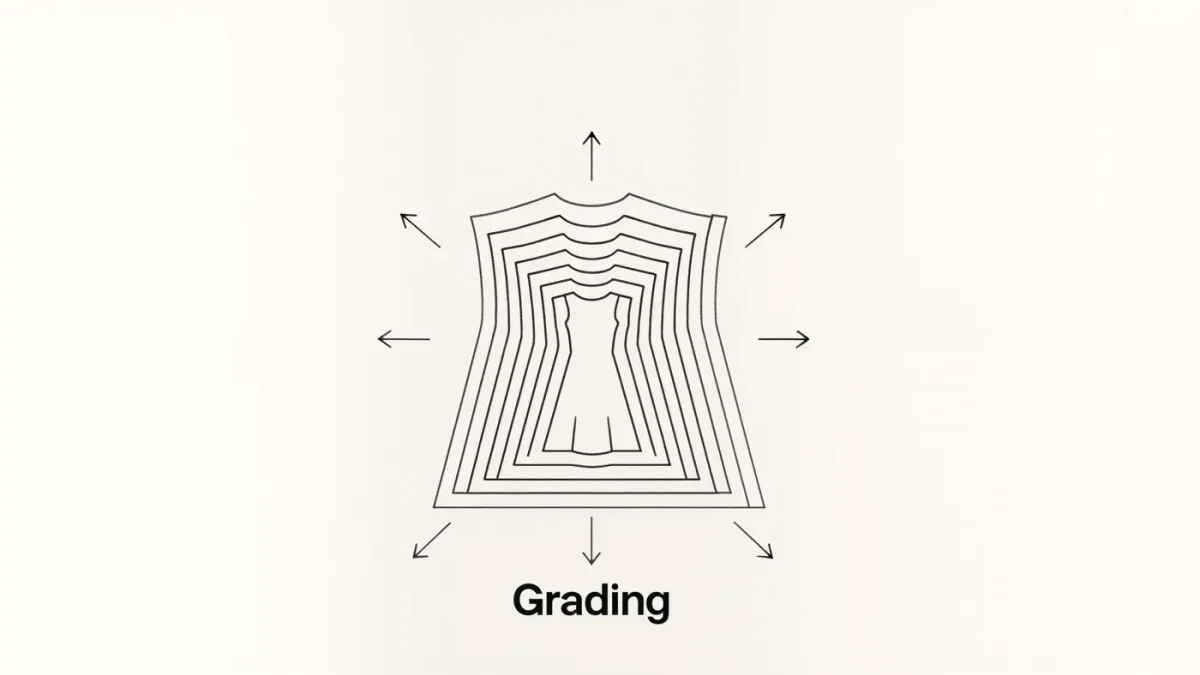
A size 12 is not a size 6 enlarged by a uniform factor, because bodies do not scale that way: as people move up sizes, girth increases faster than height, and different girth points increase at different rates. Pattern grading is the discipline of moving a base size pattern along a three-dimensional body-growth rule — adding centimeters at specified points in specified directions — rather than multiplying the drawing. The U.S. anthropometric survey data collected by NIST and its predecessor measurement programs underpinning voluntary size standards showed decades ago that cross-chest growth outpaces neck growth substantially between adjacent sizes, which is why a photographically enlarged size 6 would have a comically wide neck long before its chest reached size-12 dimensions.
What does grading actually change in a pattern?
A base-size pattern is a shaped drawing of one garment size, already fitted and styled. Grading creates the neighboring sizes by shifting each pattern edge along calculated tracks. The increments are called grade rules: fixed amounts, typically in millimeters or fractions of an inch, applied at defined points. On a bodice front, the side seam might grow by a fixed amount per size at the bust while the shoulder point grows by less and the center front by almost nothing, because body studies show the distance from neck to center chest is comparatively stable across sizes while bust circumference is not.
Where the added fabric goes is the entire craft. Growth around a circumference is split among the pattern pieces that create it: a 5-centimeter bust increase across a four-piece bodice distributes as increments at the side seams, princess seams, and dart legs, each governed by its own rule. Get the distribution wrong and the garment closes over the correct circumference but hangs wrong — the armhole drifts forward, or the bust apex sits low, because circumference was added where volume, not merely length, was needed.
Why does simple scaling fail so badly?
Uniform scaling multiplies every dimension by one factor. At a scale factor of roughly 1.12 — what an oversimplified jump from size 6 to 12 might suggest on length dimensions — the consequences compound immediately:
- Neck and armhole circumferences inflate at the same rate as the bust, producing gaping openings on bodies that never asked for them.
- Shoulder width grows proportionally with girth, though anthropometric data show shoulder breadth increases far more slowly than bust circumference across sizes.
- Vertical dimensions stretch beyond real height differences between sizes, which are small; grade rules typically change body length by a fraction of what they change girth.
- Darts deepen in proportion, but dart geometry has to change non-linearly, because bust prominence relative to ribcage follows its own curve.
- Details such as cuffs, collars, and button placements scale up even though wrist and neck measurements barely move between sizes.
The result is a garment cut for a hypothetical giant: same person, uniformly larger. Real size-12 bodies are not uniformly larger than size-6 bodies; they are differently proportioned bodies, and the pattern has to be re-balanced, not inflated.
Where do grade rules come from?
Historically, from national anthropometric surveys. The most influential American dataset came from the 1939-1940 Works Progress Administration body measurement study of thousands of women, which ASTM later used in developing voluntary standard body tables for clothing design. Those tables keyed sizes to bust measurement, then added height groupings — a recognition that the same bust could sit on different stature. Later work, including the civilian anthropometric surveys carried out with SizeUSA measurement technology in the early 2000s using 3D body scanning, updated the picture and confirmed widening disparity: girth distributions had shifted while height had moved little, and the shape variation within one size exceeded the difference between adjacent sizes for many measurements. Per reporting on the SizeUSA program by industry press, scan data showed that a single numeric size contained bodies whose key circumferences differed by several centimeters, one reason vanity sizing eroded the meaning of size numbers entirely.
Individual brands layer their own grade rules on top of any standard, which is why a size 10 varies so much between labels. The grade rules are proprietary; they encode who the brand thinks its customer is.
International size systems make the same point from another direction. European dress sizing historically stepped by roughly four centimeters of bust per size — a girth-driven ladder — while British and American numeric systems built stature groups into the tables. A technician converting a pattern between systems does not merely relabel sizes; the grade increments themselves differ, so a converted range needs its rule library rebuilt. Brands that skipped this step when exporting historically shipped ranges whose middle sizes fit and whose extremes did not, a pattern long noted in apparel trade reporting.
How does digital grading change — or not change — the work?
CAD systems such as those widely used in industry have automated the mechanics: a technician defines grade rule libraries, assigns a rule to each pattern point, and the system generates all sizes instantly. But the software does not decide the rules. A rule library built by a careful pattern engineer reflects the same body-growth logic as hand grading; a library copied carelessly between a junior and a plus range produces the same distorted garments a naive scale-up would, just faster. The failure mode of automation is silent, because every size is perfectly consistent with its own wrong rules. Per ASTM's voluntary sizing tables, even within standardized ranges, grade increments differ across body regions and height groups — the tables encode non-uniform growth by design.
Why do graded garments still fail to fit at the extremes?
Because grading extrapolates from a base size, error compounds with distance from it. A pattern graded ten sizes away from its base accumulates distortions: armholes become too deep relative to bust, sleeve pitch rotates, and ease — the wearing room designed into the fit — drifts out of its intended range. Industry practice therefore re-cuts and re-fits a pattern at intervals, a process called re-grading from a new block or sample-size validation, rather than trusting a twenty-size extrapolation. This is also why plus-size lines developed from a straight-size base fit poorly even when the measurements sum correctly: the body-growth rules of a plus body are different in kind, not just amount, particularly in bust-to-waist relationship and armhole depth.
What should a buyer understand about sizing charts?
A chart's numbers describe circumference, but fit is decided by where the pattern put that circumference. Two brands can both offer a 96-centimeter bust in size 12, yet dress one body very differently depending on their grade rules for shoulder, armhole, and dart placement. The practical takeaway: once a brand fits, stay with it across its range, because its internal grade rules are consistent — and treat any brand's jump into a new size range as a fit question requiring its own answer rather than an extension of the old one. Per Reuters coverage of apparel returns, poor fit remains the leading stated reason for online apparel returns, and grading failures at the range extremes are a substantial, measurable share of that loss.
Grading is body science encoded as arithmetic. When it is done from real growth data, a size 12 fits a size-12 body; when it is done as scaling, the industry manufactures clothes for a shape that exists nowhere.