Every fit decision in clothing reduces to one equation: finished garment dimension equals body dimension plus ease — the allowance of extra (or, in second-skin styles, negative) room built into the pattern. A size-12 bodice cut to a 96-centimeter bust on a 92-centimeter body carries 4 centimeters of bust ease, and whether that garment reads as tailored, comfortable, or shapeless depends almost entirely on those 4 centimeters being deliberate. Fit complaint data across the apparel industry consistently places tightness and looseness at the top of return reasons, per Reuters reporting on e-commerce apparel returns, and both complaints trace back to the same variable: ease budgets that were guessed, inherited, or copied between silhouettes that behave differently.
What is the difference between wearing ease and design ease?
Wearing ease is the minimum room a body needs to function inside a garment — to breathe, sit, reach, and walk without the fabric restraining movement. It is a physiological floor, not a style choice, and it varies by location: the bust and shoulders need more than the wrist, and the hip needs more when a wearer sits, because sitting can require several additional centimeters of hip circumference relative to standing. Design ease is everything beyond that floor — the extra volume that creates a silhouette. An oversized shirt's drama and a slim trouser's clean line are both design ease, positive and near-zero respectively. The confusion between the two terms is the most common fit failure in amateur pattern work: a garment can be cut with generous absolute room and still fail, because the room was placed where the body does not move.
Negative ease — a finished garment dimension smaller than the body — belongs to stretch construction. A knit garment with 5 percent negative ease relies on the fabric's elongation to bridge the gap, and the math must include the fabric's recovery, because a stretch fabric held near its elongation limit all day will relax and bag. Negative ease in a woven is simply too small, since a woven cannot lend the garment the missing centimeters.
How much ease does each garment type actually carry?
| Garment and location | Typical ease range | Rationale |
|---|---|---|
| Woven bodice, bust | Roughly 5 to 10 cm for a fitted line; 10 to 15+ for loose | Breathing plus arm movement; below ~4 cm wovens bind |
| Shirt and jacket, chest | Roughly 8 to 15 cm, more for layering | Movement plus underlayers; tailoring varies by style |
| Waist, fitted skirt or trouser | Roughly 1 to 3 cm | Sitting and digestion expand the waist measurably |
| Hip, trouser | Roughly 4 to 8 cm minimum for sitting | Sitting posture can add several cm to standing hip |
| Upper arm, woven sleeve | Roughly 3 to 5 cm | Arm flexion expands bicep circumference substantially |
| Stretch knit, body | 0 to negative 5 percent | Fabric elongation supplies the room |
The ranges are engineering conventions accumulated over a century of pattern making rather than laws, but they encode real anatomy. Per anthropometric literature summarized in ASTM's sizing standards work, seated postures alter key circumferences by amounts comparable to one full size increment, which is why ease budgets that ignore sitting produce the classic symptom: garments that photograph well and hurt by afternoon.
Where the ease is placed matters as much as how much
Two garments with identical total ease can fit oppositely, because ease distributes across a pattern at specific points. Bust ease concentrated at the side seam behaves differently from the same total split between side seam, armhole, and dart legs; hip ease added at the center back panel of a trouser solves a seat fit that the same centimeters added at the side seam never touch. Pattern makers speak of ease distribution, and the professional critique of a badly fitting garment is rarely "not enough ease" in total — it is ease located away from the demand. This is also why simply sizing up fails as a fit strategy: buying two sizes larger adds ease everywhere indiscriminately, including at the shoulder, neck, and sleeve length, where the body asked for none.
How is ease measured and verified in production?
- Measure the body at the relevant landmarks — bust, waist, hip, bicep — over the undergarments the garment targets.
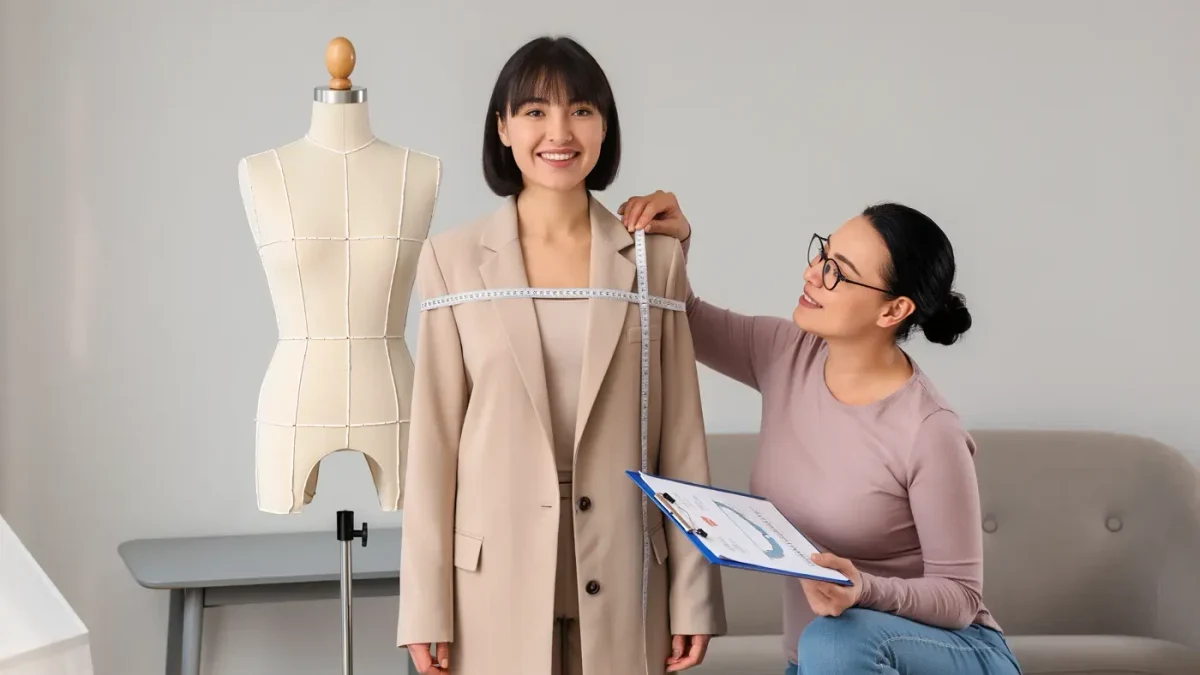
- Measure the finished garment flat, doubled where the panel wraps the body, to obtain finished dimensions.
- Subtract body from garment at each landmark to obtain the ease map, location by location, rather than one aggregate number.
- Compare against the silhouette's intended ease budget; deviations localize the fit problem to specific pattern points.
- Confirm in motion: sit, reach, and raise the arms, because static measurements cannot verify the physiological floor.
Ready-to-wear buyers can run a compressed version with any tape measure and a brand's garment measurements, which many brands now publish. The discipline of comparing specific points rather than the size number converts size charts from marketing into data. Per consumer guidance published by NIST on clothing and sizing practices, size labels are voluntary designations rather than guarantees, which places the burden of fit verification on measurement — the ease math is the verification tool available to everyone.
Why do fit models and vanity sizing complicate the numbers?
Brand ease budgets are calibrated on a fit model — a single body whose proportions stand in for a size class — so a brand's entire size range inherits one body's curve distribution. A customer whose bust-to-waist ratio differs from the fit model experiences the same nominal ease differently, because the garment's ease is distributed for someone else's geometry. Vanity sizing adds drift over time: relabeling larger garments with smaller size numbers changes nothing about ease math per garment but erodes the size number's meaning across decades. The durable response, and the one premium fit-focused brands adopted through the 2010s and 2020s, is publishing finished garment measurements, which let customers compute their own ease budgets across brands and treat ease, not size, as the universal fit language.
Childrenswear shows the discipline in its purest form, because growing bodies force the issue. Design ease in children's patterns is deliberately generous, with drawcords, adjustable waistbands, and deep hems supplying the room that growth will demand; the ease budget is written to expire slowly. Uniform and workwear specifications follow the same logic from the durability side, carrying larger ease allowances than fashion equivalents so that movement under load — reaching, crouching, lifting — never transfers strain into the seams. In both categories the extra centimeters are not stylistic generosity; they are operating margin, the same concept a structural engineer would recognize.
What does ease mean for fabric choice?
Ease and fabric behavior trade against each other. A fluid fabric with low bending resistance can carry less ease and still read as relaxed, because its folds absorb contour; a crisp, stiff fabric needs more ease to achieve the same visual volume and will strain across movement if cut close. Stretch content relaxes the budget further — a woven with 2 percent elastane tolerates a closer cut than the identical construction in rigid cloth. Pattern specifications therefore always pair an ease budget with a fabric assumption, and per reporting on apparel fit technology by Bloomberg covering brands that shifted to body-scan-driven fit, the commercial payoff of getting this pairing right shows up directly in return rates.
Fit is not magic and it is not taste; it is arithmetic performed on a body that moves. The garment industry's persistent fit crisis is, at root, an ease crisis — centimeters that were never budgeted, or budgeted at the wrong points, for bodies the patterns never met.