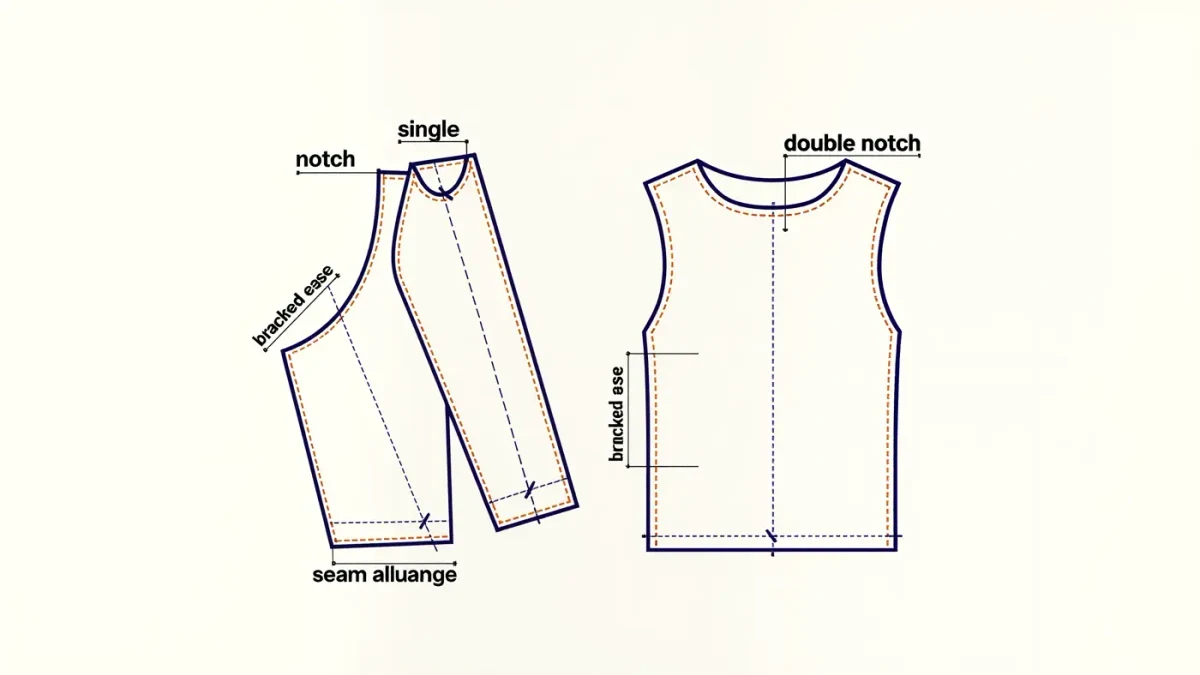
Notches — the small clips cut into a pattern piece's seam allowance at points that must align with the matching piece — are the alignment infrastructure of garment production, and they exist because a cutting room and a sewing line can hold thousands of identical-looking panels in play at once. Without them, matching a sleeve front to an armhole or a side seam to a yoke becomes guesswork at sewing speed; with them, alignment becomes verifiable in the second the plies meet under the needle. Per defect-classification frameworks used in apparel quality audits, mismatched seams and unbalanced pairs rank among the most frequent sewing defects in mass production, and missing or misplaced notches are among the most common root causes cited when those defects are traced back to the cutting room.
What do notches actually communicate?
Each notch encodes a specific instruction. A single notch on a sleeve front matched by a single notch on the armhole front says: these two points meet. A double notch at the sleeve back says: this is the back, and the balance differs from the front. Notches can also mark ease distribution — where extra sleeve-cap length is meant to be eased into the armhole, notches bound the eased zone so the operator gathers the surplus within the correct span rather than distributing it evenly, which would flatten the cap. On collars and cuffs, notches mark center-back so a doubled piece cannot be folded the wrong way. The convention is consistent across the industry precisely because operators move between factories: one notch front, two notches back, three for special instructions.
Beyond notches, the pattern carries a wider control-mark vocabulary: drill holes punched through the lay mark internal points such as pocket placements and dart ends that no edge clip can reach; awl marks serve the same purpose on single plies; and balance marks — the broader category that includes notches — include printed crosses and tailor tacks in custom work. The pattern, in other words, is not a drawing of the garment. It is a machine-readable instruction set, and marks are its syntax.
How do marks prevent defects quantitatively?
The mechanism is front-loading error detection. In a production flow without alignment marks, a reversed or shifted panel travels through sewing, pressing, and finishing before inspection catches it — if inspection catches it — and repair or scrap cost multiplies at each stage. An industry rule of thumb in quality management puts the escalating cost of late-detected defects at multiples of the cost of catching the same fault at the previous operation. Marks make the fault visible at the first operation after cutting: the operator who cannot match notch to notch stops the bundle immediately, and the loss is confined to one panel. Per apparel quality management literature from textile engineering programs, production systems with disciplined notch and mark protocols report materially lower rework rates than equivalent lines without them.
The arithmetic also runs the other way. Notch placement is itself a defect vector: a notch cut deeper than the seam allowance becomes a visible nick in the finished seam, and an awl mark placed carelessly in show fabric becomes a permanent hole. Factories therefore specify notch depth — conventionally a few millimeters into a 1-centimeter or wider seam allowance, never into the stitch line — and drill-and-awl protocols for marked fabric versus unmarked.
What does a professional pattern's mark set include?
- Matching notches at every seam intersection where two pieces must meet at a defined point — armholes, yokes, side seams, facings.
- Double and triple notches distinguishing back from front and signaling special alignment relationships.
- Ease markers bounding zones where fullness is gathered, eased, or shrunken in rather than spread evenly.
- Center-front and center-back marks, on folded or doubled pieces, preventing mis-folding of collars, cuffs, and plackets.
- Drill or awl points for internal placements — pockets, darts, button positions — transferred through the lay.
- Grainline arrows and direction-of-stretch marks, which are themselves control marks for the cutting room.
A commercial pattern missing any of these is not simplified; it is incomplete, and the sewing line will invent its own answers to the questions the marks should have settled — at whatever error rate its operators average that day.
Stripes and checks raise the stakes further. Matching a pattern across a seam requires a defined relationship between the two pieces at every intersection, and on striped fabric that relationship is only enforceable through marks: the marker planner positions pieces against the stripe repeat, and the notch set tells the operator where each pair must register. Off-grain fabric compounds the difficulty, because a skewed grid means a piece matched at the notch will drift by the hem. The combination — striped fabric, high skew, missing marks — is the standard recipe for the mismatched-seam photographs that populate customer reviews of budget patterned clothing.
Why do home sewing patterns and factory patterns mark differently?
Home patterns print notches as triangles outside the cutting line, meant to be cut outward or marked with a transfer, because home sewists cut single plies with time to measure. Factory patterns specify clips — cuts into the allowance — because production cuts stacked lays with a straight knife or bandsaw blade and speed is everything. The information is identical; the implementation is optimized for different economics. The factory version carries a discipline requirement, though: in a lay of fifty plies, a clip that drifts from the top ply to the bottom magnifies through the stack, which is why marker-making software places notches and cutting systems execute them mechanically rather than freehand. Per technical documentation from automated cutting system manufacturers, computerized cutting executes notch placement to sub-millimeter consistency across a lay, one of several tolerance gains automation brought to the cutting room.
How do marks interact with quality inspection?
Inspection audits use marks as evidence. When a QC auditor opens a finished garment and finds the sleeve back aligned a centimeter off the armhole back, the double-notch protocol identifies the failure location instantly: either the notch was missing from the marker, cut in the wrong place, or ignored at the machine. The mark set turns a vague complaint — the garment looks wrong — into a traceable chain from pattern file to cutting ticket to operator. Per defect-classification frameworks used across apparel third-party inspection services, this traceability is what allows corrective action to reach the actual root cause instead of adding inspection headcount downstream.
What can a garment buyer learn from marks?
On finished clothing, marks are mostly invisible — cut away, enclosed in seams, or hidden in allowances — but their effects are visible. Pattern matching at seams that align precisely, collar points that sit symmetrical, and sleeve caps eased exactly within their intended span all indicate that the mark protocol ran correctly upstream. A striped shirt whose chest pocket matches the stripe through the placket is a notch story: somebody placed marks, a cutting system honored them, and an operator read them under time pressure. Per reporting on apparel quality control by Reuters covering sourcing audits, factories competing on precision rather than price invest disproportionately at the pattern and marker stage, where marks live, because that is the cheapest place in the chain to buy quality.
Notches are millimeters of Nothing — clipped edges, punched holes, printed crosses — that carry the entire premise of industrial sewing: that two pieces cut miles apart should meet correctly the first time, at speed, by design rather than by luck.