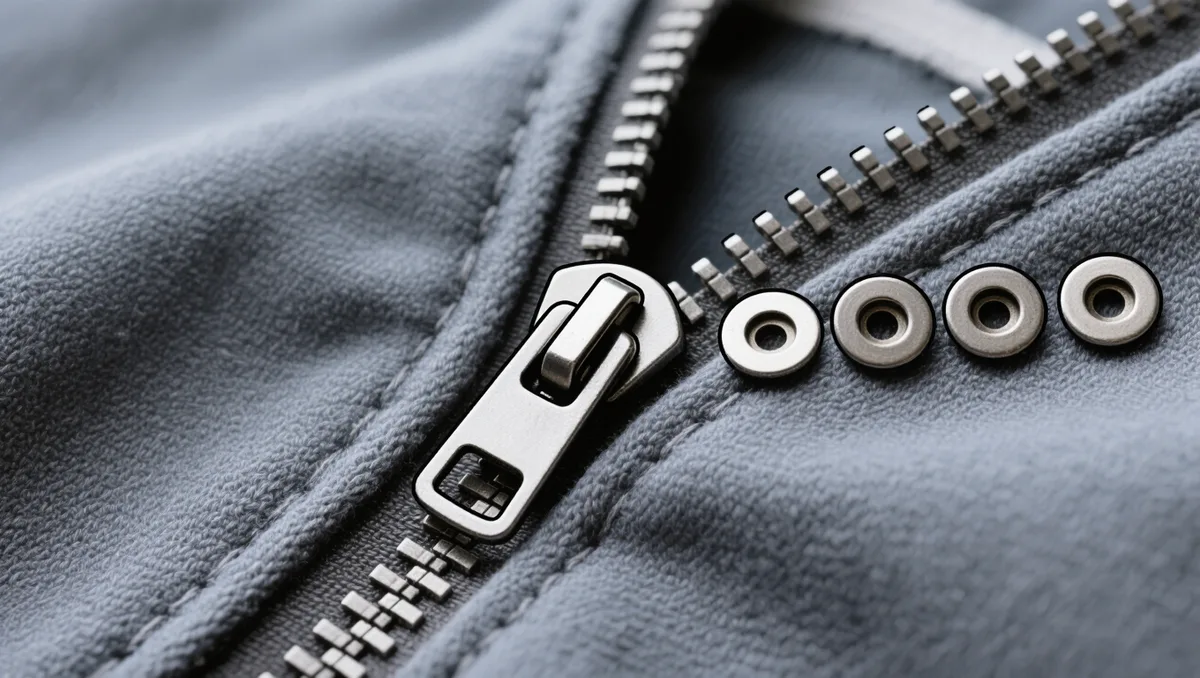
A closure is chosen by matching the fastener to the garment's job. A zipper suits a fitted dress or jacket because it opens a long seam flat; buttons suit front-opening shirts because they adjust and repair easily; snaps suit babywear and workwear because they close fast with one hand. Cost, durability, accessibility, and appearance decide the ranking.
The decision is made early, in the sampling rounds, because the closure changes the pattern itself. A button placket adds width and a fold line. A zipper needs a seam that stays flat under tension. A snap line needs a stable, layered area so the fastener does not tear free of the fabric. Every closure is a small engineering system, not a decoration bolted on at the end.
Even the language of choice carries weight. As Merriam-Webster puts it in one of its usage examples, the question is simply "Which shirt would you choose?" — and for a designer, the answer begins with what that shirt has to do.
Why does garment type come first in the decision?
The garment's shape and use set the shortlist before anything else is considered. A close-fitting bodice or a tailored jacket needs a closure that opens a long seam completely and disappears into it, which is why zippers dominate there. A shirt or cardigan opens down the front in daily wear, so buttons make sense: the wearer can adjust the top button, leave the rest open, and replace one button without touching the others.
Knit garments complicate the picture. A stable woven fabric holds a buttonhole or a snap well, because the hole keeps its shape. A stretchy knit does not; a buttonhole in a soft knit gapes and a snap can pull out of the loop. Designers either choose a closure that flexes with the fabric or add a stable facing — a hidden layer of fabric that backs the closure area and carries the stress.
Weight matters too. Heavy coatings and denim need strong fasteners. Lightweight silks and chiffons need small, light ones, because a heavy zipper pulls the fabric out of line and drags the hem sideways. The closure must weigh what the fabric can carry.
How do cost and construction time compare?
Cost is not just the price of the fastener. It is the fastener plus the work around it. A zipper is one machine operation and a topstitch, so it is often the cheapest long closure to sew. Buttons cost more in labor: each buttonhole is a separate sewn operation, and each button is attached by hand or by a slower machine cycle. This is why a button-front garment usually costs more to make than the same garment with a zipper, all else equal.
Snaps sit between the two. Standard press snaps are set by machine in seconds, once the layers are in place. Sew-on snaps cost time, because each one is stitched by hand. Decorative closures — covered buttons, specialty hooks, custom pulls — raise the cost again, because they add sourcing and handling steps.
A comparison of the three main options:
| Closure | Best suited to | Labor around it | Typical weak point |
|---|---|---|---|
| Zipper | Fitted dresses, jackets, trousers, bags | One seam plus topstitching | Slider or coil wear; a split tooth ends the zipper |
| Buttons | Shirts, cardigans, coats, adjustable fronts | One buttonhole and one attachment per button | Buttonhole gape on stretch; loose thread shank |
| Snaps | Babywear, workwear, plackets, cuffs | Fast to set once layers are prepared | Pulls free of thin or loosely woven fabric |
Which closure lasts longest, and where does each fail?
Failure points differ by type, and each one traces back to a design choice. A zipper fails at its moving parts: the slider wears, the coil or teeth separate, or the pull snaps off. A separating zipper on a jacket also fails at the two ends, where the insert pins take the most handling. The fabric around a zipper can wear before the zipper does, especially on a lightweight shell.
Buttons fail more gently. A button comes loose and can be sewn back on; the garment survives. The real failure is the buttonhole: on a stretchy or loosely woven fabric, the hole stretches and the button no longer holds. Bound buttonholes on tailored coats resist this better, which is one reason they remain a marker of higher construction — the sibling piece on buttonhole types follows that price ledger in detail. For related coverage, see Buttonholes as a Price Ledger: Hand-Worked, Bound, and Machine Types Compared.
Snaps fail at the fabric, not the fastener. A press snap holds until the material around it tears or the layers thin out. That is why snaps live on layered, stable areas: double-thick plackets, cuffs, and reinforced crotch openings on babywear. Hooks and eyes, a fourth option for waistbands and fur closures, fail the same way — at the stitch lines that anchor them. We covered a connected angle in How Fabric Grain Direction Shapes the Way a Garment Hangs and Stretches.
What does accessibility change?
Accessibility has moved from an afterthought to a design requirement, and closures sit at the center of it. A standard small button demands fine finger control and two hands. A person with limited grip, one hand, or low vision may not be able to fasten it. Magnetic closures, larger buttons, longer zippers with ring pulls, and open-front designs all reduce that demand.
The same logic runs in the other direction for children's wear and workwear. Snaps and zippers close fast with one hand, which is why they dominate babywear crotches and coverall fronts. Designers weigh who opens the garment, how often, and in what state — cold fingers, gloves, a squirming child — and pick the fastener that survives that reality.
Accessibility also interacts with aesthetics. Adaptive lines increasingly hide the adaptive feature: a magnetic placket that looks like a standard button front, a back-zip dress re-engineered to front-close. The closure choice is where function and appearance negotiate.
Hidden or exposed: how does the aesthetic choice work?
Once function is settled, the remaining question is visibility. Hidden closures disappear into the garment. An invisible zipper sewn into a seam shows only a thin pull tape, which is why it is standard on lined dresses and skirts. A hidden placket covers the button line entirely, keeping a clean front — the trade-off is more fabric, more layers, and more sewing time, and the covered placket adds bulk that shows on fine fabrics.
Exposed closures declare themselves. Metal zippers on outerwear, statement buttons on coats, and snap heads on workwear all read as design features. An exposed zipper needs a fabric that carries it; an exposed snap needs enough layers to bite into. Exposed choices also age publicly: a statement button that cracks or a shiny pull that scratches is visible in a way a hidden one is not.
The choice is a style statement with a maintenance cost attached, and designers make it knowing the garment will be judged on that front line for its whole life.
What this means for the wardrobe
Our analysis of the decision chain points to a simple reading for anyone judging a garment: the closure tells you where the designer spent the budget. A bound buttonhole line, a quality zipper with a reinforced seam, or a snap set into a proper double layer signals construction care. A closure set into thin, unsupported fabric signals the opposite, whatever the label says.
It also explains repair economics. Buttons and snaps are individually replaceable; a failed zipper usually needs a full replacement by someone with the right machine. For a garment meant to last years, the closure is worth inspecting before purchase — check that the buttonholes are cut cleanly, the zipper runs without catching, and the snaps sit in layered fabric. Those three checks answer most of what the fasteners are hiding.
Closures sit inside a larger set of construction decisions — how the seams, the grain, and the interfacing carry the garment — and the design section of this site follows each of those systems in turn. The closure is simply the one the wearer touches every day.