The buttonhole is among the most labor-intensive operations per centimeter in garment making, and the type used — a hand-worked buttonhole with a gimp cord, a piped or bound buttonhole, or an industrially machine-sewn eyelet — encodes the garment's labor budget with unusual honesty. A hand-worked buttonhole on a bespoke coat takes a trained worker several minutes each, per tailoring workshop practice; a lockstitch industrial buttonhole machine completes one in under a minute; and the difference between those two realities, multiplied across a dozen buttonholes, is a defensible share of the price gap between ready-to-wear and made-to-measure tailoring.
What are the main buttonhole types, and how is each made?
Industrial production recognizes a short list, each with its own machine class and cost profile:
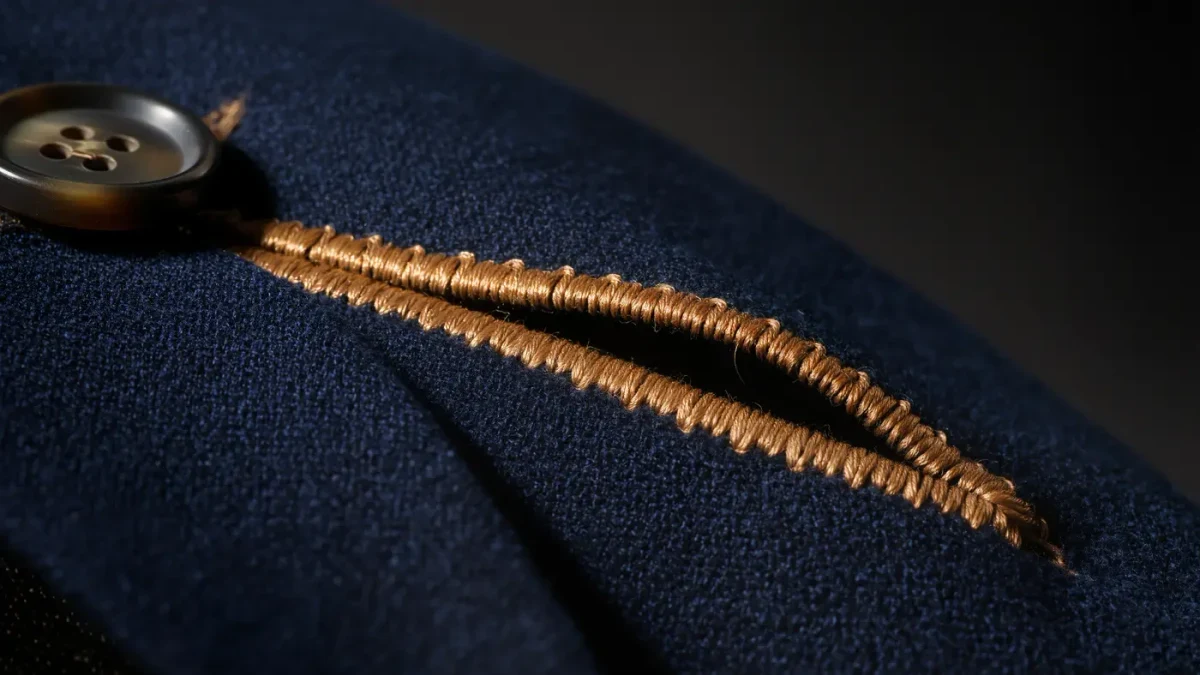
- Machine-sewn lockstitch buttonhole. A dense column of zigzag-like satin stitches with a bar tack at each end, cut open after or during sewing. This is the default on most ready-to-wear and takes seconds on a dedicated buttonhole machine.
- Machine-sewn chainstitch (Picot) buttonhole. Formed with a chainstitch that leaves a corded, slightly raised edge; common on shirts, faster still per unit.
- Hand-worked buttonhole. The worker cuts the opening, then covers the cut edge in fine buttonhole stitches worked over a gimp cord — a core thread that gives the edge its raised, durable ridge. Minutes of skilled labor per hole.
- Bound or piped buttonhole. The opening is faced with strips of self-fabric that form clean rectangular lips around the slot; no thread edging at all. Common on tailoring, eveningwear, and anywhere a discreet slot is wanted.
- Keyhole buttonhole. A machine variant with a rounded bulb at the closed end, giving the shank of a heavy button room to bear without cutting the threads; standard on coats and jackets.
The engineering purpose is constant — resist the wear of a button passing through thousands of cycles while holding its shape — but the durability and the labor differ by an order of magnitude across the list. design coverage.
Why is the hand-worked buttonhole so expensive?
Three reasons compound. Skill: consistent stitch spacing around a cut edge, over a tensioned gimp cord, takes months to learn; tailoring houses treat it as a signature because few workers reach the standard. Time: several minutes per buttonhole against seconds for a machine, and a double-breasted coat can carry more than a dozen. Structure: the gimp cord is laid under each stitch by hand, which is what gives a hand-worked edge its raised lip and longevity — a machine cannot currently replicate the cord's placement in a single pass at production speed. Per reporting on luxury tailoring by Bloomberg covering European workshops, hand buttonhole labor is repeatedly cited by bespoke houses as a defining cost line, precisely because it resists automation.
What does the machine buttonhole actually cost — and what does it save?
The industrial buttonhole machine is one of apparel manufacturing's genuine engineering achievements: a dedicated lockstitch head that sews a fixed-length satin column with bar tacks, in some classes cutting the slot mid-cycle, at rates of dozens per hour per machine. Per industrial sewing equipment manufacturer specifications, automatic buttonhole machines cycle a standard shirt buttonhole in well under a minute including positioning. The savings bought the modern shirt wardrobe — but they imposed standardization. Machine buttonhole lengths come in set sizes, which is one quiet reason button spacing on ready-to-wear follows standardized grids, and why a hand-finished garment can place buttons exactly where a specific body needs them.
Machine buttonholes also carry a characteristic failure mode. Because the satin stitches are dense and the slot is cut after or during stitching, a needle strike on the cut edge, a loose tension, or a worn cutting blade produces fraying that propagates along the column — the familiar exploded buttonhole of a worn shirt cuff. Bound buttonholes fail differently: the fabric lips wear first, so their lifespan tracks fabric quality rather than thread quality.
How do the types compare directly?
| Type | Method | Durability | Cost signal |
|---|---|---|---|
| Lockstitch machine | Dedicated automatic machine, seconds per hole | Good; frays at thread wear | Baseline ready-to-wear |
| Chainstitch machine | Chainstitch column, very fast | Good; can unravel if cut | Shirting, high-volume production |
| Keyhole machine | Machine column with rounded end bulb | Very good under shanked buttons | Coats and jackets across tiers |
| Bound / piped | Fabric lips facing the slot; two or more operations | Tracks fabric quality | Tailoring, eveningwear, higher labor cost |
| Hand-worked over gimp | Cut edge covered in hand stitches over a cord | Excellent and repairable stitch by stitch | Bespoke, made-to-measure, luxury |
The cost column is the honest one. A bound buttonhole on an inexpensive coat signals either genuine construction care or a factory with very low labor costs; a hand-worked buttonhole almost never appears below a certain price for the simple reason that the labor cannot be compressed.
Why do buttonholes reveal fit and quality information?
Because they are placed before the garment is worn and cannot be moved afterward, buttonholes are a permanent record of decisions made at the pattern stage. Horizontal buttonholes on a shirt placket resist the button pulling through — the classic tailoring choice for stress-bearing closures — while vertical buttonholes are faster to sew and tolerate slight placement error, which is why vertical rows dominate budget garments and horizontal placements appear where fit precision was trusted. A garment whose buttons strain its buttonholes was fitted loosely or graded carelessly; a garment whose placket gaps between buttons has a spacing problem set at marking, not at wearing.
Reinforcement is the quiet half of every buttonhole. None of the types performs on unreinforced cloth: a buttonhole sits over an interfaced placket or facing, because the satin stitches or fabric lips need a stable substrate to bite into. This is why buttonhole quality tracks interfacing quality — a placket fused with a lightweight, low-grade interfacing produces buttonholes that wrinkle and tear out regardless of how well the machine was set. In tailoring, hand-worked buttonholes are usually worked through the canvas as well as the facing, tying the closure into the garment's internal structure rather than leaving it anchored to a single layer of cloth. The buttonhole, in other words, is never one operation; it is the end point of an entire reinforcement chain laid earlier in construction.
What should a buyer check?
Look at the ends before the edges. A clean bar tack at each end, dense and symmetrical stitching, and no fraying at the cut are the machine buttonhole's quality marks; on coats, the presence of keyhole endings at all indicates the maker thought about button bearing. A bound buttonhole should show two crisp fabric lips of equal width. And a hand-worked edge announces itself in the raised cord and irregular-perfect spacing that no machine imitates. Per reporting on apparel craftsmanship by Reuters covering the resale market, buyers increasingly inspect construction details such as buttonholes when assessing secondhand quality, because wear reveals them faster than any other construction element.
One final asymmetry is worth naming: of all the types, only the hand-worked buttonhole is economically repairable in place. A failed machine column must be replaced wholesale on a machine; a bound lip must be rebuilt from the facing; but a worn hand-worked edge can be re-stitched over its surviving gimp by the same hand that made it. Durability, in this one corner of construction, includes the option of renewal — a property the industry's faster methods traded away.
Small, repetitive, and unforgiving, the buttonhole compresses the entire cost structure of a garment into a few centimeters of edge. Reading it takes seconds and predicts how the rest of the garment was bought.