A garment's seams are its engineering budget made visible: a five-thread overlocked side seam on trousers, a flat-felled inseam on workwear jeans, and a French-seamed silk blouse each represent a different calculation of strength, cost, and fabric behavior. The distinction that matters is between stitch class — the configuration of thread formed by the machine — and seam class, the way fabric plies are stacked and joined, two systems standardized separately in the ISO 4915 stitch classification and the corresponding seam-type nomenclature. A factory's seam map tells a trained reader, within a few seconds, which cost tier the garment was built to.
Which stitch types carry the load, and which merely look like they do?
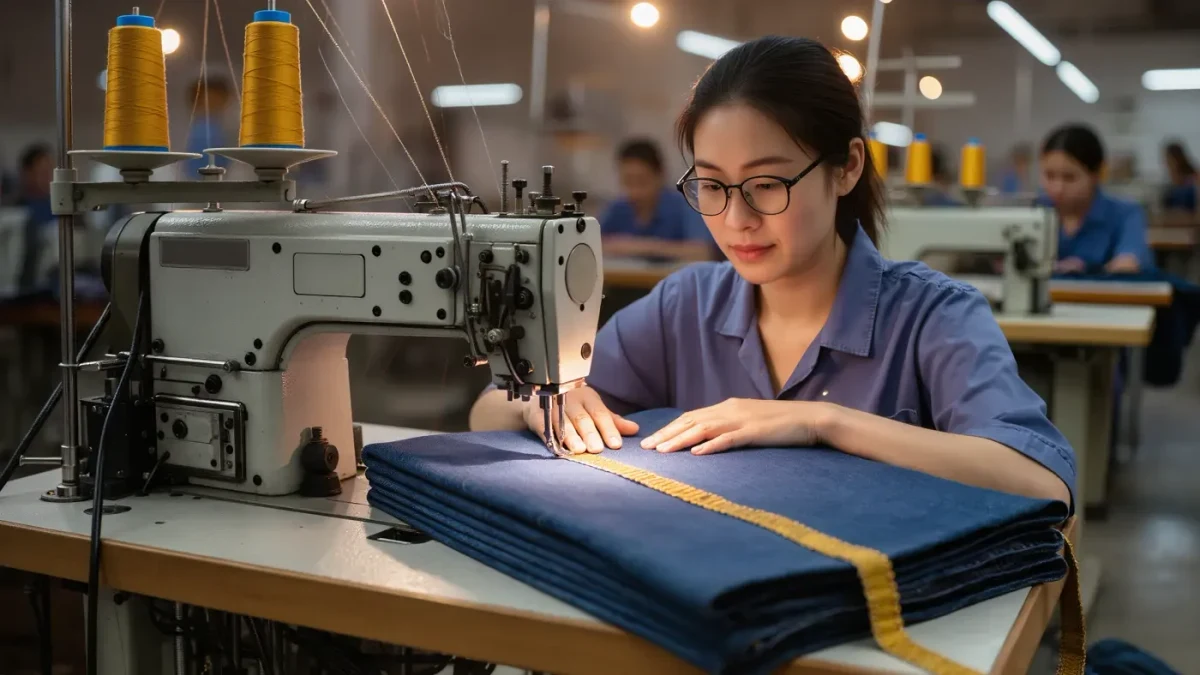
Three stitch families do most apparel work. The lockstitch — the straight stitch formed by a needle thread interlocking with a bobbin thread — is the backbone: strong in both directions, low thread consumption, and the only stitch most structural topstitching should use. The chainstitch, formed with one or more needle threads looped with an under-thread and no bobbin, sews faster and survives thread breakage better because its loop structure is self-locking under tension; per industrial sewing machine manufacturer data, chainstitch machines run at higher speeds than lockstitch equivalents, one reason they dominate long structural seams in mass production. The overedge and coverstitch family — overlocking and its flatbed variants — wraps thread over the fabric edge simultaneously joining and finishing, at high speed and with built-in stretch.
Each family carries a cost signature. Overlocking consumes the most thread per meter but sews fastest and finishes the edge in a single pass. Lockstitching is slower per meter but uses the least thread. A two-thread chainstitch on the inseam of cheap trousers can look identical to lockstitch topstitching on the finished garment while behaving differently — a chainstitch can unravel from one end if the stitching is broken, which is why quality audits chain-off and inspect seam ends.
How do seam classes differ, and where does each belong?
| Seam type | Construction | Strength and behavior | Typical placement and cost tier |
|---|---|---|---|
| Plain seam | Plies joined face-to-face, edges finished separately | Adequate; depends on edge finish for durability | Universal baseline; cheapest |
| French seam | Plain seam enclosed in a second pass, raw edges fully hidden | Clean and fray-proof; not for heavy cloth | Sheer and fine garments; two operations, higher cost |
| Flat-felled seam | Plies interlocked and folded, sewn through four to six layers | Very strong; no raw edges; rigid | Jeans inseams, workwear, shirting; high labor cost |
| Lapped seam | Plies overlapped and stitched through | Strong; bulk visible | Denim yokes, decorative topstitching |
| Bound seam | Edges enclosed in a separate binding strip | Finish-oriented; moderate strength | Unlined jackets, blankets, couture interiors |
The table's cost column rewards a second look. A French seam doubles the machine operations on every joined edge — one reason it appears on blouses, not on t-shirts. A flat-felled inseam on jeans requires both the interlock fold and dense topstitching, which is why it is a hallmark of workwear brands and why budget denim substitutes a simulated felled seam, a single needle line pressed over an overlocked edge that reads the same and fails sooner.
What actually determines seam strength?
Strength is a system property, not a thread property. Four variables interact: stitch type, stitch density — stitches per unit length, commonly specified in the range of 10 to 12 stitches per inch or roughly 3 stitches per centimeter for structural seams — thread strength, and seam class. Per seam strength test methods published by ASTM, failures in testing usually occur in one of three modes: the fabric tears beside the seam, the thread breaks, or the seam slippages as yarns shift away from the stitch line. The engineering insight is that the fabric often fails first, which means a factory can waste money over-specifying thread while an under-reinforced seam allowance or a low-density stitch line remains the true weak point.
Direction matters as well. Seams under lengthwise stress — a side seam bearing vertical load — behave differently from seams under crosswise stress such as an armhole, and knit garments need seams that elongate with the fabric. A rigid lockstitch across a high-stretch jersey panel will pop stitch by stitch as the fabric moves; the solution is either a stretch-capable stitch configuration or a seam placed to carry less strain. This is the failure mechanism behind the popped seat seams of stretch garments and the cracked topstitching at knit shoulder seams.
Thread choice completes the system, and it is more consequential than its cost suggests. Core-spun polyester thread — polyester filament wrapped around or blended with a staple cover — dominates industrial sewing because it combines tensile strength with enough elasticity to survive seam stress, and per thread manufacturer technical datasheets, apparel-grade core-spun threads carry breaking strengths several times that of a comparable cotton thread at similar diameter. Cotton thread retains a place in topstitching on natural-fiber garments partly for dye affinity and a matte line, at a real cost in strength. The classic mismatch error is pairing a strong thread with a weak needle-to-fabric relationship: an oversized needle leaves holes that become the perforated tear line a seam failure follows, which is why needle specification travels with the seam spec on factory tech packs.
Why does the same garment grade differ between price tiers?
Walk a trouser from three price points and read the interior. The budget pair: single-needle plain seams, serged raw edges, a chainstitched hem, seam allowances at the minimum the fabric allows. The mid-tier pair: plain seams with reinforced bar tacks at stress points — the crotch point, pocket mouths — where a short dense zigzag column of lockstitch spreads load. The premium pair: felled or taped structural seams, bound or bagged interior edges, and higher stitch density throughout. Per apparel manufacturing cost analyses reported by Bloomberg, direct labor minutes per garment, not fabric, increasingly separate price tiers as material costs converge across the market — and seam complexity is exactly where those labor minutes accumulate.
The bar tack deserves special mention because it is the cheapest insurance in the industry: a few seconds of machine time at each stress point, multiplying seam life at pocket corners and belt loops. Its absence on a stressed garment is not an oversight; it is the clearest single marker that the factory was told to hit a price.
How should a buyer read seams in a store?
Four checks take under a minute. Pull gently across a structural seam: gaping or visible slippage means low density or weak fabric. Open the interior: finished edges — felled, bound, or enclosed — indicate construction investment; raw serged edges everywhere indicate baseline. Count stitches: hold a ruler against a topstitched seam, and anything below roughly 10 stitches per inch in a structural area is saving thread where it matters. Look for bar tacks at every point the garment loads. None of this requires equipment, which is why buying teams at better labels perform exactly these checks on production samples before approving a run.
Seams are the least photographable part of a garment and the most honest. Design sells the garment once; the seam map decides how many years it stays sold.
What is the single fastest quality read?
Turn the garment inside out. Interiors are where factories save silently, and ten seconds of inspection — edge finishes, bar tacks, stitch density, thread quality — reveals more than any exterior styling detail, because almost nothing inside a garment exists for show.