Shoulders collapse because they carry loads a single layer of cloth was never engineered to hold: the cantilevered weight of a sleeve, the drag of a full lining, and repeated stress at the armhole every time an arm moves. The fix is interfacing — a support fabric fused or stitched to the shell to add body and distribute stress — and the quality gap between garments is largely the quality gap between their shoulder architecture. In laboratory abrasion and seam-slippage testing referenced by ASTM methods, bonded assemblies that skip shoulder support show visible distortion at a fraction of the cycles that a properly interfaced shoulder endures, which is why tailoring houses treat the shoulder as the jacket's structural keystone rather than a decorative seam.
What loads is a shoulder seam actually carrying?
Picture the geometry. A shoulder seam spans from neck point to armhole like a beam, with the sleeve hanging from its outer end. In a jacket, that outer end also holds shoulder pads, sleeve head wadding, and in heavier constructions the roped sleeve head of a Neapolitan or Savile Row style. The fabric across the shoulder is under continuous low-grade tension in wear: the wearer reaches forward, the sleeve pulls the seam, and the shell fabric — especially a soft wool flannel or a loosely woven linen — gradually yields. Woven fabrics recover from stretch differently depending on yarn set and finish, and a loosely set cloth can permanently elongate several percent at the stress point, producing the drooped, wrinkled slope that reads instantly as a worn-out garment.
Then there is gravity acting on everything attached below. A fully lined coat hangs from the shoulder line; a heavy lining fabric, plus pockets and their contents in the case of jackets, adds downward load that the shoulder seam transmits. Without reinforcement, the seam itself starts to slip — yarns at the seamline shift away from the stitching line, a failure mode the industry measures as seam slippage, commonly specified as the force required to open a seam by a fixed distance, typically a quarter of an inch, under a pulling load.
What does interfacing actually do inside a shoulder?
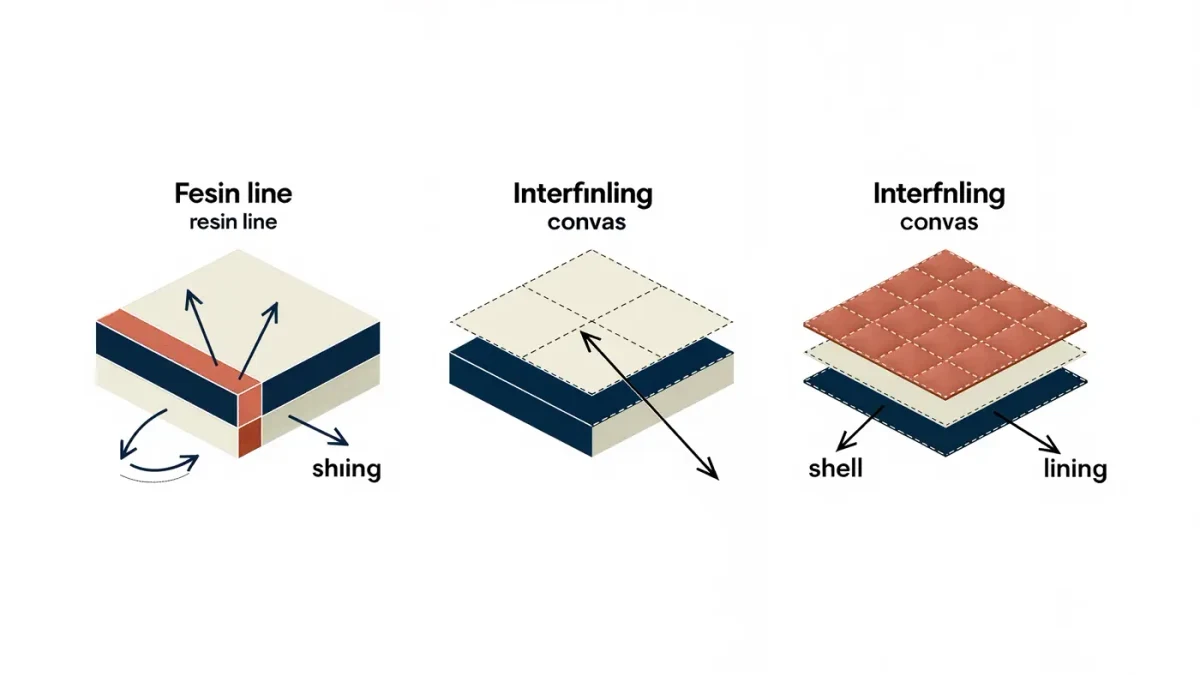
Interfacing performs four jobs at once, and understanding them explains why its omission shows so fast:
- It raises bending stiffness. A fusible resin layer or a stitched canvas makes the two-layer laminate resist folding, so the shoulder holds its designed line instead of breaking into soft creases at the armhole.
- It distributes point stress. Load arriving at the armhole spreads across the reinforced area rather than concentrating on a half-inch of seam allowance.
- It stabilizes the grain. Reinforcement locks the shell's warp orientation, preventing the diagonal migration described in any discussion of grain and twist.
- It controls recovery. When the fabric stretches in wear, the support layer pulls it back toward shape, converting a permanent deformation into a temporary one.
The classic illustration is the tailored jacket chest. A full-canvas construction — a horsehair-and-wool canvas pad-stitched to the chest with rows of hand stitches that draw the canvas into a curved shape — builds a three-dimensional chest that presses the fabric outward and keeps the shoulder area in tension. Fused constructions replace this with an adhesive-bonded resin canvas, lighter and far cheaper, and adequate for most of the market, but the fusing adhesive itself has a service limit. Per technical literature from fusing equipment suppliers, most apparel-grade fusible adhesives are rated for repeated home laundering and low-temperature care; sustained dry-cleaning solvent exposure or a hot iron applied directly can degrade the bond, which is why a cheap fused jacket can delaminate — the two layers separate and bubble — years before a canvas jacket loses its shape.
Fused, sewn-in, or full canvas: what is the real difference?
| Construction | How it works | Shape retention | Typical cost position |
|---|---|---|---|
| None (self-fabric only) | Shell sewn with no support layer | Poor; shoulders collapse within a season of regular wear | Fast fashion, low-price shirting |
| Fusible interfacing | Resin-coated support heat-pressed to the shell | Good initially; bond and resin age with laundering and heat | Mass-market suiting, most ready-to-wear |
| Sewn-in interlining | Support layer stitched, not glued, to the shell | Very good; no adhesive to fail, moves with the cloth | Better ready-to-wear coats and blazers |
| Full floating canvas | Shaped canvas pad-stitched between shell and lining | Excellent and improving with wear as the canvas molds | Tailoring houses, high-end ready-to-wear |
The table explains a market behavior that confuses shoppers: two jackets can look identical on the hanger and diverge completely after eighteen months of wear. The fused garment's decline is adhesive-driven; the canvas garment's improvement is mechanical, because pad stitching sets permanent shaping into the canvas fibers themselves.
Why do shoulders fail even when interfacing is present?
Three recurring causes account for most field failures. First, wrong interfacing weight: a heavy fusible on a featherweight wool creates a stiff island whose edges telegraph through the shell as ridges, while a too-light interfacing on heavy coating does nothing. Second, poor fusing technique. Fusing presses require correct temperature, pressure, and dwell time together; per guidance published by fusing press manufacturers, a bond made at insufficient temperature can look attached yet fail below the rated peel strength, a latent defect that surfaces after the first wash. Third, ignoring stretch direction: fusibles come in stretch and non-stretch versions, and bonding a rigid fusible across a stretch-woven shoulder kills the cloth's give, concentrating all movement stress at the reinforcement boundary until the shell tears along that line.
How does a knit shoulder differ from a woven one?
Knit shoulders fail differently. A jersey or interlock knit has no woven grid to stabilize, so a rigid fusible is the wrong tool; knit-specific fusibles and stay tape take over. The classic prevention is clear stay tape — a narrow stable strip sewn into the shoulder seam — which converts an elastic shoulder into a non-elastic one at exactly the point where gravity applies. T-shirt makers learned this the expensive way: un-taped knit shoulders grow, and the classic symptom is a neckline that droops sideways after washing, a defect so common that sewing-pattern instruction sheets now routinely mark the shoulder seam with a tape placement line. Per testing data cited by knitwear quality labs, a taped shoulder seam shows a fraction of the elongation of an untaped seam under the same cyclic load, which is a precise way of saying the tape works.
What should a buyer check before paying for structure?
Three checks separate construction tiers without opening a seam. Pinch the shoulder: a canvas-front jacket feels layered and slightly springy, while a fully fused one feels uniformly papery. Look at the lapel roll: a canvas jacket's lapel rolls in a long, soft curve because the canvas is shaping the cloth, while a fused lapel often bends at a flatter, more abrupt angle. Finally, read the care label against the price: a garment sold as dry-clean-only at a low price point is frequently protecting a fragile fusible bond rather than the shell fabric. Per market surveys reported by Reuters on apparel pricing tiers, construction differences invisible at purchase account for much of the durability gap between price segments.
The shoulder is where a garment's budget is spent invisibly and where its absence is eventually visible to everyone. Interfacing is not padding for its own sake; it is the difference between clothing that holds a designed shape and fabric that slowly surrenders to gravity.