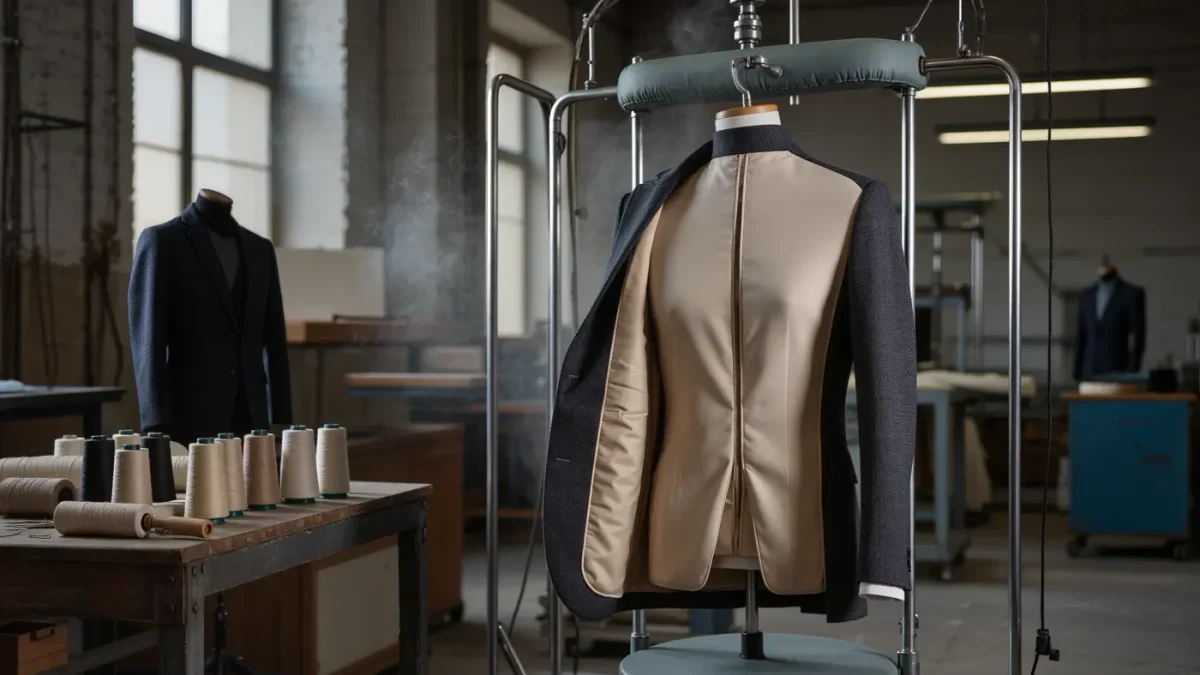
A lining — the interior fabric layer sewn to a garment's shell — performs four engineering jobs at once: it reduces friction so the garment moves over the body and over under-layers instead of gripping them, it carries and distributes load away from the shell, it manages opacity on light or open cloth, and it protects delicate shell fabrics from body soil and abrasion. Ready-to-wear adds a fifth, quieter function: finishing. Interior edges of an unlined jacket must be bound or overlocked, while a full lining buries raw construction entirely, which is why lining coverage has become a visible shorthand for a factory's finishing investment.
What does the friction function change in practice?
Slip is the lining's most underrated contribution. A wool or linen shell worn directly over a shirt or skin grips with every movement, dragging hemlines up, twisting the garment on the body, and creasing the shell. A smooth lining — the classic choices are cupro, a regenerated cellulosic fiber prized for its silk-like slip, and bemberg-type rayon linings — inserts a low-friction interface, and the garment hangs from the shoulders instead of clinging. This is mechanical, not cosmetic: skirts and dresses in heavy coating or suiting cloth need the slip layer to move correctly at the hem, and trousers lined to the knee reduce both wear at the thigh and the fabric bagging that comes from constant skin contact. Per textile fiber reference literature, cellulosic linings are specified for wear comfort because they absorb moisture vapor rather than trapping it, which keeps the two-layer garment wearable in warmth that a synthetic lining would convert into a vapor barrier.
How does a lining carry load?
A full lining acts as an internal suspension system. It attaches to the shell at the neckline, armholes, and hem, so the garment's weight distributes across two layers and a network of attachment points rather than hanging from the shell's seams alone. In coats, the lining takes direct load from pocket bags — a pocket sewn only to the shell stretches the shell fabric every time the pocket is used, which is why unlined garments develop baggy pocket mouths. The same logic applies to sleeve heads and shoulder areas, where a lining connected to internal structure helps hold shape. The engineering term of art is load path: a lined garment has more of them, and redundancies in load paths are the oldest trick in structural design, borrowed from sailmaking and tentmaking before it entered clothing.
Why does opacity drive lining choices so often?
Light-colored and loosely woven shells are translucent to a degree their marketing photographs never show, and the standard remedy is a lining matched to the shell's transparency and the wearer's modesty requirement. The specification logic is twofold: the lining's own opacity must suffice, and its color must not shift the shell's perceived shade. White linen over a navy lining reads as cool-toned light blue; over cream, it reads warmer. Per color-science practice in apparel development documented by AATCC's colorimetry guidance, layered fabrics evaluate as subtractive color mixtures, which is why lining color is selected under the same light sources the finished garment will be sold and worn under rather than by the color card alone.
How do lining types differ by material?
| Lining material | Behavior | Typical application |
|---|---|---|
| Cupro / bemberg rayon | High slip, moisture-absorbing, drapes close to the shell | Suits, coats, dresses; the standard tailoring choice |
| Viscose rayon | Good slip and drape, less durable when wet | Mid-market suiting and skirts |
| Polyester | Low cost, low absorbency, static-prone | Budget outerwear and dresses |
| Silk (habotai, charmeuse) | Excellent slip, breathable, delicate and costly | Luxury tailoring, eveningwear |
| Quilted / thermal lining | Insulating loft, adds bulk | Winter coats, outerwear |
The polyester row explains a familiar complaint. A polyester-lined garment traps vapor between the layers, and the wearer experiences the shell as hotter than its fiber content suggests — a real effect that returns of summer clothing repeatedly cite. Lining fiber choice is therefore a comfort decision as much as a cost decision, and per consumer textile guidance published by university extension services, reading the lining content on a care label is as informative as reading the shell.
What is the difference between a full, partial, and jacket-back lining?
Full lining covers every interior surface and buries all raw edges — the maximum investment in finish, comfort, and structure. A partial lining, lining only the upper back and front panels of a jacket, keeps weight and heat down for warm-weather tailoring while still hiding the interior's most visible zone. A sleeve lining without a body lining, common in shirts and light jackets, targets the friction that matters most — arms moving against arms — while leaving the torso unlined for breathability. Each is a calibrated answer to the same four jobs, and each carries a distinct cost position visible in the finishing: a fully bagged-out lining, sewn so no raw edge shows anywhere, is the most labor-intensive version and reads as such on the rack.
Lining and shell also shrink differently, which is the specification error that ruins good garments. A shell that shrinks two percent in laundering over a lining that shrinks one binds the garment at their shared seams, producing the puckered hems and dragged facings that appear after the first wash of an ill-specified run. Professional practice therefore tests lining and shell together under the same laundering protocol before production, and per dimensional change standards published by AATCC for layered fabrics, differential shrinkage between plies is a standard measurement precisely because it predicts this failure mode. A garment whose care label demands dry cleaning at a low price point is sometimes protecting exactly this mismatch.
Why do linings fail before shells fail?
The lining is the sacrificial layer: thinner, lighter, and more abraded at every interface, so it wears out first by design. Seam failure at the lining's stress points — the armhole where lining meets shell across a moving joint, the center-back pleat that must allow reach — is the standard wear pattern of an aging lined garment. The center-back pleat deserves note: it is a deliberate pleat of surplus lining so a wearer can reach forward without tearing the back seam, and its absence in cheap construction converts every reaching motion into lining stress. Per durability test protocols published by ASTM for sewn seam performance, multi-layer assemblies fail at the interface stress points before either fabric fails in the panel — the garment version of a chain wearing at its links.
What should a buyer read in a lining?
Four data points on inspection: fiber content, because comfort follows the absorbency of the lining more than the shell; coverage, because finishing investment tracks lining extent; the center-back pleat or its equivalent, because mobility provision indicates pattern competence; and pocket attachment, because pockets anchored to the lining rather than the shell will still be flat in year five. None of this requires opening a seam — all four are visible in a minute with the garment turned toward the light.
A lining is the garment's second opinion of itself. Shells are chosen to be seen; linings are chosen to make the garment work, and the difference between the two choices is where construction quality actually lives.