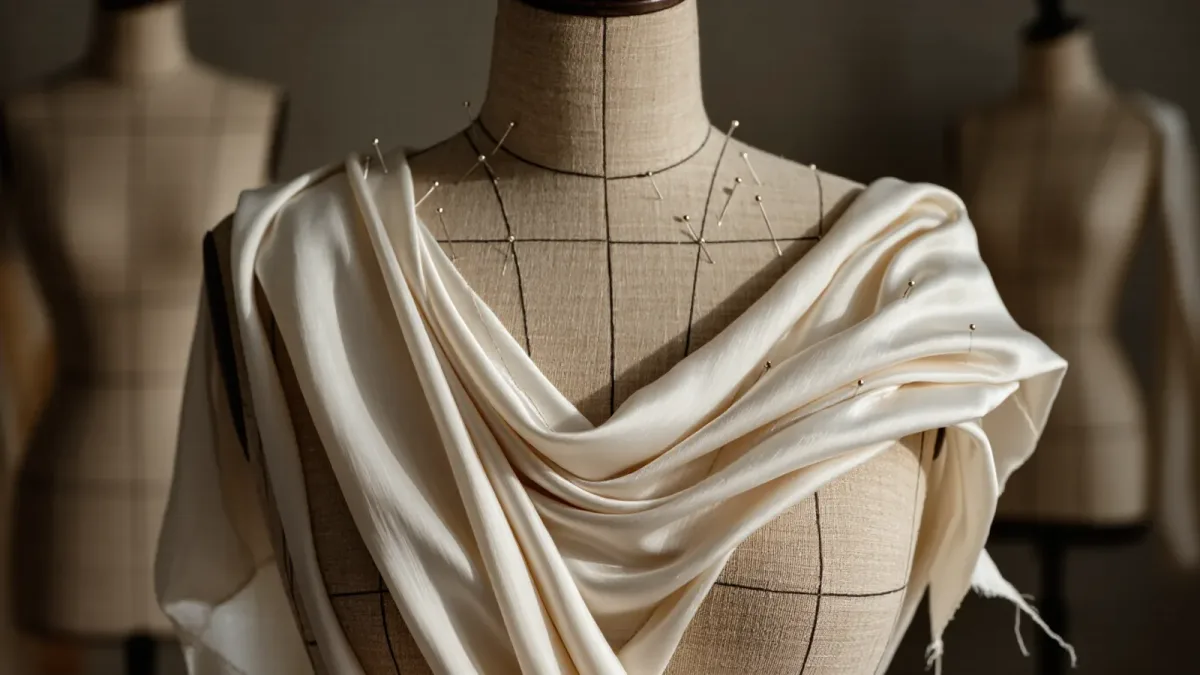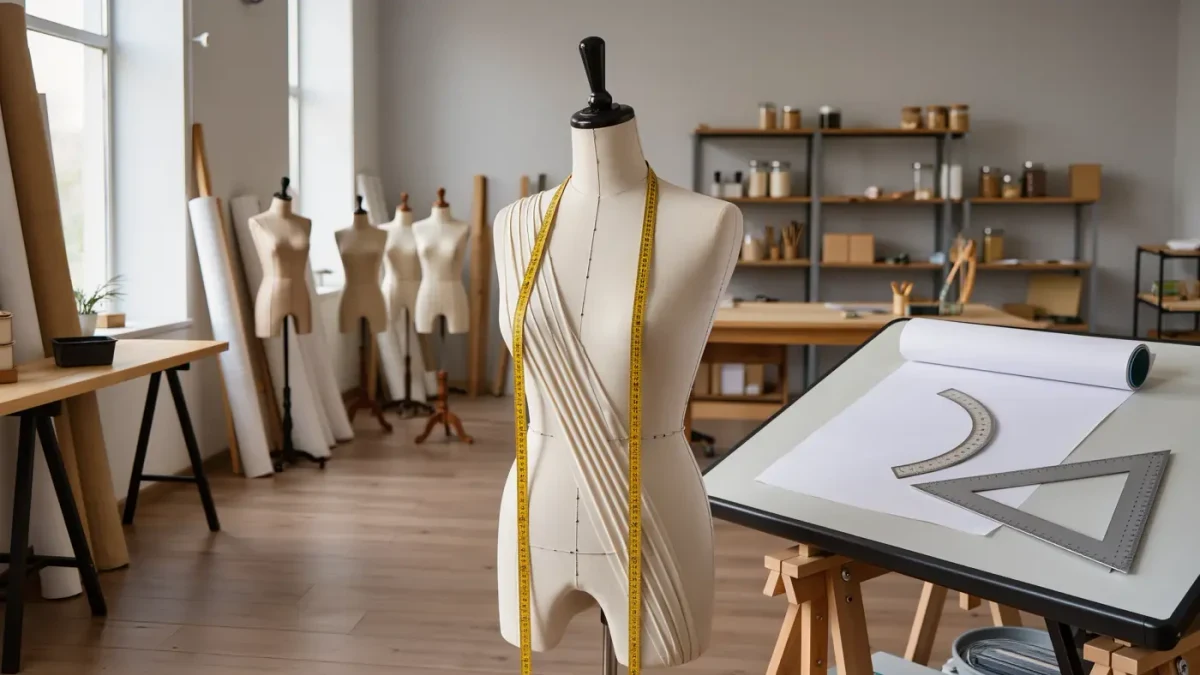
A dart and a drape solve the same geometric problem — a flat plane of cloth must enclose a curved body — by opposite methods: the dart removes or folds away fabric at defined points to create controlled shaping, while draping manipulates fullness across the body and lets the surplus fold, gather, or flow where the design wants it. Flat pattern-making is arithmetic performed before cutting; draping is sculpture performed on the dress form. Madeleine Vionnet, working in Paris in the 1910s and 1920s, built an entire design language from the second method, cutting bias panels that shaped themselves around the body with minimal suppression — a demonstration that the same fit can be achieved by removing fabric or by relocating it.
What does a dart actually do, geometrically?
A dart is a wedge of fabric eliminated by stitching: wide at the shaping end, tapering to nothing at the point. Its function is to convert a two-dimensional pattern into a three-dimensional shell. Where the body protrudes — bust, shoulder blade, elbow, hip — the flat pattern must be longer on the outside of the curve than on the inside; the dart absorbs that difference. Dart width encodes the depth of the curve, and dart length and placement encode its location. A standard bust dart on a fitted bodice might intake 5 to 7 centimeters at the side seam and end 2 to 3 centimeters short of the bust apex, with that short distance — the dart's point-to-apex gap — existing because fabric cannot be stitched to a sharp point without puckering.
The apex principle generalizes: every dart points toward a body prominence and stops short of it. This is why dart placement is fit information. Moving a bust dart from the side seam to the armhole, the neckline, or a waistline seam changes nothing about the intake — the same wedge of suppression is required — but it changes the grain flow and therefore the visual line of the finished garment. Pattern makers call this dart manipulation or dart equivalent, and it is the conceptual bridge between the darted and draped approaches: a princess seam is, in effect, a dart extended into a flowing style line.
How does draping achieve fit without suppression?
Draping positions fabric directly on a dress form or fitting model, pinning, slashing, and releasing cloth until the silhouette and fit resolve. Fullness that flat patterning would dart away is instead expressed: gathered into seams, released as flares, absorbed into bias stretch, or tied down with ties and belts. The fit comes from distribution rather than subtraction. Bias draping is the extreme case — a fabric on the 45-degree diagonal stretches around the form, so shaping is delivered by the cloth's own shear behavior, and the pattern that results looks almost featureless on paper while fitting closely on the body.
The trade is control for expressiveness. A dart delivers a guaranteed, repeatable amount of shaping at a guaranteed location, within a tolerance of millimeters. A drape delivers whatever the fabric's weight and stretch produce, which varies between fabric lots, between cutters, and over the life of the garment as the cloth relaxes. Per garment engineering literature from production management programs, suppression-based construction holds fit tolerances several times tighter than fullness-based construction in mass production, one reason tailoring — the fit-critical category — is dart-and-seam based almost everywhere.
What does each method cost in production?
| Dimension | Darted construction | Draped construction |
|---|---|---|
| Fit repeatability | High; intake is fixed in the pattern | Variable; depends on fabric behavior and operator |
| Sewing cost | One additional stitch operation per dart | Fewer operations, but more handling and pressing |
| Fabric consumption | Efficient; pieces nest tightly in the marker | Higher; draped styles typically use more yardage |
| Fabric sensitivity | Low; works in stable wovens of any weight | High; requires correct weight, shear, and drape |
| Fit adjustment later | Local; a dart can be altered | Global; reshaping affects the whole panel |
The economics explain a market pattern: draped silhouettes concentrate in categories where fabric behavior is predictable and price points absorb the extra yardage — eveningwear, bias slips, jersey knitwear — while darted construction dominates shirting, tailoring, and anything size-range sensitive.
Shirting demonstrates the arithmetic in miniature. A classic fitted shirt suppresses through matched bust darts or, in menswear-derived blocks, through a curved side seam taking up the difference; the pattern tolerates no more than a centimeter of error before the button placket gapes or pulls. The same body in a gathered-bodice blouse absorbs several centimeters of individual variation without visible failure, because the gathers redistribute instead of terminating. Neither blouse nor shirt is better made — they make different promises, and the consumer's complaint history at any brand will show which promise each silhouette broke most often.
Why do modern pattern systems blend the two?
The contemporary workflow is a hybrid. Drapers develop a silhouette on the form, then the draped shell is transferred to paper — a step called truing — where its seams are measured, straightened, and converted into a flat pattern with darts or seams replicating what the pins achieved. From that flat base, grading extends the fit across sizes. Going the other direction, a flat pattern block can be converted into a draped style by slashing and spreading it on the form until fullness appears. Neither method owns the result; each is a coordinate system for the same three-dimensional problem, and the professional skill is translating fluently between them.
3D digital tools have compressed the loop rather than replaced either side. Virtual fitting software drapes fabric simulation over an avatar, letting a pattern team see fold behavior before cutting cloth; per reporting on apparel technology adoption by Reuters, large brands integrated 3D sampling into development pipelines through the early 2020s to cut physical sample rounds. The simulation runs on fabric physics data — bend, stretch, shear coefficients measured on the actual cloth — which is a formal acknowledgment that draping outcomes are physical properties, not stylistic accidents.
Which method fits real bodies better?
It depends on which error a body can tolerate. Darted fit is exact at the size it was fitted for and degrades predictably at the extremes of a size range, because dart intake is a fixed assumption about body curvature. Draped fit is forgiving across a wider band of body shapes — gathers, bias, and released fullness absorb individual variation — but it cannot deliver the close, structured line of tailoring. A blazer with a defined shoulder and suppressed waist is practically unreachable without suppression; a fluid wrap dress is practically unreachable with it. Designers choose the error they prefer to live with, and the garment's entire construction follows.
How can a wearer read the difference in a finished garment?
Look at where the shaping lives. Visible darts — small tapered folds ending before the bust or blade — signal suppression-based construction and a fit tuned to a specific curvature. Diagonal seams sweeping from shoulder or armhole through the bust signal dart equivalents converted to style lines, a middle path. Gathers, cascades, cowl folds, and bias swing signal fullness-based fit that trades precision for tolerance. None of these is superior in itself; each is a different contract between the garment and the body it will meet.
Darts and draping are the same engineering statement in two dialects: one says remove, the other says redistribute. Every fitted garment on the market is a position along that axis, chosen for cost, for character, and for the shape it must hold.