A shopper who wears a medium in one brand and a large in another is not changing shape; the labels measure different things. Size letters map to body measurements through grading rules each brand sets, and those rules can differ by four to eight centimetres at the chest. Measurement audits find discrepancies routine, which is why standardised sizing keeps failing.
What does a size actually encode?
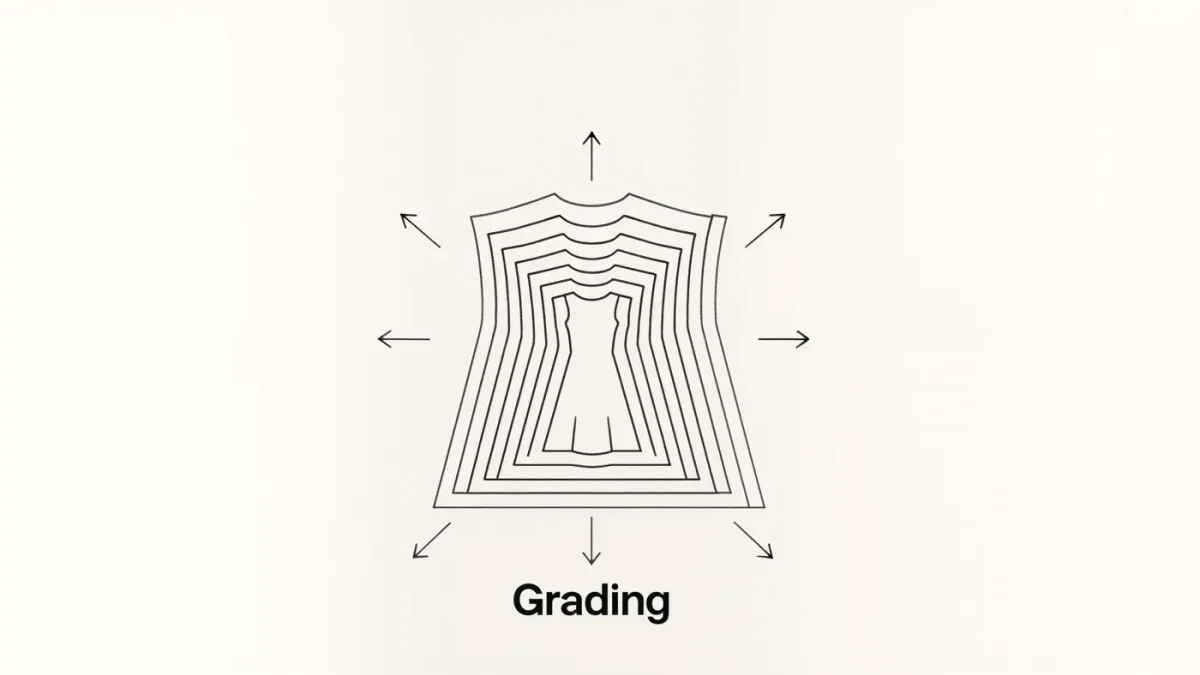
A size chart translates garment labels into body measurements, but the translation chain has several independent links. Each brand begins from a base size — a sample garment built on a fit model or a measurement set — and then applies grade rules: fixed increments added or subtracted per size step. Both the base and the increments are proprietary, and neither appears on the label. Two brands can sell a size 10 dress while their base bust measurements differ by six centimetres, and their step sizes can differ by another centimetre or two, so the divergence compounds steadily across the full range.
Beyond the base, several factors systematically shift charts: retail coverage.
- Target demographic: brands grade for a specific body proportion — shoulder slope, bust-to-waist ratio, rise depth — learned from their fit model and home market.
- Vanity sizing: over decades, many brands have relabelled larger measurements with smaller size numbers, at different speeds and starting points, so identical labels now describe different bodies.
- Fabric and construction: a chart for rigid woven trousers cannot match one for stretch denim of the same style name, because ease requirements differ.
- Country of origin: US, UK, EU, and Japanese nominal sizes follow different numbering traditions, and the printed conversions are conventions rather than equations — three conversion charts will often disagree with one another on the same garment.
Why did standardisation efforts fail?
The most serious attempts came from government measurement surveys. The United States National Institute of Standards and Technology maintains historical work on voluntary product standards, including a voluntary sizing system built from large-scale body measurement surveys conducted in the mid-twentieth century. The system foundered on a commercial reality: voluntary standards invite voluntary compliance, and relabelling garments to a national scale would have forced every brand to admit that its sizes were changing — an admission with no upside in the showroom. Comparable efforts in Europe produced the EN 13402 standard, adopted patchily and honoured most consistently in bra sizing, where the cost of guessing wrong is highest for both sides of the transaction.
The economics have not changed since, and arguably cannot. A brand's size curve is a competitive asset and a customer-bonding device at once: a shopper who knows her size in a brand returns to it and avoids the fitting risk of switching, which is a real, recurring, and privately captured commercial benefit. Standardisation would erase that loyalty moat, so no brand volunteers to go first, and regulators have long stopped trying.
How large is the practical discrepancy?
Measurement audits of same-category garments, conducted by consumer-testing organisations and journalists, repeatedly find spreads wide enough to change the label a wearer needs. Representative patterns from published comparisons:
| Comparison | Typical spread | Effect on the wearer |
|---|---|---|
| Womenswear, same nominal size, different brands | 4–8 cm at waist or bust | One to two label sizes apart |
| Menswear trousers, labelled waist vs measured waist | 2–5 cm inflation | Label understates the garment |
| Same brand, different production years | 2–4 cm drift | Vintage and current sizes diverge |
| Cross-market conversions (US/EU/UK) | One full size step | Conversion charts disagree with each other |
Menswear avoids part of the problem by printing body measurements — a 32-inch waist is nominally a measurement, not a code — yet audits find that measured waistbands often exceed the label, a softer form of the same vanity dynamic, merely applied through inches rather than abstract codes. Womenswear, built on abstract numbers with no measurement anchor, carries the larger spread and the deeper shopper distrust.
How do shoppers and retailers cope?
Shoppers improvise around the chaos. Surveys of online apparel buying behaviour consistently show high rates of multi-size ordering, repeated purchases of the same style in several labels, and heavy reliance on reviews mentioning fit — behaviours that amount to a tax imposed by inconsistent charts. Retailers, aggregating many brands, publish fit notes per brand precisely because a shared chart would mislead; some maintain per-style fit flags such as runs small, runs large, or true to size — crowd-sourced admissions, in effect, that the chart alone is insufficient.
Technology has entered the gap from two directions. Body-scan and fit-recommendation tools — the same systems reshaping return-rate economics — effectively build a private size translation layer per customer. And some marketplaces now standardise display charts on their platform — requiring sellers to enter measured garment dimensions rather than brand claims — which shifts the reference point from the label to the tape measure for the first time at scale, and quietly disadvantages sellers whose charts were never accurate to begin with.
The deeper cost sits in trust. When charts contradict each other, every new brand is a fitting gamble, and shoppers rationally narrow their wardrobes to labels that already fit them — a consolidation that punishes newcomers and small designers most. Size inconsistency is often framed as a shopper inconvenience; for the industry's long tail, it functions as an entry barrier with a tape measure for a gatekeeper.
Will size charts ever converge?
Full convergence is unlikely, because the incentives run the other way. What is converging instead is the measurement infrastructure around the label: fit-tech profiles, marketplace dimension fields, and national body-survey data sets that give designers a common anthropometric base even while they grade from it differently. The label will probably keep its elasticity; the tape measure is steadily becoming the honest interface between garment and body. Until then, the practical guidance stands: treat size charts as brand-specific dialects of the same language, readable only with translation — and the translation is always the garment's actual measurements, not its letter. The brands will not standardise the word; shoppers can at least standardise the ruler.