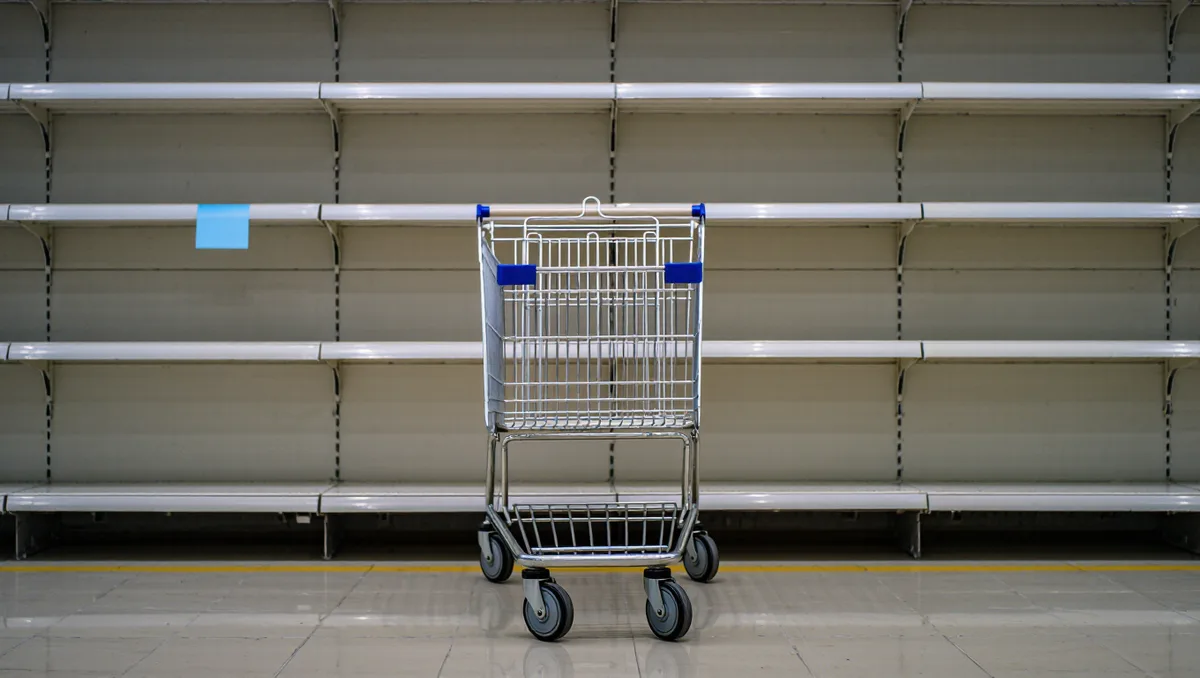
Stores restock on a schedule set by inventory data, not by how empty a shelf looks. A stockroom team works from a replenishment list, usually generated overnight, that ranks what needs pulling to the floor based on sales from the previous day and the store's current stock count. The timing of that work, and the timing of the markdowns that make room for new stock, is what this guide covers — a plain-language retail 101 on the machinery behind a full rack.
The most important qualification: replenishment is a forecast, not a response. By the time a size run looks thin on the floor, the replacement units are either already in the back or already sold at another channel. That gap between what a shopper sees and what the system knows is the whole story of how stores restock.
What triggers a restock in the first place?
A restock starts with a stock count, not a salesperson's observation. Modern point-of-sale systems decrement inventory the moment an item sells, so the software knows, continuously, how many units of each size and colour sit on the floor versus the stockroom versus the warehouse. When the floor count for an item drops below a set threshold — often called a reorder point or minimum presentation quantity — the item lands on the replenishment list for the next shift.
That list is usually printed or pushed to handheld scanners before the store opens. Staff pull the listed units from the back, size and face them on the rack, and scan them as moved so the system stays accurate. The work is deliberately unglamorous: it happens early, before peak shopping hours, because a half-stocked rack during a busy afternoon costs sales that cannot be recovered later.
One complication is that a store's number is only as good as its count. Mis-scanned items, damaged goods waiting to be written off, and units stuck in fitting rooms all create gaps between the recorded count and the real one. This is why periodic full counts and cycle counts — small, rolling counts of sections rather than the whole store — exist alongside the daily rhythm.
How do new shipments arrive and get processed?
New stock arrives on a delivery cadence set by the retailer's distribution network, commonly several times a week for large apparel chains and less often for smaller independents. A shipment typically follows the same path every time, and the steps are worth spelling out:
- Receiving: cartons are checked against a packing list, and discrepancies are flagged before anything reaches the floor.
- Processing: garments are tagged where needed, security devices attached, and units scanned into the store's inventory.
- Sortation: items are sorted by department, fixture and size so replenishment later is a pull, not a hunt.
- Placement: a portion goes straight to the floor to fill holes; the rest is held in the stockroom as backstock.
The split between floor and backstock is a deliberate decision. Retailers keep enough on the floor to present the size run, and hold the rest in reserve. Floor space is expensive — a point explored in rack-density terms in Rack Density Math: How Linear Feet Turn Into Revenue per Foot — so cramming every unit onto the floor is not automatically better merchandising.
Why does the same item sit at different depths in different stores?
Allocation is the answer. A chain's buying team decides how many units of a style to purchase in total; an allocation team then decides how those units split across stores, based on each location's sales history, local climate, store size and customer profile. Two stores in the same chain can hold very different quantities of the exact same dress, and neither number is a mistake.
This is also why an item can be sold out in one location and plentiful in another. Rebalancing — transferring units between stores — exists, but it costs labour and freight, so retailers weigh the transfer cost against the odds the units will actually sell at the receiving store. Keeping one dress counted consistently across channels is its own operational problem, covered in Cross-Channel Inventory: How a Store Counts One Dress Across Web, App, and Rack. For related coverage, see Cross-Channel Inventory: How a Store Counts One Dress Across Web, App, and Rack.
What do markdown schedules have to do with restocking?
Markdowns and restocks are two ends of the same pipe. Floor and stockroom space is finite, so old stock must leave before new stock can arrive in volume. Markdown calendars — the schedule of planned price reductions through a season — exist to accelerate that exit, and the decisions behind them are examined in Markdown Cadence: Who Decides Price Cuts and on What Calendar.
The practical consequence for shoppers: clearance density on the floor tends to rise as a season's end approaches, because the retailer is clearing space for the next season's allocation. Some retailers also run standing discount fixtures year-round, a format with its own economics described in The Permanent Markdown Rack: How Standing Discounts Reshape Store Economics. Neither pattern guarantees a specific discount on a specific day; calendars vary by chain and by season.
When is the best time to shop for full size runs?
The general pattern, stated qualitatively: new season stock tends to land on the floor early in a season's cycle, when size runs are most complete, and full-price availability shrinks as the season progresses. Within a week, stockrooms are usually fullest right after a delivery, and the floor is most completely replenished before opening hours — so early in the shopping day is when presentation is at its best. Peak weekend afternoons are when replenishment lags behind sales the most.
What this means in practice: a shopper hunting a specific size in a specific colour has better odds early in a product's life cycle than late, and better odds at opening than at close. None of this is a promise — allocation, sell-through speed and channel competition all intervene — but the direction of the pattern is consistent across apparel retail.
Shoppers who collect online and collect in store interact with the same inventory from a different door; the operational cost of that pickup flow is laid out in BOPIS Operations Inside the Store: The Real Cost of Order Pickup. And when a purchase goes back, the returned garment re-enters this whole system — inspection, triage, restock or write-off — a loop detailed in What One Returned Garment Really Costs a Retailer to Process.
What should a reader take from all this?
The stockroom is a scheduling system wearing a storage room's clothes. Restocks run on counts and thresholds, shipments run on a delivery cadence, markdowns run on a calendar, and all three exist to keep the floor presenting the right items at the right depth without wasting the most expensive resource a store has: selling space. The evidence here establishes the mechanism; what varies by chain — exact thresholds, delivery frequency, markdown depth — is set by each retailer's own data and is not published in any standard form. That is the honest limit of a behind-the-scenes look, and it is also why the visible floor is only ever a partial view of the inventory a retailer actually holds.
Sources: store.steampowered.com