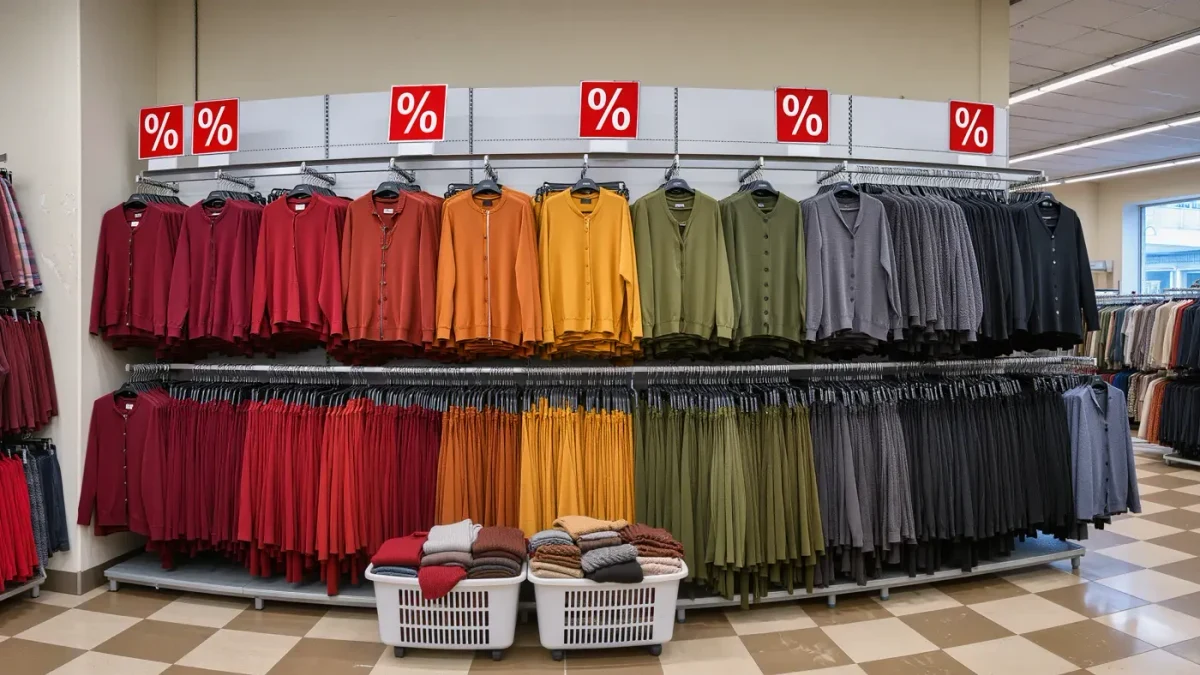
Clearance events end; permanent markdown does not. Whether a clearance wall, an outlet, or a sale carousel, standing discounts hold a stubborn share of apparel selling, and analysts reviewing discounting through 2025 found markdown depth and duration ran long by historical standards. The economics are less obvious than the signage: a permanent rack taxes more than the goods it holds.
What is a permanent markdown rack?
The permanent markdown rack is a fixture, not an event: a designated zone where discontinued, overstocked, and returned merchandise is repriced on arrival and offered continuously at a standing discount. Unlike a scheduled clearance, it has no end date and no planned sell-out. It is fed by the store's own failure inventory — whatever missed its season — and sometimes by purpose-bought goods priced to move, a practice that blurs the line between clearing mistakes and running a second, cheaper store inside the first.
Three formats dominate:
- The in-store clearance corner, which absorbs the branch's own slow sellers and keeps the recovery inside the business.
- The outlet channel, physically separate, which mixes prior-season goods with merchandise manufactured specifically for outlet pricing.
- The always-on online sale section, where filters and infinite shelf space let a retailer run thousands of permanent discounts without fixture constraints.
Why do standing discounts train customers?
Price perception is learned. When a store maintains a reliable zone of 50-to-70-percent-off goods, a segment of customers reorganises their entire visit around it — entering, walking straight to the rack, and ignoring full-price floors on the way. Pricing research has documented the pattern for decades: repeated discounts in a consistent location build a waiting segment that buys only there, and the segment grows with every cycle it is rewarded.
The rack also teaches a subtler lesson about everything beyond it. If last season's coat reliably appears at 60 percent off within a few months of launch, the 100-percent price starts to read as a temporary asking price rather than the price. Full-price conversion drifts down, planned markdowns must go deeper to move the same units, and the discount zone grows to absorb the shortfall. Merchandisers describe the loop bluntly: the store has taught its customers not to shop at full price.
What does the rack contribute to the P&L?
Managed honestly, the permanent rack earns its space three ways:
- Cash recovery: selling failed inventory at a discount returns cash that would otherwise sit in aged stock and eventually leave through donation or disposal.
- Traffic: value shoppers visit frequently, and a share of each trip spills over into full-price purchases, particularly in adjacent categories.
- Inventory hygiene: a reliable exit channel lets buyers clear mistakes quickly, which in turn funds faster replenishment of what is selling.
The costs sit mostly off the rack itself. Buying teams that treat the zone as an outlet for poor purchasing discipline stop negotiating quantities carefully, because failure has become someone else's floor problem. Gross margin percentage on rack units is thin to negative after labour, and the space could carry full-price goods — the true cost of the rack is the margin of the best alternative use of its footprint.
| Effect | Direction | Comment |
|---|---|---|
| Cash conversion of aged stock | Positive | Core purpose; recovery beats disposal |
| Full-price conversion nearby | Negative | Waiting behaviour spreads beyond the zone |
| Buying discipline | Negative if unmanaged | Failure must stay visible to the buyer who caused it |
| Store traffic | Positive | Value trips are frequent and spill over |
The outlet variant deserves its own caution. Investigations by consumer journalists over the past decade established that a large share of outlet merchandise is manufactured for the channel — lower-grade fabrics, simplified constructions, and distinct style numbers — rather than being overflow from the main line. The practice protects main-line pricing, but it also means the discount customer is frequently buying a different product, not the same one cheaply. For brands whose outlet and full-price customers overlap, the reputational arithmetic is delicate: the channel's profitability depends on shoppers not reading the style-number fine print, and several brands have faced criticism when they did.
Location inside the store matters as much as existence. A rack placed deep in the floor makes value shoppers traverse full-price merchandising on the way, converting some of them en route; a rack placed at the entrance lets them extract the discount and leave without touching anything else. Retail fit plans that treat the clearance corner as an afterthought forfeit this routing lever, which is one of the few free conversion tools a store has.
There is also a data story underneath the rack. Because permanent clearance absorbs failure continuously, its composition is a running audit of the buying office: which categories overshoot, which sizes break, which suppliers ship late enough to miss the season. Retailers who mine the rack's intake reports treat it as diagnostic instrumentation; retailers who treat it as a bin where mistakes go to be forgotten lose the signal and keep the losses. The rack, read correctly, is the cheapest merchandising consultant a company employs — its weekly intake list is simply the buying office's homework, graded in public, in red ink, on the sales floor.
How do successful retailers contain the rack?
The operators who run permanent discounting without hollowing out full price tend to enforce four disciplines. First, quarantine: the zone is merchandised as a distinct destination with its own visual language, so discount codes do not migrate to the rest of the floor. Second, rotation: goods cycle through the rack within a set number of weeks, with leftovers exiting to jobbers or donation rather than squatting at deeper cuts. Third, attribution: markdown origin is tracked to the buying decision that caused it, keeping accountability intact. Fourth, gatekeeping: manufactured-for-outlet goods live in separate channels, not in the store's own clearance, so that the core brand does not quietly become a discount brand in the eyes of its own regulars.
The permanent markdown rack, in short, is neither villain nor free money. It is a pressure valve, and pressure valves are useful precisely as long as they are not the plumbing.