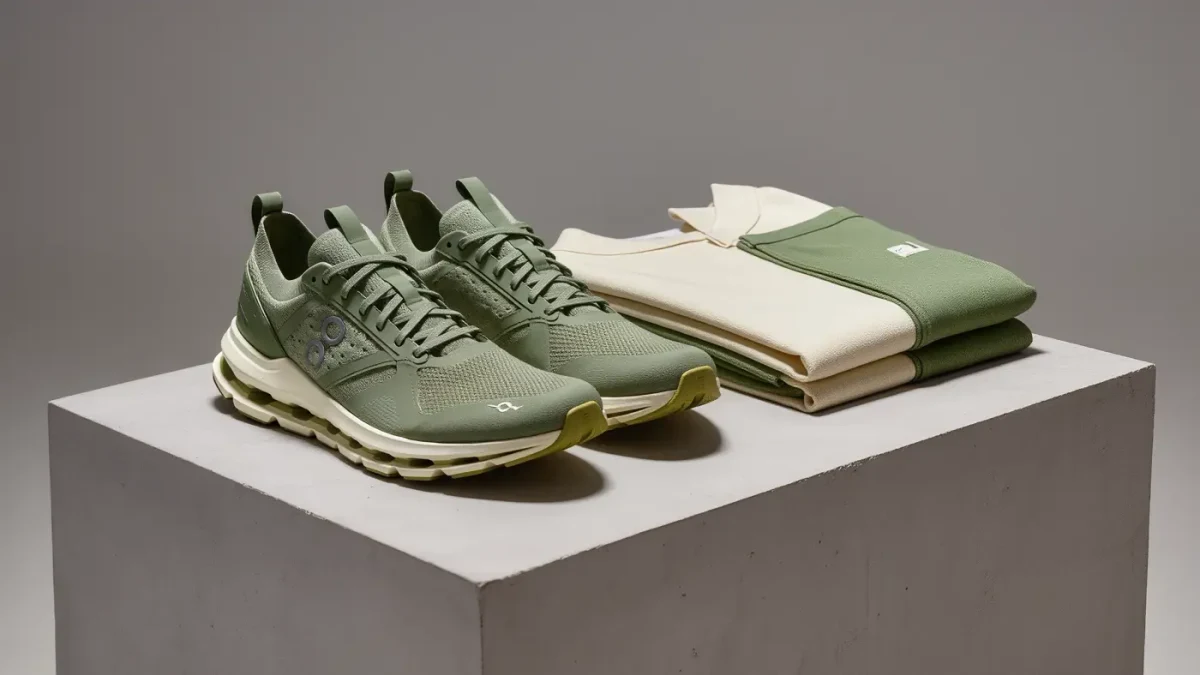
Kith and On launched their Spring 2026 collaboration on March 6, 2026 at 11 a.m. Eastern, per Kith's campaign announcement, pairing two original footwear silhouettes with an apparel range rather than the single-tee-plus-sneaker formula of earlier sneaker capsules. The release continued a pattern visible across the quarter — adidas and Bad Bunny followed with an apparel capsule on March 28, and Stone Island x New Balance scheduled apparel for June 4 — in which the sneaker partnership has become an apparel distribution channel. The shift changes what these capsules are for.
Why are sneaker brands pushing apparel now?
Margin and frequency. Footwear capsules spike and vanish; apparel gives the partnership a longer selling curve and a higher repeat rate, because clothing sizes restock where shoe sizes sell out forever. Per On's own press materials for its Sky High Farm collaboration in February 2026, the brand describes apparel as the connection point between its running base and its lifestyle buyers. A sneaker brand that sells only sneakers competes on drop-day theater; one that sells apparel competes on wardrobe share, which is a more durable business.
What does an apparel capsule demand that a shoe does not?
A grading plan. Footwear scales across a handful of last widths; apparel must grade across an entire size range, and every graded size is a fit claim the brand has to honor in returns. Per the fit and returns economics that trade analysts have documented, apparel returns run several times footwear rates, driven mostly by size and fit rather than quality. That is why the credible test of any sneaker-brand apparel line is not the lookbook but whether the line survives into a second season with the same blocks — the point at which the brand has absorbed what its grading actually costs.
What does the release format reveal about the strategy?
The 11 a.m. drop time, per the announcement, belongs to footwear scarcity culture — the artificial-clock release that manages demand for limited stock. Applying it to apparel is the interesting choice, because clothing does not need drop mechanics: sizes restock, demand curves are flatter, and artificial scarcity on a hoodie mostly creates returns processing problems, not lines around the block. Per the campaign materials, the apparel range was scoped as a full capsule rather than a single piece, which suggests the drop format is being borrowed for attention while the assortment is built for a season of selling. That hybrid — scarcity theater, program economics — is the working definition of the 2026 sneaker-apparel capsule.
Does the collaboration change the garment itself?
Less than either brand's marketing implies, and that is fine. Capsule apparel typically runs on the apparel partner's existing blocks with palette and branding changes, because a one-season run cannot justify new pattern engineering. Per the Kith announcement, the Spring 2026 range leans on the two brands' shared color logic rather than new construction claims. The buyer's rational read: the silhouette is proven, the fabric program is the apparel partner's standard, and the premium buys the collaboration, not the cloth. The exception worth watching is any piece with a technical fabric claim — that is where sneaker-brand engineering actually reaches the clothing.
What happens to the capsule market next?
The June 4 Stone Island x New Balance release, with its apparel-heavy scope, suggests the answer: capsules are becoming quarterly apparel programs with a shoe attached, reversing the original formula. Per the release calendar visible through March 2026, nearly every major running brand now has at least one standing apparel partnership. The scarce asset is no longer the collaboration but the blocks underneath it — and the brands that own their blocks, not their hype cycles, will still be grading profitably when the pairing rotates.