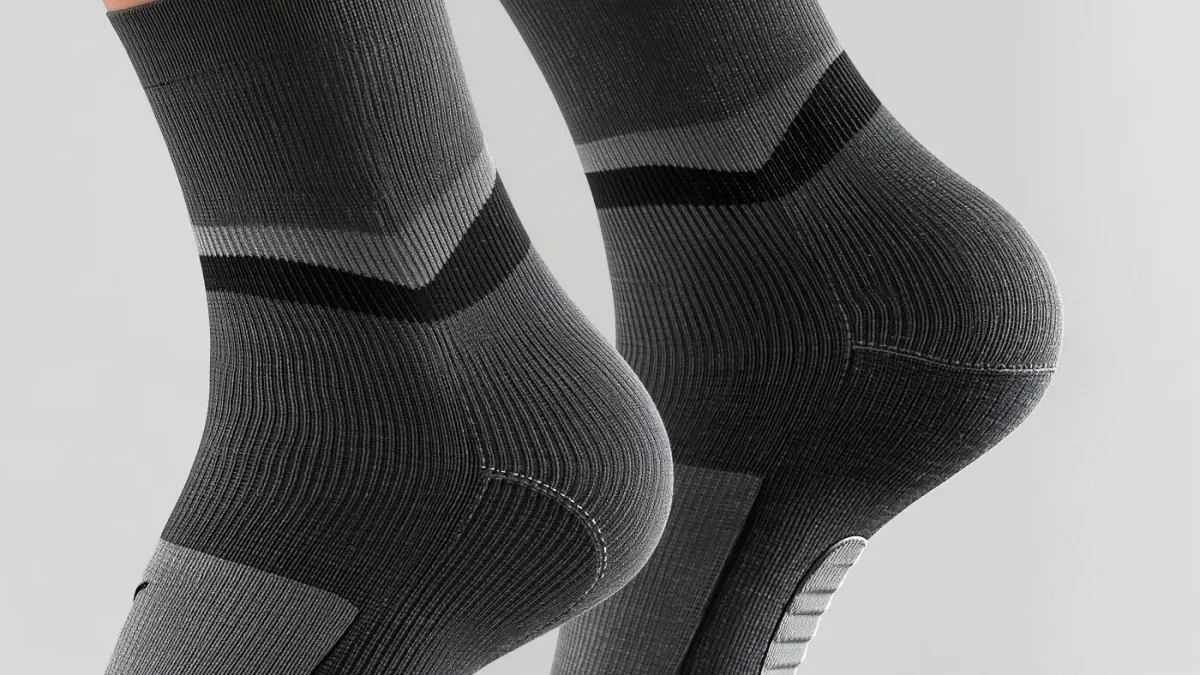
Revitalign, a Waco Shoe Company brand built on orthotic footwear, launched a performance sock line in March 2026, per Textile World's April 2026 coverage — a move from shoes into the knitwear that touches them. The entry joins a busy season of category migration in legwear: Apparel Brands and Castore announced a premium sock and underwear range for the UK and Europe, license holder PS Brands took on Fila sock distribution in the United States, and Splendid tapped Majesty Brands for a fall sock collection. Socks have become the cheapest door through which an apparel brand enters — or a footwear brand completes — its wardrobe claim.
Why do footwear brands move into socks first?
Because the sock is the footwear's fit system. For an orthotic brand especially, the sock is not an accessory but part of the arch-support stack: cushioning zones, arch compression and moisture management all change how the footbed performs. Per the Textile World coverage, Revitalign framed the line as an extension of its comfort proposition rather than a new category. The technical barrier is low — established sock mills knit to spec on license or contract — and the brand-logic barrier is lower still, because customers already experience the two products as one purchase decision.
What does a licensing entry change about quality control?
The accountability chain. Most of 2026's sock entries are licensing deals: the brand whose name is on the cuff does not own the mill, the pattern engineering or the return stream. Per the licensing announcements cited, PS Brands and Majesty Brands will run their respective programs as specialists, which usually means better knit machinery than the brand could justify — and a quality relationship held together by royalty audits instead of factory floor control. The buyer's practical consequence: the sock's spec lives in a license agreement, so spec drift between seasons is more likely than in an owned operation, and the composition label is again the only contractually binding claim on the package.
How crowded is the premium sock category?
Crowded enough that entries now differentiate on system claims rather than socks themselves. Bombas built the reference case by pairing socks with a three-basics architecture; per legwear trend analysis the LYCRA Company published for 2026, the category's growth runs through performance and sustainability claims — grip technology, recovered yarns, arch zoning. A sock line's gross margin is among the best in apparel because the unit cost is low and shipping is trivial, which is precisely why every footwear, loungewear and DTC brand has now walked through the same door. The scarcity is not socks; it is a reason to buy yours.
What is the honest test of these launches?
Elastic recovery after thirty washes. Sock quality is a durability claim more measurable than almost any other garment: rib recovery, heel-pocket shape retention and cushion loft can be compared against the out-of-package state with nothing but eyes and a washing machine. Per the category's own history — Bombas proved the premium sock survives on repeat rate, not launch buzz — the brands that will still be in the drawer in 2028 are the ones whose second sell-through matches the first. A March 2026 launch is a claim; the laundry is the audit.