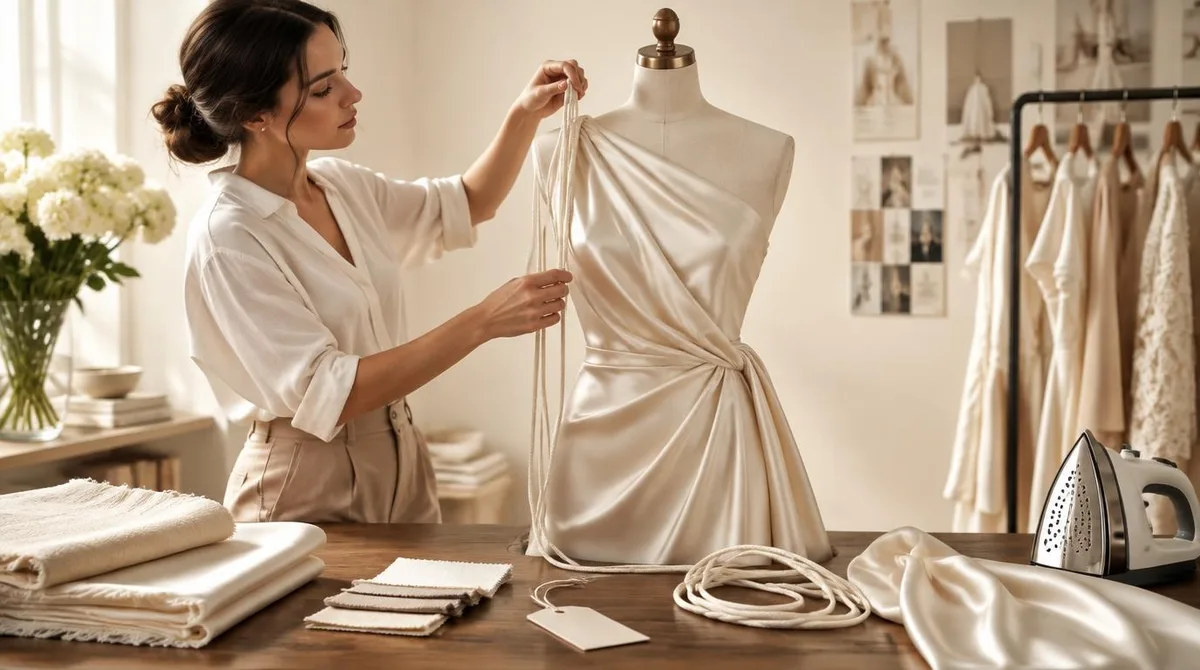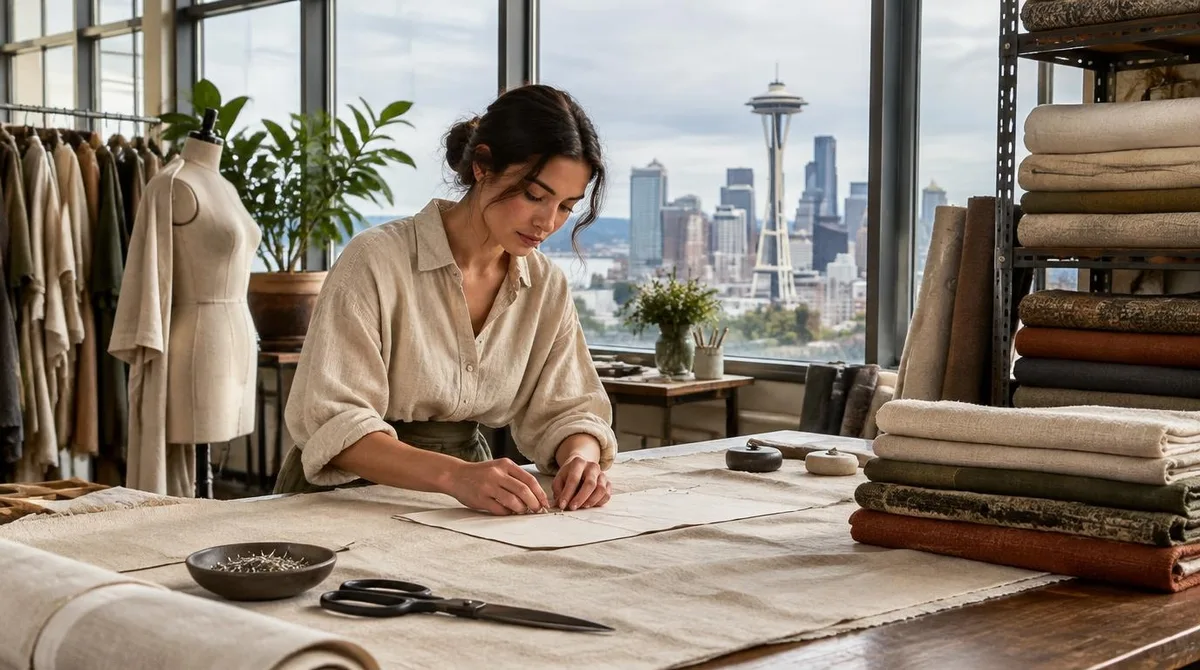
Transcend matters because it is not a marketing exercise in sustainability. It is a Seattle production studio, a fashion brand and a circular textile company run as one operation, founded by Nazia Siddiqui in 2020, per KOMO News. The important qualification: most of its sourcing and production claims come from the company itself, so the model is what the evidence supports, not an audited certification.
The company describes its work as building "more meaningful relationships between materials, makers and markets," according to KOMO's November 10, 2026 report. In practice, that means reclaiming vintage, deadstock or surplus textiles for some pieces, and using natural fibers — cotton, linen, silk, wool, cashmere — when it buys new fabric. The studio connects a Seattle production team, including refugee and immigrant makers, with artisan and manufacturing partners in India, alongside textile traditions from Bangladesh and Uzbekistan.
What does "circular textiles" actually mean at Transcend?
For this company, it means two things the evidence supports. First, feeding the studio from existing stock: vintage, deadstock and surplus textiles — fabric left over from other productions — become the raw material for some pieces. Second, when new fabric is needed, the company says it restricts itself to natural fibers rather than synthetics.
That is a narrower definition than the full industrial loop of textile-to-textile recycling, and the distinction matters. Deadstock reuse is a design and sourcing discipline: the collection is shaped by what exists. A brand working this way does not write a brief and order fabric to match. It designs around supply, which changes the cadence of a collection and, arguably, the designs themselves. The company's own framing — that the clothing is "only the beginning" — points the same direction, per KOMO.
Why is the production structure the more unusual part?
The Seattle studio model is what separates Transcend from brands that simply buy sustainable fabric and outsource everything else. The company runs its own production team in Seattle, which includes refugee and immigrant makers, and pairs that team with artisan and manufacturing partners in India. Traditions from Bangladesh and Uzbekistan sit in the same network. For related coverage, see CMT Versus Full Package: The Two Ways Brands Buy Production, Compared.
That is a distributed, small-batch structure rather than a conventional factory pipeline. It keeps cutting and sewing close to the design decisions, which is how a studio can respond to a deadstock find quickly — the fabric arrives, the team is already in the building. It also spreads the work across more hands and more places than a single contract factory would. The trade-off, which the reporting does not quantify, is scale: a structure like this is built for depth of control, not volume.
Why did a downtown Seattle store matter to this model?
One year ago, Transcend opened its first store at Pacific Place, bringing circular fashion into the heart of downtown Seattle, per KOMO. For a circular brand, retail is not just a sales channel — it is where the story of a garment's material gets told at the point of sale, and where a local production studio can put its own output in front of its own city. We covered a connected angle in How Fashion Journalists Actually Work, From Front Row to Filing Deadline.
The location choice is the analytical point. Pacific Place is a downtown retail address, not a studio district. A circular brand setting up there is betting that the materials story can carry a full-price retail experience in a high-traffic commercial corridor, not just in a craft-market or consignment setting. On Nov. 21, the store will host a Sustainable Fashion Anniversary Party marking the first year.
What does the Emmy Awards appearance signal?
This year, Siddiqui wore one of her own creations to the Emmy Awards, according to KOMO. For a studio of this size, a red-carpet placement is a visibility event with a specific function: it demonstrates that reclaimed and natural-fiber construction can hold up at the highest-visibility end of clothing — photography, movement, close inspection — where material flaws are hardest to hide.
It also collapses the distance between maker and ambassador. The founder wearing her own design to a major awards ceremony is the strongest available proof of confidence in the studio's own production, and it does the marketing work without a campaign budget.
What should readers watch next?
The evidence establishes a working model: reclaimed and natural-fiber sourcing, in-house Seattle production with refugee and immigrant makers, partner networks in India, Bangladesh and Uzbekistan, and a downtown store entering its second year. What it does not establish is scale, pricing, or third-party verification of the sustainability claims — those are company statements, attributed as such. The near-term marker is the Nov. 21 anniversary event at Pacific Place, which will show whether the first year of downtown retail has built a durable customer base for a circular studio.