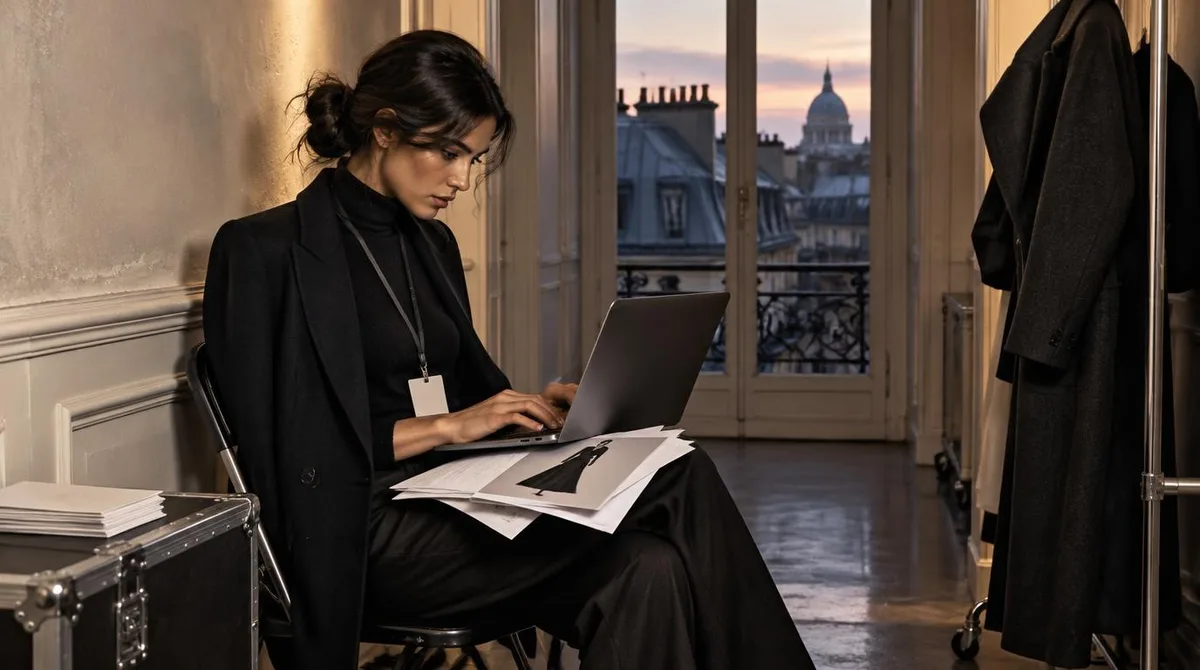
The picture most people hold of a fashion journalist is the front row: sunglasses, notebook, celebrity two seats down. The real job looks more like a relay. A reporter watches a show, decides in minutes which of forty looks matter, gets a quote if the schedule allows, and files a piece before the next venue opens its doors. The front row is roughly five percent of the day. The other ninety-five percent is logistics, reading, and writing at speed.
That rhythm follows the industry's own calendar. Fashion weeks in New York, Paris, and Milan remain the central events where designers show new collections to audiences, with Tokyo, London, and Los Angeles often counted as second-tier centers, according to Wikipedia's overview of the fashion industry. For the reporters covering them, that means weeks of compressed, back-to-back deadlines rather than a single big night.
This piece walks through how the work actually runs: what happens before a show, during one, and after, and how the digital shift has changed the job. It is a systems explainer, not a glamour piece, because the system is the story. Readers who want the audience side of the same machinery can start with our Fashion News coverage.
What happens before the show starts?
Preparation is most of the job. A reporter covering a season does not arrive cold. Weeks ahead, they read lookbooks, designer interviews, and last season's reviews so they can judge what has changed rather than describe what they see. They build a schedule: dozens of shows, presentations, and appointments stacked across a city, with travel time between venues that rarely cooperates.
Invitations are part of that logistics. Seating itself is a coded system, and our explainer on who sits where in the front row covers how a seat assignment signals a publication's standing before a single look walks. A reporter's placement affects access: a good seat means clear sightlines and a chance to catch the designer afterward; a bad one means watching a video feed on a screen at the back of the room. This connects to our earlier piece, Fashion News Network — The Front Row Explained: Who Sits Where and Why.
The reading matters as much as the routing. Before a show, working reporters typically know the house's commercial situation, its recent creative changes, and what competitors have already written. That background is what turns a description into analysis.
What does a reporter actually do during a show?
A runway show lasts minutes. The journalist's job during those minutes is triage. Which pieces carry the collection's argument? Which depart from what the house did last season? What is new here versus what is a house signature doing its usual work? Writing notes in the dark, on a phone or a paper card, while also photographing details, is a learned skill.
Some shows reward different instincts. A debut creative director's first collection is a news event, judged against the predecessor's record. A house's commercial line is judged against what will actually sell. The same reporter may need both judgments in a single day. As our guide to reading a fashion week like a pro explains, the shows are only one input; what retailers buy is often the more telling signal. Readers following this should also see Fashion News Today: How to Read a Fashion Week Like a Pro, From Seating Charts to What Actually Sells.
Backstage and post-show access fill the gaps a runway leaves. A short quote from a designer about intent, or a look at a garment's construction up close, can be the detail that separates one publication's review from the dozens of others filing the same night.
How does the filing work after the lights go down?
The deadline pressure is the defining constraint. A review of a morning show may need to be filed by early afternoon so the publication owns the story before the news cycle moves on. That means drafting in transit, editing on the move, and shipping copy with whatever sourcing is at hand rather than what a slower process would allow.
Speed shapes the genre. The fast pieces are the show reviews and the news items: a creative director's exit, a surprise casting, a standout look. The slower pieces, the analysis of what a season means commercially, come days or weeks later, once the numbers and the reactions settle. Good desks run both tracks at once.
The daily feed is its own discipline. A rolling fashion desk covers far more than runways: celebrity style, trend cycles, shopping edits, and industry moves, all on a continuous schedule. Hello! Fashion's latest-news feed shows the shape of that output plainly, ranging from runway roundups and trend pieces to items like Seán McGirr's departure from McQueen, where the outlet reported fashion insiders' reactions to the Irish creative director leaving the Kering-owned brand after three years. A single desk, in other words, is running several beats simultaneously.
How has the digital shift changed the job?
The industry itself has moved online, and the reporting has followed. Wikipedia's industry overview notes that fashion has migrated online to a significant extent, so the geographical importance of the traditional fashion capitals, while still central, has become less so. For journalists, that means the story is no longer only in the room. A collection drops on a brand's own channel; a trend surfaces on a street-style account hours before any review publishes.
The practical consequence is that the reporter's competitive edge has shifted from access to judgment. Anyone can see the images. The value a journalist adds is context: which trend has commercial weight, which designer move signals a strategy, which headline is noise. Our Technology section tracks the tools reshaping that judgment, from AI-driven discovery to the data systems changing retail.
Newsletters and social feeds have also changed how the work reaches readers, and how reporters build an audience of their own. The desk is no longer the only distribution channel; the individual byline increasingly is.
What this means for readers
Our analysis: the day-in-the-life picture matters because it explains the product. A show review written in ninety minutes is a first draft of history, valuable for speed and thin on consequence. A systems piece written two weeks later has the reverse profile. Neither is the whole truth, and a well-run publication needs both.
For readers, the useful habit is checking what a piece is. Is it a review filed from the room, an analysis built on data, or a trend roundup assembled from the feed? Each has a different reliability profile, and each answers a different question. The reporters filing from the front rows are working under real constraints, and knowing those constraints makes anyone a better reader of what they produce.