Grainline — the direction of the warp yarns, running parallel to the selvage, along which a woven fabric has almost no stretch — is the quiet arbiter of how a garment hangs. A skirt cut with the warp falls long and stable; the same skirt cut 45 degrees off-grain, on the bias, clings and swings. Cutting even a few degrees off true grain can shorten the visual line of a trouser leg by more than a centimeter at the hem, a deviation quality teams at tailoring houses treat as a rejectable defect.
What exactly is grain, and why does direction matter so much?
Woven fabric is a grid. Warp yarns run lengthwise down the roll; weft yarns run crosswise. On the lengthwise grain, cloth resists stretching almost completely. On the crosswise grain it stretches slightly, because weft yarns are typically a little looser in tension. On the diagonal — the bias — the grid itself can shear, and the fabric stretches dramatically. This is not a subtle effect: a 100 percent cotton poplin stretched on the bias can elongate several percent of its length under modest hand tension, then recover only partially, which is why bias-cut pieces settle and lengthen over the first wears.
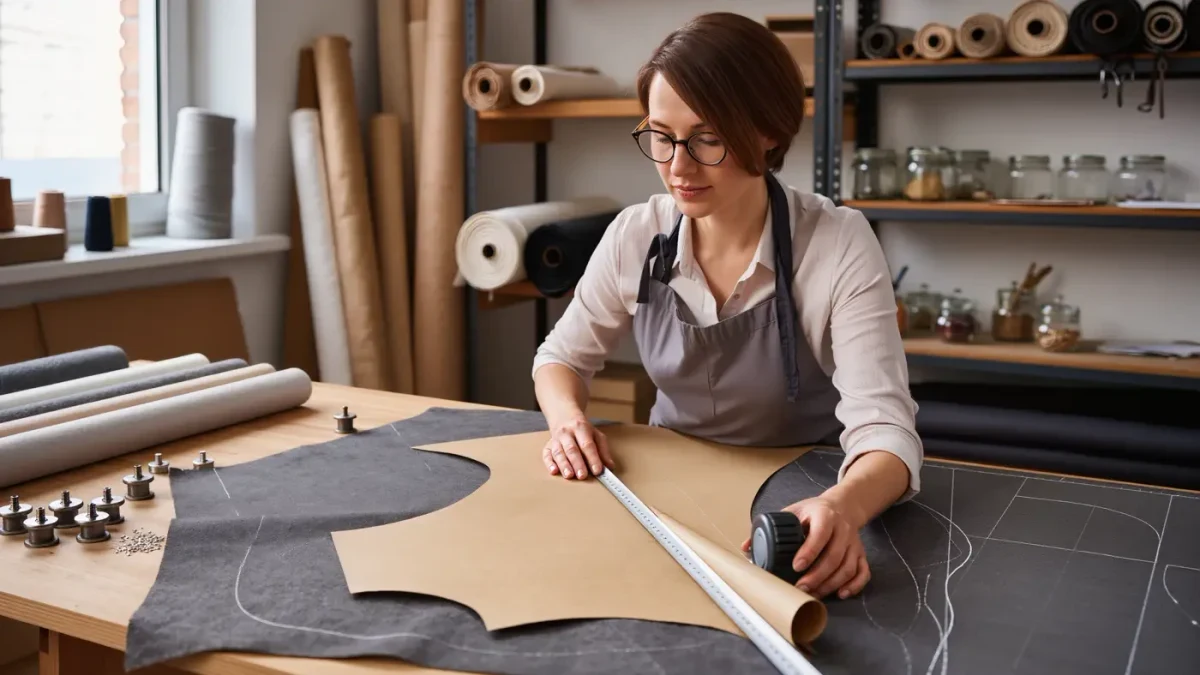
Because each direction behaves differently, the pattern cutter assigns a grainline to every pattern piece — a straight arrow printed on the pattern that must be aligned with the warp during layout. Ignore that arrow and the garment is not merely different; it is structurally unpredictable. One trouser leg cut slightly off-grain will twist toward the diagonal, pulling the side seam forward while the other leg hangs true.
How does a cutter actually keep a piece on-grain?
Professional cutting rooms follow a fixed sequence:
- Square the fabric. The spreader pulls the cloth so warp and weft sit at 90 degrees; knit and woven goods off the loom are frequently skewed, and cutting skewed cloth bakes the distortion into every panel.
- Align the pattern arrow with the selvage, measuring from arrow to selvage at both ends of the arrow. If the two measurements differ, the piece is rotated until they match.
- Pin or weight along the grainline first, then the perimeter. Pinning corners before the grainline is set is the classic amateur error, because the pattern rotates around the first pin.
- Cut with the lay flat and undisturbed, then let panels relax before sewing, since cutting and handling can shift the grid temporarily.
Why do off-grain garments twist and hang crookedly?
When a panel is cut off-grain, one side of the panel contains more diagonal behavior than the other. Under gravity and body movement, the fabric rotates toward its most stretchable direction — the bias — over time. This is why a cheap shirt's center front crease migrates sideways after washing, and why one side seam of a dress creeps toward the front. The industry measures this as fabric skew, expressed as a percentage of width displacement; per ASTM's published guidance on woven fabric tolerances, skew beyond roughly 2 percent is commonly treated as a second-quality indication in piece goods, and cutting rooms hold themselves to tighter internal limits because garment distortion compounds the fabric's own.
The effect is worst in garments with long vertical panels — trousers, skirts, coat fronts — because a small angular error is multiplied over distance. A 3-degree error at the waist becomes a visible spiral at the hem. Short pieces such as collars and cuffs hide the error, which is why mass-market factories sometimes re-cut small parts from remnant sections where grain cannot be verified.
Does grainline affect drape as much as fabric choice?
Nearly. Drape — the way a fabric falls into folds — is usually credited to fiber and weight, but direction modulates it heavily. A crepe cut on the bias releases soft, fluid folds because the shear direction lets the surface undulate. The identical crepe cut on straight grain produces flatter, more columnar folds with a heavier visual line. Designers exploit this deliberately: the bias-cut slip dress of the 1930s, revived repeatedly since, exists precisely because diagonal orientation converts a relatively stiff satin into a liquid surface. Per the mill technical literature published by warp and weft suppliers, bias orientation can roughly double apparent elongation at low load compared with straight grain in plain weaves — enough to change a fabric's drape coefficient on a cantilever test.
When is cutting off-grain a deliberate design decision?
Bias cutting is the legitimate exception. It is used to gain stretch without knit construction, to let fabric skim the body, and to produce spiral hems on skirts that flare evenly all around. But bias is expensive: it consumes more yardage because pieces cannot nest tightly in the marker, it requires hanging time — finished bias garments are often left to drop for 24 to 48 hours before hemming so the fabric finishes stretching — and it demands careful handling to avoid stretching seams during sewing. A factory that skips the hanging step ships a hem that will drop unevenly on the customer, one of the most common bias-related returns.
How does grain interact with fusibles and knits?
Interfacing — a support fabric fused or sewn into panels such as collars and plackets to add body — carries its own grainline, and matching it to the fashion fabric is a rule with real consequences. A fusible interfacing applied on its crosswise grain where the shell is on lengthwise grain creates two layers with different elongation in the same panel; after a few launderings, the mismatch shows up as bubbling or a rolled edge. Tailoring houses that build chest canvases for jackets treat grain orientation of haircloth, canvas, and domett as non-negotiable, because the interior structure is what transmits the intended silhouette from the cloth to the body.
Knits shift the vocabulary but not the principle. Instead of warp and weft, a knit has wales — the vertical columns of loops — and courses, the horizontal rows. Lengthwise stretch in a knit follows the wale direction, and crosswise stretch, usually greater, follows the courses. A panel cut off the wale grows at a different rate from its neighbors, which is why sleeves on inexpensive jersey tops often end up visibly longer than the body after three washes. Pattern engineers therefore mark knit patterns with a direction-of-greatest-stretch line and treat it with the same discipline cutters apply to a woven grain arrow.
What should a buyer look for?
Two quick checks reveal grain discipline. First, hold a trouser or dress up by the shoulders or waist and sight down a vertical seam: it should hang plumb, not spiral. Second, examine a checked or striped garment — patterns that match at the side seams but drift out of alignment across the front indicate off-grain cutting, because the grid has been rotated relative to the panel. Per NIST's published work on textile measurement practices, visual grid alignment remains one of the few inspection methods that requires no instrument, which is why seasoned merchandisers rely on it during line review.
Grainline is invisible on the rack and decisive in the closet. It costs nothing to respect and a fortune to ignore, which is why cutting-room supervisors treat the pattern arrow not as a suggestion but as the garment's load-bearing instruction.