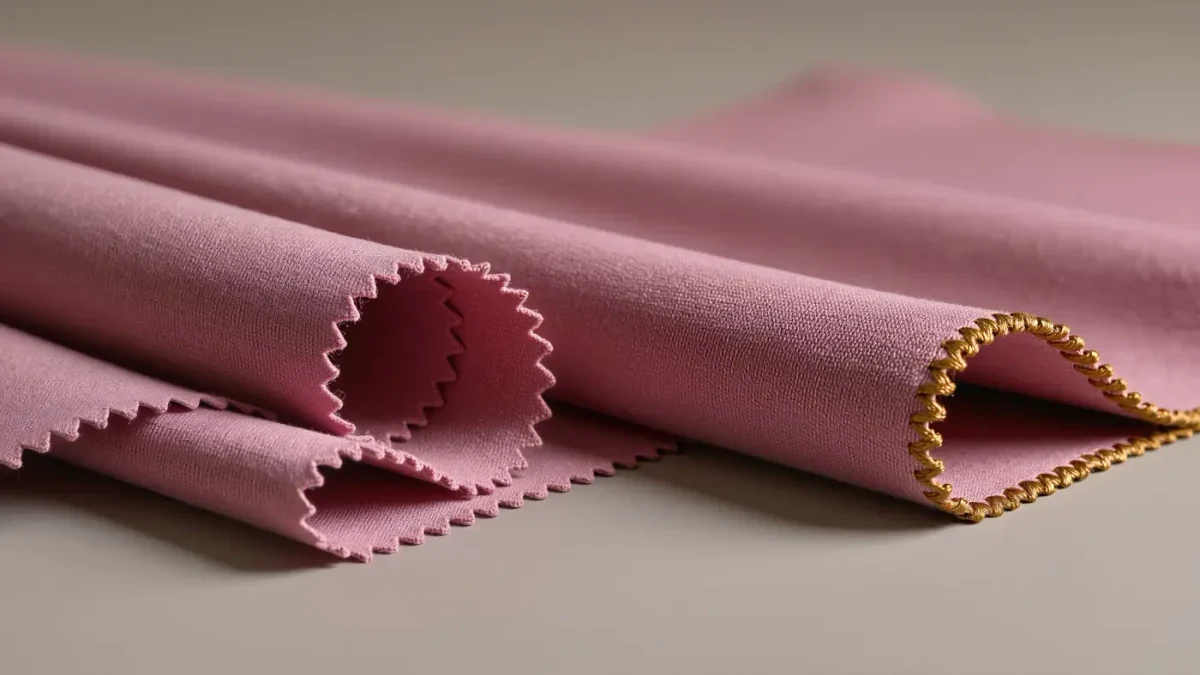
Hems twist and roll because fabric has a preferred resting geometry: woven cloth relaxes toward its lowest-energy state after cutting and sewing disturb it, and any imbalance in yarn twist, grain, or finishing tension rotates or curls the edge. A hem is the perimeter of that conflict, which is why the fault shows there first. In knit goods the effect is strong enough to be engineered around deliberately — per technical literature from circular-knitting machine makers, single-jersey fabrics curl at the edges by design of their loop structure, with curl direction set by the direction of yarn twist, S or Z, used in spinning.
What causes a hem to twist sideways?
Twisting — a trouser leg whose inseam migrates toward the front, a skirt hem that spirals — usually begins before sewing. Three mechanical causes dominate. First, off-grain cutting: when a panel is cut even a few degrees off the warp, its two edges contain unequal diagonal behavior, and the panel rotates toward the bias over wear and washing. Second, fabric skew from the mill: knitted tubes and some woven goods come off the machine with the loops or yarns already spiraled, a defect measured as skew and expressed as a percentage of width; industry practice treats skew beyond roughly two to three percent as second quality for most apparel uses. Third, mismatched seam feeding: when the two plies of a hem travel through the feed dog at slightly different rates — uneven presser-foot pressure, or a walking foot missing where it is needed — one ply gathers invisibly, and the finished hem ripples or leans.
The tell is diagnostic. Fold the garment flat with side seams matched: if the hemline still hangs unevenly, the fault is in the panels or the fabric; if it only appears on the body, the fault is in feeding or wearing stress. Factory quality teams use exactly this flat-table test because it separates cutting-room blame from sewing-room blame.
Why do knit hems curl, and can it be prevented?
Single jersey curls because its loops are asymmetric: each stitch is drawn from one side of the fabric only, so the face and back have different yarn curvature, and the edge rolls toward the back at the top and bottom, toward the face at the sides. Yarn twist direction amplifies it. In spinning, Z-twist yarns — twisted clockwise when held vertically — and S-twist yarns twist-counter opposite ways, and the residual torque in the yarn seeks release. A jersey knitted from high-twist Z yarn curls more aggressively than the same structure in low-twist yarn, and per knitting industry technical references, fabric relaxation after knitting releases a measurable share of that torque in the first wash, which is why pre-washing roll goods before cutting is standard practice for jersey production.
Prevention is a chain, not a step:
- Relax the fabric before cutting — 24 hours or a full wash cycle for jersey, so loop torque and shrinkage settle before geometry is fixed.
- Cut with edges on-grain and, where possible, avoid exposing raw single-jersey edges at all.
- Stabilize the hem edge as it is sewn: fusible hem tape, a narrow band of self-fabric, or feed synergy so the ply nearest the feed dog does not stretch.
- Finish the edge — a coverstitch that traps the curl, or a twin-needle hem that balances tension across both plies.
Why do woven hems roll differently from knit hems?
In wovens, rolling is a finishing and fabric-choice question rather than a loop-structure one. High-twist yarns — crepe yarns are the canonical case, spun with strong twist that texturizes the cloth — carry torque that persists in the finished fabric. A georgette or crepe de chine hem rolls because those yarns are trying to untwist, and per silk and synthetics mill technical datasheets, high-twist fabrics are typically finished with heat setting to lock the geometry; skip or under-do the setting and the hem finds its own curl. Sheer fabrics amplify the symptom because a narrow rolled hem has almost no mass to hold itself flat, which is why fine blouse hems are rolled rather than turned twice — a rolled hem feeds the curl into a deliberate, uniform scroll instead of fighting it.
Weight and stiffness matter too. A hem with sufficient bending stiffness resists curl; a fluid fabric with none cannot. Interfacing a hem — even a narrow strip of lightweight fusible — adds the missing bending resistance, which is why tailoring protocols interface hems of soft coating fabrics that would otherwise ripple.
What does the finishing choice have to do with it?
| Hem finish | Behavior on fluid fabrics | Typical use |
|---|---|---|
| Straight-stitch double turn | Ripples on knits; acceptable on stable wovens | Woven trousers, skirts, shirts |
| Twin-needle coverstitch | Stable if tension balanced; skips and waves if feed is uneven | Jersey tees, knit dresses |
| Blind hem | Nearly invisible but little added stiffness | Tailored skirts, coats, dress trousers |
| Rolled hem | Turns the curl into a controlled scroll | Sheer blouses, scarves, silk |
| Faced or interfaced hem | Adds stiffness and weight so the hem hangs plumb | Soft tailoring, coating, fluid suiting |
The table makes clear that no finish is universal: the right choice depends on the fabric's torque, weight, and bending behavior. A factory that applies one hem type across an entire range is announcing that fabric behavior was not considered per style.
Hem allowance depth participates too. A generous allowance — the classic 4-centimeter skirt hem or the deep 10-centimeter trouser cuff on tailored trousers — adds mass at the perimeter, and that mass stabilizes the hang the way a curtain hem weights fabric. Fast-fashion production cuts allowance to a centimeter or less to save material and machine time, which removes the stabilizing weight at precisely the edge most exposed to torque and feed error. Costume workshops working with fluid stage fabrics routinely weight hems deliberately, because under theater lighting a spiraling hemline reads from the back row while every other fit fault does not.
How does laundering change hem behavior over time?
Each wash is a relaxation event. Residual torque from spinning and knitting releases progressively; shrinkage percentages differ between warp and weft; and heat from drying can set a new geometry, good or bad. This is why a hem that hangs straight out of the factory can twist after three home launderings: the factory's geometry was balanced against a fabric state that no longer exists. Per testing protocols published by AATCC, the textile chemistry association, dimensional change after repeated laundering is a standard measurement precisely because single-wash shrinkage data underpredict long-term movement.
What can a wearer do about a hem that has already gone wrong?
Diagnose before altering. If the flat-table test shows the twist lives in the panels, no re-hemming will fully cure it — the rotation is in the cloth. Where the fabric itself skews, a tailor can sometimes re-block the panel with steam and tension, though results on knits are temporary. If the fault is feeding, re-sewing the hem with stabilization — hem tape or a walking foot setup — usually resolves it. And for high-twist or sheer fabrics, adopting the factory's own answer, a rolled or faced hem, converts the symptom into a design feature rather than a defect.
Hems are honest. They summarize every upstream decision — yarn twist, loop structure, grain discipline, finishing tension — in a single visible line, and when that line misbehaves it is pointing at a specific, findable cause.