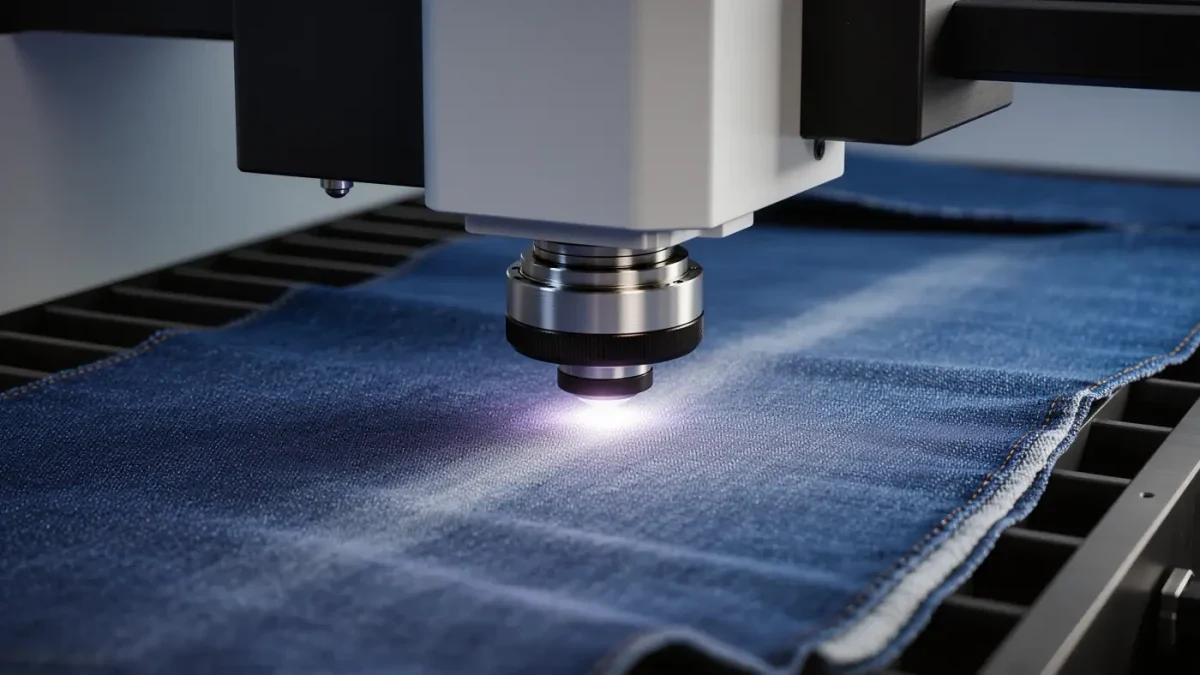
Laser finishing, in which a CO2 laser burns controlled abrasion patterns directly into denim garments, produces whiskers, fades, and distressing in roughly thirty seconds to two minutes per pair without pumice stones, potassium permanganate, or the rinse cycles those materials require, per vendor process descriptions circulated through the mid-2020s. The technology arrived in industrial denim finishing during the 2010s and, by 2025, sat alongside ozone and e-flow processes in the standard toolkit of large finishing plants. Its promise is environmental; its constraint is capital and digital pattern capability.
What does a denim laser actually do?
The machine directs a carbon dioxide laser beam across the garment's surface in a programmed path, and each point of the fabric receives a dose of energy calibrated to char the indigo surface without burning through the yarn. Faded areas are created by removing indigo from the fabric face; whiskers, the fine radiating crease lines at hip and knee, are burned along pattern paths; distressing and hole effects are achieved with higher doses. The garment is worn over a form or laid on a vacuum table so the surface stays flat and the focal distance constant.
The pattern is a digital file, which changes the labor equation completely. One operator loads files and garments while the machine cycles; the traditional hand-sanding station it replaces employed workers executing thousands of repetitive abrasion strokes per shift, a job with well-documented ergonomic injury rates.
What is the laser replacing, chemically and physically?
Traditional denim finishing built its looks through wet abrasion. Stone washing tumbles garments with pumice; a local application of potassium permanganate, an oxidizing agent sprayed by hand to bleach targeted areas, produced the high-contrast sprays and whisker bleaching before sanding. Each method carries a cost ledger beyond the label price: pumice mining and sludge disposal, permanganate handling and neutralization, and water consumption for rinsing that trade reporting during the 2010s placed among the finishing industry's heaviest environmental burdens.
The comparison below gathers the process differences that plants actually weigh.
| Attribute | Wet abrasion and PP spray | Laser finishing |
|---|---|---|
| Water use per garment | Multiple rinse cycles | Near zero for the laser step |
| Chemicals | Potassium permanganate, neutralizers | None in the burning step |
| Abrasives | Pumice, sandpaper | None |
| Time per garment | Hand work plus tumble cycles | Tens of seconds to two minutes of machine time |
| Repeatability | Operator-dependent | File-driven, near identical across runs |
| Look fidelity | Organic, irregular character | Can read as artificial if overdosed |
The last row is the technology's reputational boundary. Laser burns produce clean-edged fades that can look mechanical; experienced operators modulate dose and combine laser with light enzyme washing to restore an organic irregularity. Brands that simply swap laser for hand work without retuning the look have shipped product that consumers read as artificial, which industry commentary documented repeatedly during the adoption wave.
How does a laser finishing workflow run?
The production sequence below reflects standard practice in plants running laser as the primary abrasion step.
- The brand's design team supplies or approves a digital pattern file defining every fade, whisker, and distress zone with dose values.
- Garments arrive after sewing and before final wash; the operator mounts them on forms or the vacuum bed and loads the pattern file.
- The laser scans the garment in one pass, burning the programmed pattern in under two minutes depending on coverage.
- A shortened wet finish follows, typically an enzyme or rinse bath, to clean the burned surface and restore softness, using far less water than full stone washing.
- Inspection verifies dose consistency across the batch, since fabric shade variation between dye lots shifts how the same dose reads.
Step five matters more than buyers expect. Indigo shade varies between dye lots, and a dose calibrated on one lot can under- or over-burn the next, so plants either standardize shade feeding into the laser or re-profile per lot. Skipping that discipline produces batches where the identical file reads as three different washes, a defect invisible in the file and obvious on the shelf.
What does the technology cost, and who runs it?
Industrial denim lasers from suppliers such as Jeanologia and TBT carried price tags reported in industry coverage in the range of hundreds of thousands of dollars for multi-head configurations through the mid-2020s, per vendor and trade press reporting. The payback case combines labor displacement, water and chemical savings, and throughput, and it closed first for high-volume brands and their finishing plants in Mexico, Turkey, Bangladesh, and China. Small ateliers continue outsourcing laser work to job shops rather than owning machines.
Adoption concentrated where brand sustainability commitments created demand. Several major denim brands publicly committed during the late 2010s and early 2020s to eliminating potassium permanganate and to drastic water reduction in finishing, and laser was the enabling technology in those programs. Trade reporting through the mid-2020s, including coverage in outlets such as Reuters of the textile industry's water footprint, tied finishing water use to regulatory pressure in producing regions.
Does laser finishing change the garment's wear behavior?
It can, and this is the technical caveat buyers check. Burning removes fiber from the fabric surface, and an overdosed area loses yarn integrity, so the faded zones can fatigue and hole earlier in wear than hand-abraded equivalents, which tear fibers without vaporizing them. Well-run programs specify a maximum dose per fabric weight and verify burst strength at the burned zones in lab testing. The lesson generalizes: the laser is a precision instrument, and its output quality is bounded by the finishing plant's pattern engineering and quality control, not by the machine's datasheet. Plants that treat the file library with the same rigor as physical patterns, versioning designs, archiving approved doses per fabric, and reviewing sample burns before bulk, obtain looks that hand work cannot match for repeatability at any wage level.
How does the laser fit into the wider finishing toolkit?
The laser is one of three dry technologies that reshaped denim finishing during the 2010s and 2020s, and they work as a set. Ozone machines fade garments in a closed drum using ozone gas, replacing some bleach baths and reducing rinse loads. E-flow and nanobubble systems apply chemicals through mist rather than bath water, cutting water use in the softening and washing steps. The laser handles patterned abrasion, the whiskers and fades that hand work once did. A modern low-water finishing line typically combines all three, with the wet loop shortened to a minimal rinse.
Sequencing matters as much as equipment. The standard recipe runs laser first on the unwashed garment, because the indigo surface the laser reads is most predictable before wet processing, then ozone or enzyme washing to develop and clean the burned effect, then the minimal rinse and softening. Plants that reverse the sequence fight shade unpredictability, since washed indigo reads differently under the beam and dose calibration becomes guesswork.
The kit's combined effect is what brands now purchase. Trade reporting on denim finishing through the mid-2020s described plants promoting finishing programs with a large majority reduction in water per garment relative to conventional stone-wash recipes, per the finishers' published claims, with the laser as the visible centerpiece and the dry-wash technologies as the supporting cast. Buyers evaluating a factory's sustainability story should therefore inspect the whole line and its water metering, not the laser alone, because a laser bolted onto a conventional wet line changes appearance more than it changes effluent.