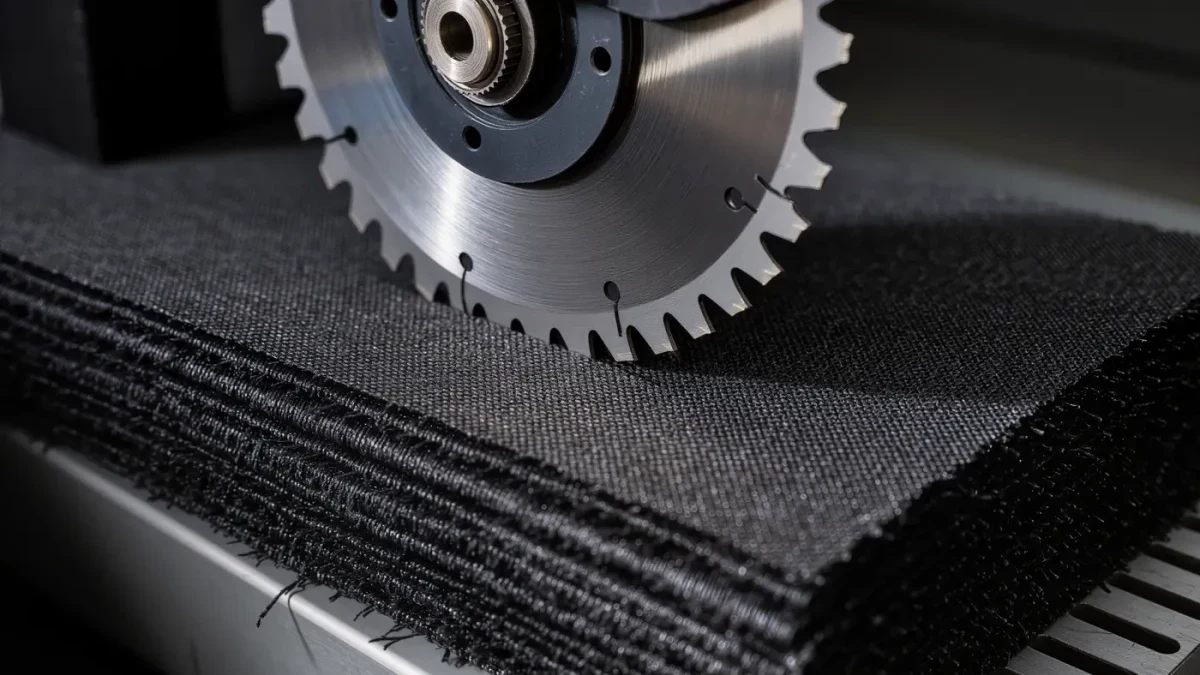
An automated cutting system, which is a computer-controlled gantry that cuts stacked fabric plies from a programmed marker, delivers edge accuracy in the range of tenths of a millimeter and cuts a spread in minutes rather than hours; vendor datasheets for leading systems commonly quote cutting tolerances well under one millimeter and ply heights of several centimeters. Yet the financial case rarely lives in the blade. It lives in the marker, the cutting layout that determines what percentage of the fabric becomes garment pieces, and in the reduction of miscut plies that must be scrapped.
What does an automated cutting line consist of?
The system is a chain of three machines plus software. A spreader lays fabric plies into a stack, either flat or rolled, with controlled tension; an automated spreading error of half a centimeter at each ply edge compounds across a fifty-ply lay into visible distortion. The cutter itself is a gantry carrying a reciprocating blade, a rotating blade, or both, with vacuum holding the plies compressed and stationary. A delivery system offloads cut panels to bundling. Above all of it sits the nesting and cutting software that converts pattern data into tool paths.
Manual cutting, by contrast, depends on a cutter following a paper marker with a straight knife, and its accuracy is a human variable. The automation argument is that a machine removes that variable while raising throughput per operator.
How accurate is automated cutting in practice?
Accuracy has two parts: the precision of the tool path and the stability of the fabric in the stack. Machine precision is the easy half. Published specifications from major manufacturers such as Lectra, Gerber, and bullmer position positioning repeatability and cutting tolerance in the sub-millimeter band, per the vendors' technical datasheets. The harder half is material behavior. Knits relax and shift; slippery linings migrate under the blade; a vacuum that is set too low lets plies drift, and a drill mark that misses its target by two millimeters ruins every ply below it.
In practice, plants report that automating a cutting room tightens panel dimensions dramatically but does not eliminate quality control. The inspection step moves from checking every panel edge to checking the first articles from each lay and monitoring spread quality.
Where do the fabric savings actually come from?
Three mechanisms, in decreasing order of financial weight, and the first is often misunderstood.
- Marker efficiency: software nests pattern pieces more densely, and skilled human markers remain competitive on simple lays; the automation advantage grows on complex marker mixes and short lays where manual optimization is impractical.
- Shrinkage of end-of-lay waste: planning software pairs markers to the actual roll lengths on hand, cutting the unusable remnant from each lay.
- Miscut elimination: a miscut ply in manual cutting scraps fabric and rework time; at machine tolerances these events become rare enough to plan around.
Industry practice for decades has treated fabric utilization, expressed as the percentage of fabric area converted into garment pieces, as the cutting room's headline metric. Manual marker making by skilled staff commonly achieved utilization figures in the low-to-mid eighty percent range on many woven products, and modern nesting software typically matches or exceeds a good human marker, with gains concentrated on hard marker mixes. Exact numbers vary by product, and no single utilization figure is honest across categories.
What does the equipment cost, and what is the payback?
A single-ply or low-ply digital cutter can run from tens of thousands of dollars for entry configurations, while high-volume multi-ply systems with spreaders and conveyors reach into the hundreds of thousands, per public vendor pricing ranges. Payback calculations rest on the three savings above plus labor, and the sensitivity is stark: a plant cutting high-value wool suiting justifies automation at utilization gains of one or two percentage points, while a plant cutting commodity cotton tees may never justify it on fabric alone and buys automation for throughput instead.
| Factor | Manual cutting room | Automated cutting room |
|---|---|---|
| Cutting tolerance | Operator-dependent, typically several millimeters | Sub-millimeter, per vendor datasheets |
| Throughput per operator | Lower; accuracy trades against speed | Multiple plies cut continuously with one attendant |
| Marker utilization | Strong with expert markers | Matches or exceeds experts, strongest on complex mixes |
| Capital exposure | Minimal equipment cost | Tens to hundreds of thousands of dollars |
| Flexibility | High; marker changes are paper and skill | High in software, but capacity is fixed in hardware |
Who is adopting automated cutting, and where does it stop making sense?
Three adopter profiles dominated through 2025. Technical textile producers, including automotive interiors and protective equipment, adopted earliest because tolerances are contractual. Sportswear and outerwear brands followed for high-value fabrics and technical panels. Large uniform and workwear manufacturers bought multi-ply systems for sheer volume. The holdouts are high-fashion ateliers and very small manufacturers, where single-ply manual cutting remains both accurate enough and cheaper than amortizing a machine.
The other limit is fabric character. Automated systems handle wovens and stable knits well; extremely elastic, slippery, or hairy fabrics can demand slower cutting speeds, lower ply heights, and special holding that erodes the throughput premium. University textile programs, including North Carolina State University's Wilson College of Textiles, continue to train cutting room engineers on exactly this boundary between machine capability and material behavior.
Does better cutting accuracy change the garment?
It changes consistency more than design. Tighter tolerances mean the smallest size in the range is as true as the largest, sewing lines receive panels that align without compensation, and finished measurements hold within tighter tolerance bands, which reduces alteration and rejection downstream. Research and industry reporting on apparel quality frequently notes that a majority of assembly defects trace back to cutting variation, which is why the cutting room upgrade so often shows up as fewer sewing defects rather than as a cutting room statistic.
The honest summary for a factory weighing the investment in 2026: the machine delivers its promised accuracy, the marker software protects utilization, and the payback depends on fabric value, product mix, and volume in ways no datasheet can decide.
How should a cutting room prepare before buying a machine?
Plants that rushed the purchase and skipped the preparation consistently under-delivered on vendor promises, and the preparation list is unglamorous. Pattern data must be digitized accurately and named consistently, because the cutter amplifies whatever error the digital pattern carries. Fabric testing for cutting behavior, including ply shifting, relaxation, and blade compatibility, prevents months of parameter tuning on live orders. And spreading discipline must reach a standard first: an automated cutter fed by a careless spreader simply makes identical mistakes across fifty plies at once, converting one miscut panel into fifty.
Staffing and skills form the second preparation axis. The operator role changes from manual cutting skill to machine supervision, first-article inspection, and routine maintenance, while a planner or engineer takes over nesting and marker policy. Finding or training that combination takes longer than the machine installation itself, which is why staged implementations, running the cutter on one product family before converting the room, have become the recommended path in trade guidance through the 2020s.
Measurement discipline completes the groundwork. A plant without a baseline of current utilization, miscut rates, and cutting labor hours cannot prove the machine's payback afterwards, and internal arguments about whether the investment worked have destroyed more automation programs than technical failure has. The shops that report satisfaction with automated cutting are, almost without exception, the ones that measured the manual process they replaced.