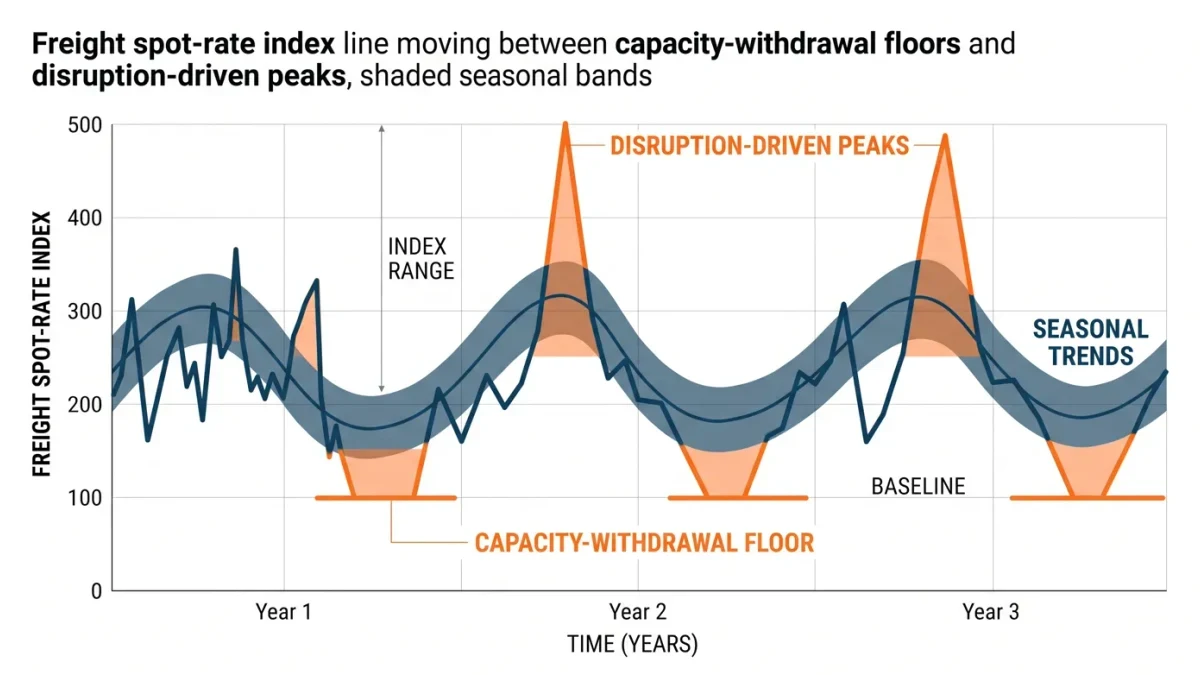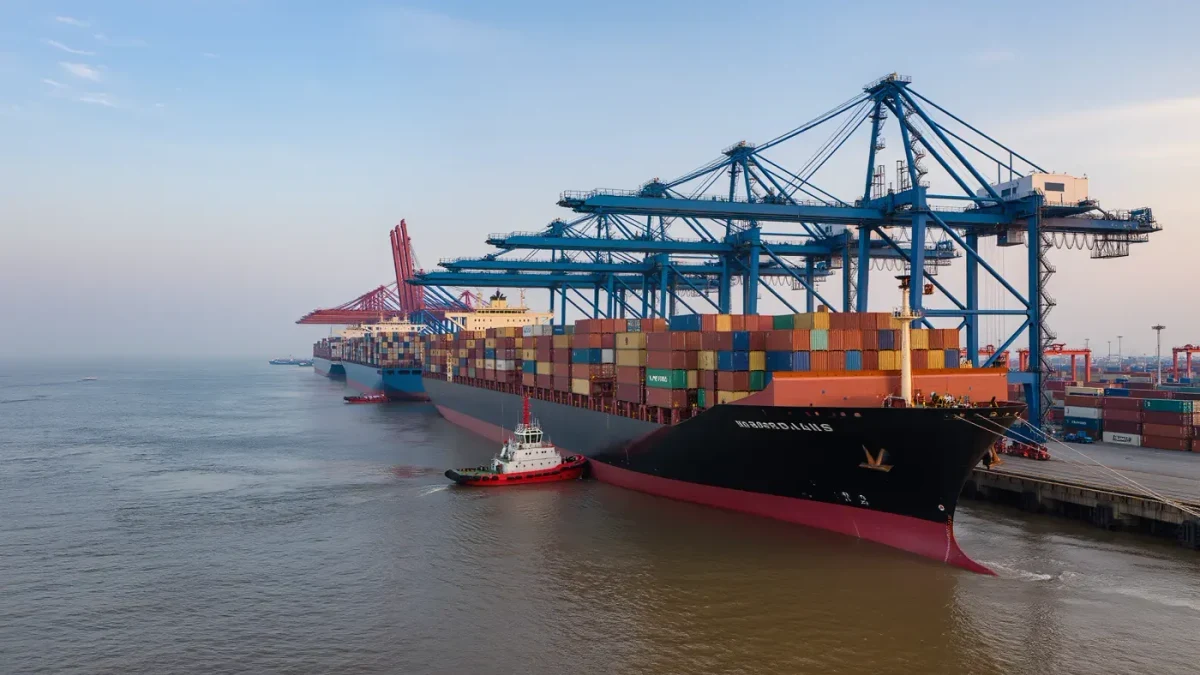
Every imported shirt carries a container in its price, and per spot-rate data the Bureau of Transportation Statistics maintains for eastbound transpacific lanes, that container's price is the most volatile line in the garment's cost sheet — ranging from roughly $1,700 to $3,000 or more per forty-foot box on West Coast lanes per freight-index data cited through early 2026, with disruption spikes far above. Freight is small next to fabric but enormous next to margin: per the sourcing arithmetic analysts publish, a garment's freight share looks trivial until a rate doubling wipes out the entire planned margin of a basics program.
How is a container rate divided among shirts?
By weight and cube, mechanically. A forty-foot container holds roughly 50,000 to 60,000 cotton t-shirts, so a $2,500 rate adds four to five cents per shirt; at 20,000 heavier denim jackets, it adds twelve cents. The arithmetic explains why freight volatility is felt hardest at the cheap end of the assortment: on a $30 shirt, five cents is noise, but on a $7.50 promotional tee it can be the whole profit. Per the landed-cost breakdowns sourcing analysts maintain, freight typically runs a low single-digit percentage of garment cost — which is exactly why a doubling of the rate moves the promotional tier from profitable to markdown.
Why is spring the unpredictable season?
Because contract and spot rates diverge when the fall merchandise moves. Brands shipping autumn production book annual contracts months ahead; the spring window is where spot exposure concentrates, because replenishment orders — the re-orders that keep best-sellers in stock — ship when they ship, at whatever the lane charges that week. Per the rate structures the federal data tracks, eastbound transpacific spot rates respond within weeks to capacity changes, port congestion and tariff-driven volume shifts, all of which were active through early 2026. A replenishment-dependent brand is a spot-rate taker; that is the structural fact behind spring freight anxiety.
What did tariffs change in the freight math?
More than rates did. Per the import volumes University of Delaware analysis compiles from official data, US apparel import values contracted sharply through 2025 into 2026 as tariffs suppressed orders — and falling volume is, in the short run, freight deflation, since fewer containers chase the same vessel space. Per the rate indexes cited through early 2026, transpacific rates sat well below their disruption-era peaks even as the container index rose year over year. The paradox for brands: tariff-driven import weakness is currently holding their freight costs down, a subsidy of sorts that evaporates the moment import demand recovers.
What can a brand actually do about it?
Three levers, all familiar and all costly. Longer-term contracts buy rate certainty at the price of volume commitments a soft-demand market punishes. Nearshoring trades ocean freight for higher unit labor, sensible for replenishment-driven categories and wrong for cost-driven ones. And packing density — the unglamorous discipline of fitting more garments per container — is the only lever that pays at every rate level, which is why per the industry's own practice, carton specifications are fought over internally with a passion outsourced observers never guess. Freight cannot be controlled; it can only be positioned for, and the brands that survived the last disruption cycle are the ones that did the positioning before the rate board moved.