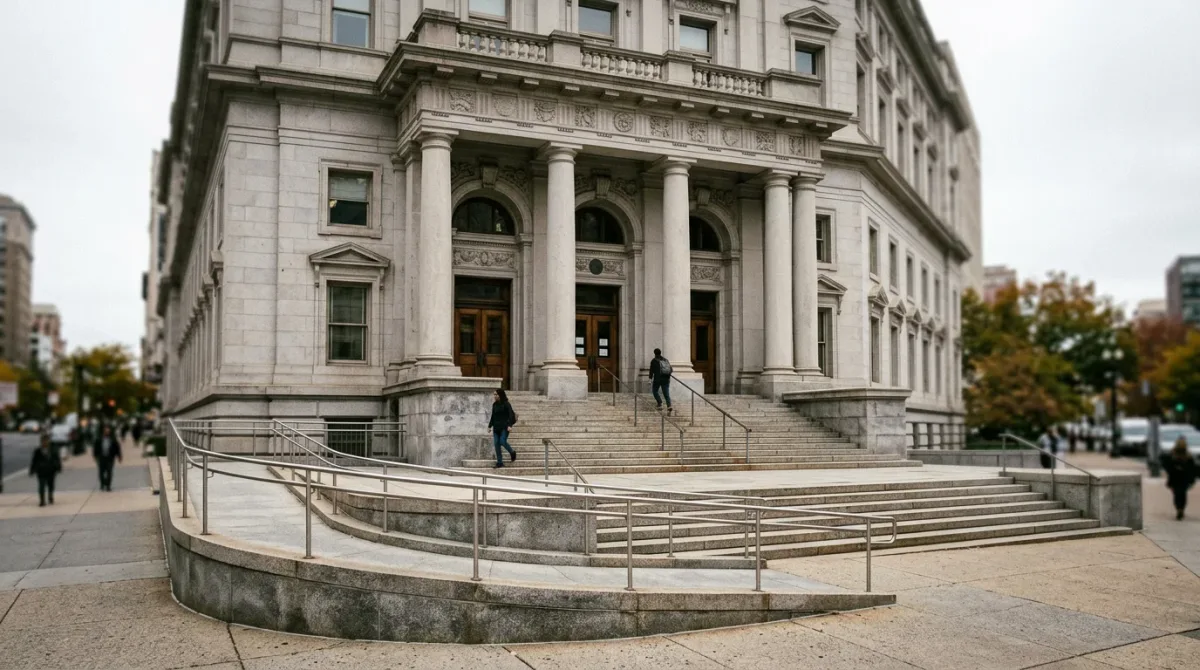
State and local governments must make their websites and mobile apps meet WCAG 2.1, Level AA, a specific technical standard covering captions, screen-reader compatibility, and keyboard navigation, under a Department of Justice rule finalized in April 2024 — but the deadline to comply, originally April 2026 for larger entities, is now April 26, 2027, after DOJ granted a one-year extension in April 2026.
The rule is the first time Title II of the Americans with Disabilities Act has been paired with a named, enumerated technical standard rather than a general nondiscrimination mandate. Before 2024, DOJ treated web inaccessibility as a Title II violation case by case, without specifying which guidelines satisfied the law. The final rule, published in the Federal Register on April 24, 2024, closed that gap: it named WCAG 2.1 AA — the Web Content Accessibility Guidelines maintained by the World Wide Web Consortium — as the measurable bar for compliance, in a DOJ fact sheet on the rule.
The rule sorts covered entities by population. State and local governments serving 50,000 or more residents originally had until April 24, 2026, to comply; smaller jurisdictions and special districts had until April 26, 2027. On April 20, 2026, DOJ published a notice in the Federal Register extending both deadlines by one year: large entities now have until April 26, 2027, and small entities and special districts until April 26, 2028.
What does WCAG 2.1 AA actually require?
The standard covers how web content and mobile apps present information to users with disabilities. DOJ's fact sheet describes the requirement as covering captions for video, transcripts or alternative descriptions for audio, text that works with screen readers, and interfaces that function without a mouse. WCAG itself, maintained by the World Wide Web Consortium's Web Accessibility Initiative, organizes those requirements under four principles: content must be perceivable, operable, understandable, and robust across assistive technology. Level AA sits in the middle of WCAG's three conformance tiers, above the minimum Level A and below the more demanding Level AAA, which DOJ did not adopt for this rule.
The rule applies whether a government entity builds its own digital services in-house or contracts them out to a vendor — outsourcing does not exempt an agency from the requirement, and the underlying obligation runs to the government entity even when a third party wrote the code. "Web content" under the rule covers text, images, sound, video, and documents; "mobile apps" covers downloadable software built to run on phones and tablets. Both categories are covered whether the government entity hosts them directly or arranges for someone else to provide them on its behalf.
The rule does carve out specific exceptions. Archived web content kept solely for reference or recordkeeping, unchanged since it was archived and clearly labeled as such, is exempt. So are preexisting conventional electronic documents — word-processing files, PDFs, spreadsheets, and presentations — posted before an entity's compliance deadline. Content that members of the public post independently, such as comments on a government social media page, is not itself covered, though the platform hosting it must be. Individualized, password-protected documents tied to a specific person's account, property, or benefits are also excluded, as are government social media posts made before the compliance date.
Why did DOJ push the deadline back?
DOJ's stated rationale, laid out in the April 2026 Federal Register notice, is that the department “overestimated the advancement and availability of technology” available to covered entities. The notice cites resource and staffing constraints among state and local governments and states that generative artificial intelligence tools cannot yet reliably automate accessibility remediation at the scale the rule demands. The extension applies only to the compliance timeline — it does not change the WCAG 2.1 AA standard itself, the population thresholds, or the underlying legal obligation under Title II. DOJ also left a public comment period open on the extension, running through June 22, 2026, meaning the new dates are not necessarily final.
School and local-government administrators had pressed for the delay. Sasha Pudelski of AASA, the School Superintendents Association, told NPR that districts already operating under financial strain were struggling to afford the remediation costs of retrofitting existing digital systems — older course-management platforms, archived instructional video, and legacy student portals — on the original timeline.
What does the pushback from disability advocates argue?
Disability rights organizations opposed the extension on the record, and their objections form the strongest counterargument to DOJ's timeline. Corbb O'Connor of the National Federation of the Blind of Minnesota said the delay meant “the blind have been told to wait to live on terms of equality,” noting that web accessibility guidelines have existed in some form since 1999 — longer, he argued, than the technology excuse can account for. Katy Washington, president of AHEAD, an association of higher-education disability service providers, said the delay “slows critical momentum and leaves institutions without the clarity needed to fully realize equitable access.” Jennifer Mathis, who worked on the original rulemaking, called the postponement “mindless and cruel” given what she described as sixteen years of process behind the rule.
Both sides are arguing about timing, not substance: no party in the public record disputes that WCAG 2.1 AA is the correct standard, or that state and local governments are ultimately bound by it. The dispute is entirely over how much runway compliance requires, and DOJ's own notice acknowledges the criticism is about pace rather than principle by keeping the standard and thresholds intact while moving only the calendar.
What does this change?
For the roughly three years between now and the new deadlines, the legal obligation exists but the specific technical deadline has not yet arrived, so enforcement leverage rests on whatever a complainant can establish under Title II's general nondiscrimination standard rather than a missed WCAG deadline. DOJ directs residents who encounter an inaccessible government website or app toward its ADA Information Line or its online complaint process — that channel does not change with the extension, and it predates the 2024 rule.
The bigger signal is precedential. This is DOJ's second look at implementation costs for a rule it had already finalized after extensive rulemaking, and the department chose to revisit a deadline rather than the underlying standard. Whether the June 2026 comment period produces further schedule changes, or whether April 2027 and April 2028 hold, is what the record supplied so far does not resolve. What the record does establish is that the technical bar those dates lead to — WCAG 2.1 Level AA, on every covered government website and app — has not moved since 2024.
This explainer covers the federal rule governing government websites specifically; it does not address the separate body of Title III litigation over private-sector websites, which proceeds under different, less specific case law, or answer whether a particular website currently complies.
For a related policy perspective, read How a Federal Government Shutdown Actually Works.
For more context, read YouTube raises new-channel monetization to 8,000 watch hours.
For more context, read photography.
For more context, read jewelry.