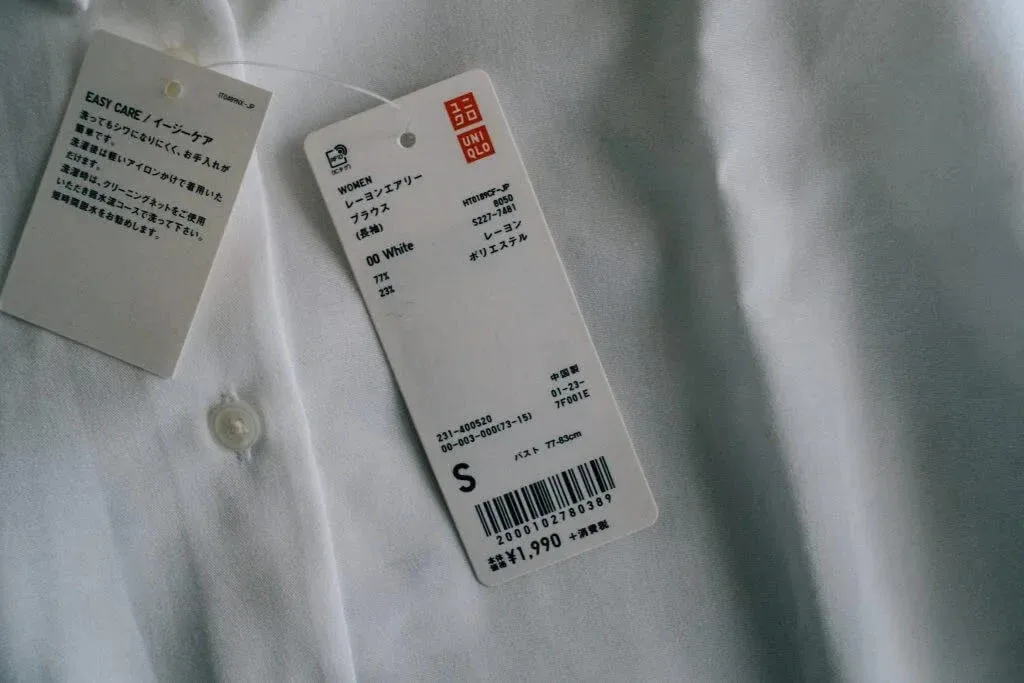
Item-level RFID is a system of passive radio tags built into a garment's care label or hangtag that let a reader count an entire rack of stock in seconds without unfolding or scanning a single item individually; apparel suppliers and retailers including Nike, PVH Corp., Kohl's, and Macy's tested a serialized version of this system together in 2019, in a project coordinated by Auburn University's RFID Lab.
What Makes RFID Different From a Barcode?
A barcode carries one fact: what the item is. A retail associate has to hold each tag in front of a scanner, one at a time, in direct line of sight. Radio-frequency identification instead uses a radio signal to read a chip's stored data without a scanner ever seeing the tag, according to GS1 US, the standards body that governs the identifiers behind both systems.
That distinction is the whole business case. Because an RFID reader does not need a clear sightline, it can register a tag sitting inside a folded stack of sweaters, inside a shipping carton, or on a hanger buried mid-rack. GS1 US describes this as the core advantage of RAIN RFID, the passive UHF variant apparel uses: automatic, high-speed data capture without direct scanning, even when tags are not visible, such as inside a container or a stack of folded units.
A store associate doing a barcode cycle count still has to pick up, orient, and scan each unit in turn, which is why full-floor counts historically happened rarely and imprecisely. A reader capable of registering many tags in a single pass changes what counting a rack even means: instead of a sample or an estimate, it becomes a full census, taken as often as staff choose to run it.
How Does an RFID Tag Actually Work?
An RFID tag has no battery. Its inlay is a microchip bonded to a small antenna on a thin substrate, and it does nothing until a reader antenna sends it a signal. That signal both powers the chip and asks it to respond, per GS1 US's technical description of the system's four components: tags, antennas, readers, and the host software that stores what gets read.
Once powered, the chip transmits the Electronic Product Code, or EPC, held in its memory back to the reader, which forwards it to the retailer's inventory system. Apparel tags overwhelmingly use passive construction rather than battery-powered active tags, since a passive inlay is cheaper to produce and never needs replacing. The identifiers themselves follow the GS1 EPC Gen2 and ISO/IEC 18000-63 standards, which is what lets a tag printed by one supplier be read correctly by a reader built by a different manufacturer.
Why Did Apparel Retailers Move to Item-Level Tagging?
Retail had used RFID at the pallet and case level for years before it moved down to the individual garment. The harder problem was proving that a serial number assigned to one specific hoodie could stay attached to accurate data as that hoodie moved from factory to distribution center to store floor to point of sale, with every handoff recorded correctly.
That is what the CHain Integration Project, or CHIP, set out to test. Over 2019, Auburn University's RFID Lab worked with Nike, PVH Corp., HermanKay, Kohl's, and Macy's on a proof of concept that connected serialized RFID data across that full chain using a Hyperledger Fabric blockchain foundation, according to the lab's published research. The goal, in the lab's framing, was integrating data streams from source to store and connecting touchpoints that had previously stayed isolated in separate systems. Retailer, brand, and distribution-center participation in a single pilot is itself notable: apparel supply chains rarely get competitors as large as Kohl's and Macy's testing shared infrastructure together, which is part of why the project's findings carried weight beyond any one company's internal pilot.
The economic argument for doing this predates CHIP. Auburn's RFID Lab, working with GS1 US and the American Apparel and Footwear Association, had already studied item-level RFID quantity auditing at apparel supplier distribution centers, examining inventory accuracy, shipping accuracy, and what it costs a supplier to reach high accuracy using the technology. That earlier research gave retailers a documented basis for the audits and cost models they still use to justify tagging programs today.
What Does an RFID Tag Cost to Make and Certify?
Not every inlay that claims to work performs consistently once it is sewn into fabric and run through a warehouse conveyor thousands of times. Auburn's RFID Lab addresses that through its ARC program, which tests and certifies RFID inlays against a performance bar. The program exists, in the lab's own description, to ensure that RFID tags meet or exceed the levels of performance and quality necessary to provide benefit to the end user in a consistent and cost-effective manner.
Avery Dennison, which holds ARC certification from Auburn, is now the case study for how far the supply side of this market has scaled. Following its acquisition of the Smartrac transponder division, the company's combined RFID business generates more than $500 million in annual revenue, and Avery Dennison describes itself as the world's largest manufacturer of UHF RFID tags, according to a company release distributed on PR Newswire. That release also disclosed the company's total 2019 revenue of $7.1 billion across roughly 30,000 employees in more than 50 countries — context for how large the overall business is relative to the RFID segment growing inside it, and for why a single supplier's capacity decisions can move availability for the whole apparel industry.
Who Is Building the Supply for This?
The same release announced Avery Dennison's fifth global RFID manufacturing plant and its first in Brazil, in Vinhedo, São Paulo, inaugurated in 2021 to serve rising Industry 4.0 demand across South America. The facility produces RFID inlays using chips sourced from partners Impinj and NXP, and the company named retail, fashion, beauty, food, healthcare, and aviation as the sectors it expected to draw on that capacity, per the release.
That geographic spread matters for a simple reason: an item-level tagging program only works at the scale apparel retailers need if inlays can be manufactured and certified in enough volume, in enough places, to reach every supplier feeding a chain the size of Kohl's or Macy's. The standards from GS1 US make a tag readable anywhere; the ARC certification from Auburn makes it reliable; and manufacturers building out plants on multiple continents are what makes tagging every unit financially workable rather than a pilot-only exercise.
The earlier GS1 US and American Apparel and Footwear Association research on quantity auditing at supplier distribution centers, run through Auburn's RFID Lab, is what gave retailers a documented cost basis before any of this manufacturing scale existed. That study looked specifically at what it takes a supplier to hit high inventory and shipping accuracy using item-level tags, and it provided tools suppliers could use to calculate their own return on investment rather than taking a vendor's word for it — the kind of independent groundwork that made later commitments, like CHIP and Avery Dennison's expanded manufacturing footprint, a lower-risk bet for the retailers who eventually signed on.
| Capability | Traditional Barcode | Passive UHF RFID (RAIN) |
|---|---|---|
| Read method | Requires direct line of sight to a scanner | Reads via radio signal; line of sight not required, per GS1 US |
| Items read per pass | One at a time | Multiple tags in a single reader pass, per GS1 US |
| Governing standard | GS1 barcode symbologies | GS1 EPC Gen2 and ISO/IEC 18000-63, per GS1 US |
| Independent tag certification | Not applicable | Auburn University RFID Lab's ARC program |
None of this replaced the barcode outright — most garments still carry one for point-of-sale checkout. What changed is that the stockroom count, the shipment audit, and the supplier's proof that the right quantity left the distribution center no longer depend on a person handling every unit. That is the shift Auburn's research and the CHIP pilot with Nike, PVH Corp., HermanKay, Kohl's, and Macy's were built to document, and it is why a technology apparel treated as a warehouse tool for pallets has moved down to the individual hoodie on the rack.
For a related design perspective, read How Item-Level RFID Tagging Is Rebuilding Inventory Accuracy in Apparel.
For more context, read Why RFID Took Over the Stockroom, and What It Replaced.