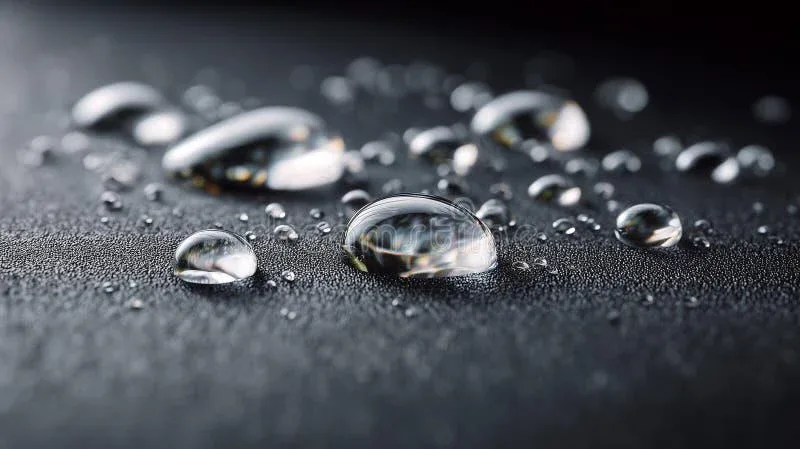
A durable water repellent, or DWR, is a surface finish that lowers a fabric's critical surface energy so rain beads and rolls off instead of wetting the yarn. For decades that finish was fluorinated. New York now prohibits the sale of new apparel containing intentionally added PFAS, a restriction its Department of Environmental Conservation says took effect on January 1, 2025.
What Is a DWR Finish Actually Doing to the Fabric?
It is coating fibers, not sealing cloth. A DWR is applied topically — usually by pad-bath and cure — so it wraps the individual filaments and leaves the spaces between yarns open, which is why a treated shell still passes air and vapor while a laminate or coating does the actual waterproofing. Strip the DWR and a garment does not leak through a seam; it wets out, the face fabric saturates, and vapor transfer collapses.
The chemistry doing the work has a name. California's Department of Toxic Substances Control, in its product-chemical profile on PFAS textile treatments, identifies the relevant subclass as side-chain fluorinated polymers — "fluorinated acrylate, methacrylate, urethane, oxetane polymers" — in which a polymer backbone anchors to the fiber and fluorinated side chains orient outward to form the presented surface.
That orientation is the entire mechanism. Water meets a dense field of low-energy end groups rather than the cellulose or polyester underneath, and beads instead of spreading. The finish does one thing: it changes what the droplet touches.
Why Did Fluorine Do the Job So Well, and Why Is It Being Removed?
Because carbon-fluorine bonds sit at the bottom of the surface-energy scale, and because that same stability is what regulators object to. DTSC's profile states that "the bonds between the carbon-fluorine (CF3 and CF2) groups present in PFASs create very low critical surface energy, resulting in lipophobic and hydrophobic characteristics" — repelling oil and water at once, which is why the chemistry became standard for stain resistance as well as rain.
Chain length is the industry's shorthand for the regulatory history. PFOA and PFOS, DTSC notes, "are referred to as 'C8' because they contain eight carbon atoms in their molecules"; the same profile records that 3M announced in 2000 it was discontinuing Scotchgard, then based on C8 chemistry, and reintroduced a reformulated version 16 months later. The industry's move to shorter chains was a response to that first wave, not a departure from fluorine.
The durability argument then runs the other way. Side-chain fluorinated polymers can degrade to shorter-chain fluorinated compounds and, eventually, to perfluoroalkyl acids, per DTSC — so the finish on a jacket is also a reservoir. The Environmental Protection Agency's summary of PFAS risks states that many PFAS "break down very slowly and can build up in people, animals, and the environment over time," lists stain and water repellents on clothing and other fabrics among their uses, and cites reduced immune response and developmental effects in children among identified outcomes. EPA also notes that surveys by the Centers for Disease Control and Prevention show most people in the United States have been exposed to some PFAS.
What Do the Apparel Bans Actually Prohibit?
Intentionally added PFAS in clothing sold as new, in two phases, with technical outerwear carved out until later. New York's law, as summarized in the state's PFAS in Apparel Law guidance, provides that from January 1, 2025 "no person shall sell or offer for sale in this state any new, not previously used, apparel containing PFAS as intentionally added chemicals," and extends the restriction to outdoor apparel for severe wet conditions from January 1, 2028.
The definitions carry the compliance burden. DEC's summary defines apparel expansively — undergarments, shirts, pants, skirts, dresses, vests, dancewear, suits, saris, scarves, tops, leggings, leisurewear, formal wear, outdoor apparel, onesies, bibs and diapers — and treats an "intentionally added chemical" as one that "serves an intended function or technical effect in the product or product component," including intentional breakdown products. A finish applied on purpose is squarely in scope; the harder questions are residues arriving from elsewhere in the chain.
The severe-wet-conditions category is narrow by design. DEC describes it as covering "extreme and extended use products for applications that provide protection against extended exposure to extreme rain conditions or against extended immersion in water or wet conditions, such as from snow" — waterproof rather than water-resistant, safety-driven. A rain trench for commuting is not that; a survival shell for exposed alpine work is.
Enforcement runs through paperwork. Rather than filings to the state, DEC's summary describes compliance certifications: written statements retailers obtain from manufacturers documenting PFAS compliance, held on site and not submitted to the agency. That pushes the evidentiary work onto vendor-manual language and mill documentation, where most sourcing teams keep it.
What Do PFAS-Free Finishes Give Up?
Oil repellency, mainly, and endurance under sustained heavy rain. Reporting by Time in 2023 quoted Richard Blackburn, professor of sustainable materials at the University of Leeds, to the effect that workable water-repellent alternatives exist but that combining water and oil repellency remains technically unfeasible without PFAS. For a rain shell that distinction is tolerable; for workwear, hospitality uniforms and upholstery specified against staining, it is the whole specification.
The wet-weather limit is the second constraint. In the same reporting, Fjällräven sustainability director Aiko Bode described paraffin- and beeswax-based alternatives as performing well in light moisture while conceding that in extended heavy rainfall "you will not be dry." Any performance figure a mill or brand attaches to a fluorine-free finish is that supplier's claim until an independent test method and body are named alongside it.
Market scale is harder to pin down than the chemistry, and the available public numbers are old. DTSC's profile cites a 2008 Danish estimate that at most 10 percent of treatments for textiles and leather contained PFASs, and records roughly 50 new treatment product releases identified in a September 2019 search of a commercial new-products database over the preceding five years. Neither figure describes the 2026 market; both indicate that treated goods were always a slice of the category rather than the whole of it.
Who Committed to Switching, and by When?
Most of the outdoor majors announced end dates between 2019 and 2025, ahead of the statutes. The timeline below is drawn from company commitments as reported by Time in February 2023; several of the dates have since passed, and whether each was met is a matter for current company disclosures rather than that reporting.
| Company or jurisdiction | Stated PFAS phase-out |
|---|---|
| Jack Wolfskin | "100% PFC-free" by mid-2019 |
| Vaude Sport | PFC-free by 2020 |
| Lululemon Athletica | End of 2023 |
| Patagonia | End of 2024; 78% of materials reported achieved as of the 2023 reporting |
| W. L. Gore & Associates | "Vast majority" of portfolio by end of 2025 |
| New York, California, Washington | Apparel restrictions beginning 2025 |
| Maine | Complete ban by 2030 |
The pattern matters more than any single date. Brands whose products live in light-to-moderate wet conditions moved first and fastest; the holdouts clustered where oil repellency or extended immersion is part of the promise, which is precisely the boundary New York drew when it deferred severe-wet-conditions outerwear to 2028.
What Changes in Sourcing?
The finish becomes a documented input rather than a mill default. Because the New York restriction turns on intentional addition and is policed through manufacturer certifications held by the retailer, the practical work is contractual: naming the finish chemistry in the tech pack, requiring the supplier statement DEC describes, and deciding where residual-PFAS testing is worth its cost.
Product development absorbs the rest. A fluorine-free finish generally asks for a tighter face fabric, more attention to yarn and construction, and honest care instructions, since heat reactivation and washing regimes affect how these finishes behave. None of that is exotic; it is the ordinary consequence of removing a chemistry that had been compensating for the fabric underneath it.
And the labeling question stays open. DEC's public summary of the apparel law addresses certifications rather than consumer-facing labels, so a garment can be compliant without saying so on the hangtag — which means, for now, that a PFAS-free claim on a label is a marketing decision, not a regulatory one.
For a related style news perspective, read 24FASHION IS A NEW GLOBAL FASHION NETWORK AND TV CHANNEL ON AMAZON FIRE TV AND ROKU TV.