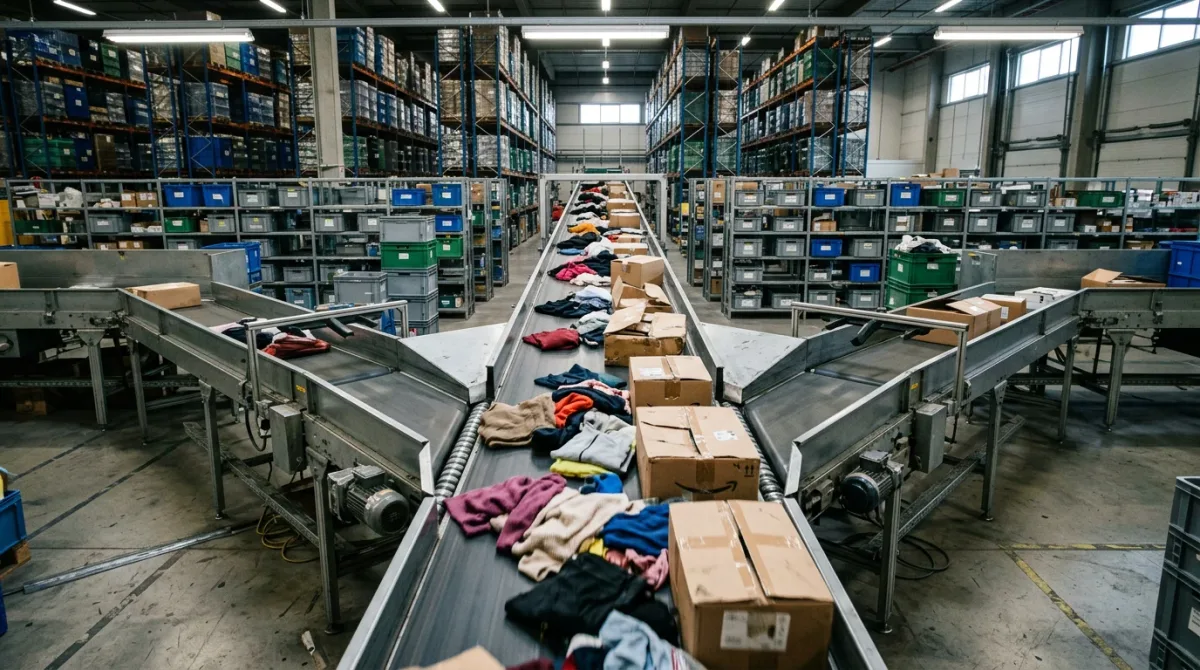
A retail return is a reverse supply chain, not a refund line, and in the United States it now moves an estimated $849.9 billion of merchandise a year — 15.8 percent of annual sales, and 19.3 percent of online sales — according to the 2025 Retail Returns Landscape published by the National Retail Federation and Happy Returns in October 2025. The fees arrived because that channel has to be paid for.
The figures come from two surveys the two organizations ran in summer 2025: 2,006 consumers who had returned an online purchase in the previous twelve months, and 358 ecommerce professionals at merchants with more than $500 million in revenue. They describe a system that has been growing at the same time as the industry's ability to account for what happens at the end of it has not.
How big is the returns channel, and what moves through it?
Roughly one dollar in six. The NRF and Happy Returns put 2025 returns at $849.9 billion, or 15.8 percent of sales, with online purchases returned at 19.3 percent and holiday-season merchandise expected to come back at about 17 percent. Apparel sits at the high end of that distribution for the obvious structural reason: fit is decided after delivery.
That gap between the online rate and the overall rate is the whole story of the last decade of retail operations. A store sale ends at the register. An ecommerce sale ends, on average, only after a second shipping leg has been priced, a garment has been inspected, and a disposition decision has been made about whether it can be sold again at full price.
The same report attributes 9 percent of all returns to fraud. Retailers surveyed named overstated quantity (71 percent), empty or fake boxes (65 percent), and counterfeit items (64 percent) as the most common practices they encounter, and 85 percent said they use artificial intelligence to detect or prevent return fraud. Those are retailer-reported figures, not audited ones, and the report presents them as such.
Why did free returns stop being free?
Because the cost is real and the volume stopped being marginal. By December 2025, mail-in return fees were standard at large apparel and department chains: ABC News reported on December 9, 2025 that Marshalls and T.J. Maxx charged $11.99 per returned package, Macy's roughly $9.99 to $10, JCPenney $8, and J. Crew $7.50, citing the National Retail Federation's finding that nearly three-quarters of stores now charge some form of return fee.
The structure of those fees is the informative part. In each case reported, returning the item to a physical store removed the charge, and Macy's loyalty members were exempt. The fee is not priced as a penalty on returning; it is priced against the specific leg of the journey that costs the retailer the most, which is the individually shipped parcel travelling backwards through a network built to move pallets forwards.
| Retailer | Mail-in return fee (December 2025) | Fee if returned in store |
|---|---|---|
| Marshalls | $11.99 per package | None |
| T.J. Maxx | $11.99 per package | None |
| Macy's | About $9.99 to $10 | None |
| JCPenney | $8 | None |
| J. Crew | $7.50 | None |
Fees as reported by ABC News, December 9, 2025, for the 2025 holiday season; policies are revised seasonally.
Retailers have not framed this as a retreat from service. Katherine Cullen, the NRF's vice president of industry and consumer insights, said in the association's October 2025 announcement that returns are an opportunity for retailers to create a positive customer experience that can translate into brand loyalty. The operating reality underneath that position is a fee schedule that steers the return toward the cheapest physical path.
Where do returned garments actually end up?
Nobody can say precisely, and that is a documented finding rather than an inference. In its December 2024 report on textile waste, the Government Accountability Office concluded that federal textile-waste data is thin: there is no national requirement for states to report municipal solid waste data, waste characterization studies are expensive and infrequently updated, and private sorters and graders do not track or publicly report what they reuse or recycle.
What is measured is the aggregate. The Environmental Protection Agency estimates that 17 million tons of textiles were generated in 2018 — 5.8 percent of total municipal solid waste that year — of which 2.51 million tons were recycled, 3.22 million tons were combusted with energy recovery, and 11.3 million tons were landfilled, a recycling rate of 14.7 percent. That 2018 figure remains the most recent year in the EPA's published material-specific textiles data.
The direction of travel is clear even where the resolution is poor. The GAO report records an increase of more than 50 percent in textile waste between 2000 and 2018 on EPA figures, alongside International Trade Administration data showing a 182 percent rise in textile and apparel imports between 2000 and 2023. The GAO also notes that landfills were the third-largest source of human-related methane emissions in the United States in 2022.
One caution matters here, and the industry frequently elides it: none of this federal data isolates returned merchandise from textiles discarded by households. A returned garment that is resold, liquidated, or discarded enters the same undifferentiated stream. Claims that a specific share of returns is landfilled do not come from these datasets.
What changes when producers have to pay for disposal?
The cost of the last stage moves onto the balance sheet of the company that made the garment. California's Responsible Textile Recovery Act, SB 707, requires apparel and textile producers to join an approved producer responsibility organization, fund reuse, repair, and recycling infrastructure, and ensure collected textiles are reused, repaired, or recycled, according to CalRecycle, the state agency administering the program.
The covered-product definition is broad. Per the statute's provisions as summarized by CalRecycle, it reaches clothing and fashion accessories as well as household textiles: curtains and window coverings, towels, bedding, linens, tablecloths, napkins, blankets and pillows. A brand cannot exit the obligation by reclassifying a product line as homeware.
| Milestone | Date |
|---|---|
| Landbell USA approved as sole producer responsibility organization | February 27, 2026 |
| All producers must join an approved PRO | July 1, 2026 |
| PRO submits initial needs assessment | March 2027 |
| CalRecycle regulations take effect | July 1, 2028 |
| PRO must have an approved plan | July 1, 2030 |
| Full plan implementation | 2031 |
Timeline per CalRecycle's textile stewardship program page.
What does this mean for how retailers run the channel?
Two pressures now push in the same direction. The fee schedules make the reverse leg visible to the customer at the moment of the return, and extended producer responsibility makes the disposal leg visible to the brand years after the sale. Both convert what used to be an unpriced externality of the ecommerce model into a line item with a named owner.
The sequencing is slow by design. The California program does not reach full implementation until 2031, and the GAO reports that most federal efforts on textile waste began within the last five years, with the EPA planning a national textile recycling strategy on a five-to-ten-year horizon. Merchandising decisions made now — size-range accuracy, fit data, fabric that survives a second inspection — land inside that window.
The channel itself will not shrink on its own. As long as fit is decided after delivery, apparel will return at rates in the high teens, and the operating question is not how to eliminate the reverse flow but how much of each returned unit's value can be recovered before the item reaches a waste stream nobody currently measures well.
For a related style news perspective, read 24FASHION IS A NEW GLOBAL FASHION NETWORK AND TV CHANNEL ON AMAZON FIRE TV AND ROKU TV.