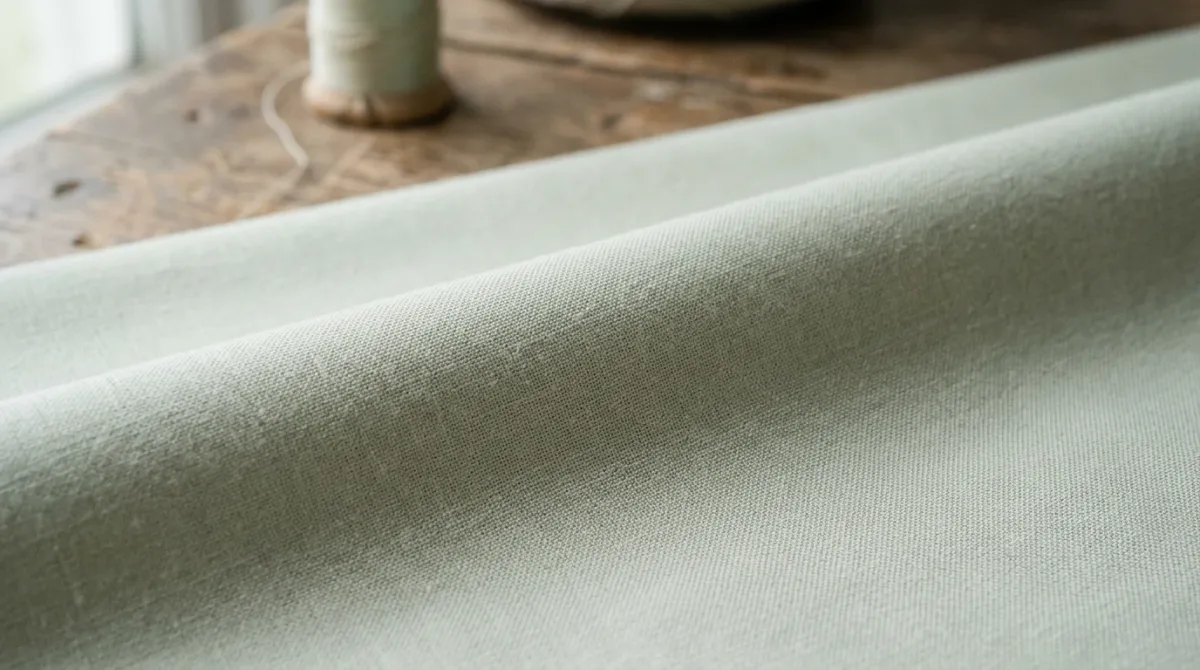
Wrinkle resistance in cotton is achieved by cross-linking — a resin finishing process in which a chemical, historically a formaldehyde-releasing agent, forms covalent bonds between neighboring cellulose molecules so the fiber's hydrogen bonds, the ones that reset into creases, can no longer rearrange freely. The treatment is described in standard textile-chemistry references and is the same chemistry behind the "durable press" standards codified by AATCC and ASTM test methods since the 1960s. The cost is documented in the same literature: cross-linking lowers cotton's tensile strength, sometimes by double-digit percentages, which is why non-iron shirts trade smoothness for a measurable loss of tear strength.
Why does cotton wrinkle in the first place?
Because of hydrogen bonds — the weak, constantly re-forming attractions between cellulose chains. When cotton bends, those bonds break and reform in the new position; a crease is simply the fiber set in a bent configuration with its hydrogen bonds re-formed around it. Moisture accelerates the process — water disrupts the bonds, letting them reset — which is why steam removes wrinkles and humidity creates them. Wool, by contrast, recovers because its protein chains are joined by stronger disulfide and covalent links that pull the fiber back toward its shape; cotton has no such spring. The entire durable-press industry exists to give cotton one.
What does the treatment actually do?
The documented process, per standard finishing literature:
- The fabric is padded with a solution of a cross-linking resin — DMDHEU (dimethylol dihydroxyethyleneurea) became the industry's dominant workhorse after earlier urea-formaldehyde systems were regulated and reformulated.
- A catalyst is added; the fabric is dried to remove water without starting the reaction.
- Curing at elevated temperature — typically in the 150-160°C range, per finishing-equipment documentation — triggers cross-linking inside and between the cellulose chains.
- The fabric is washed and finished; the new covalent bridges hold the cellulose in place through bending, washing, and wear.
The chemistry does one thing: it locks the cellulose network so hydrogen bonds cannot rebuild around a crease.
What does the treatment cost the fabric?
Three documented trade-offs, all in the textile-chemistry literature:
| Property | Effect of cross-linking |
|---|---|
| Tensile and tear strength | Losses commonly reported in the 20-50 percent range, depending on resin level |
| Abrasion resistance | Reduced, following the strength loss |
| Free formaldehyde potential | Legacy issue; modern low-formaldehyde and formaldehyde-free resins reduce but, per certification limits rather than eliminations, manage it |
The strength loss explains a familiar garment fact: non-iron dress shirts often wear through at collar points and cuffs before their untreated equivalents would, because the finish that keeps them smooth also embrittles the fiber. Finishing engineers tune resin load to land between the AATCC smoothness grades buyers specify and the strength minimums mills must meet.
Whose claim is whose?
A greenwashing-adjacent note this desk holds to: "formaldehyde-free" and "non-iron" are marketing words whose technical content is set by standards, not adjectives. Oeko-Tex's Standard 100 sets limits for formaldehyde release by product class — infant items at the strictest, not-detectable tier — and compliance is a certification claim, verifiable against the certificate number, not a blanket purity statement. The label says whose claim it is. This paragraph does too.
Why do mills still bother?
Because the consumer value is durable and the alternative — mechanical smoothing — does not survive a wash cycle. Cotton's share of world fiber consumption remained near one-fifth to one-quarter across recent seasons, per Textile Exchange's published materials market reports, and the non-iron segment is one of the few finishes consumers pay a visible premium for at retail. The resin is cheap relative to the price gap between a regular and a non-iron shirt; the chemistry earned its place on the cost sheet. What the literature does not establish is a free lunch: every smoothness grade bought with resin is paid for in strength, and the mill's art is setting the exchange rate.