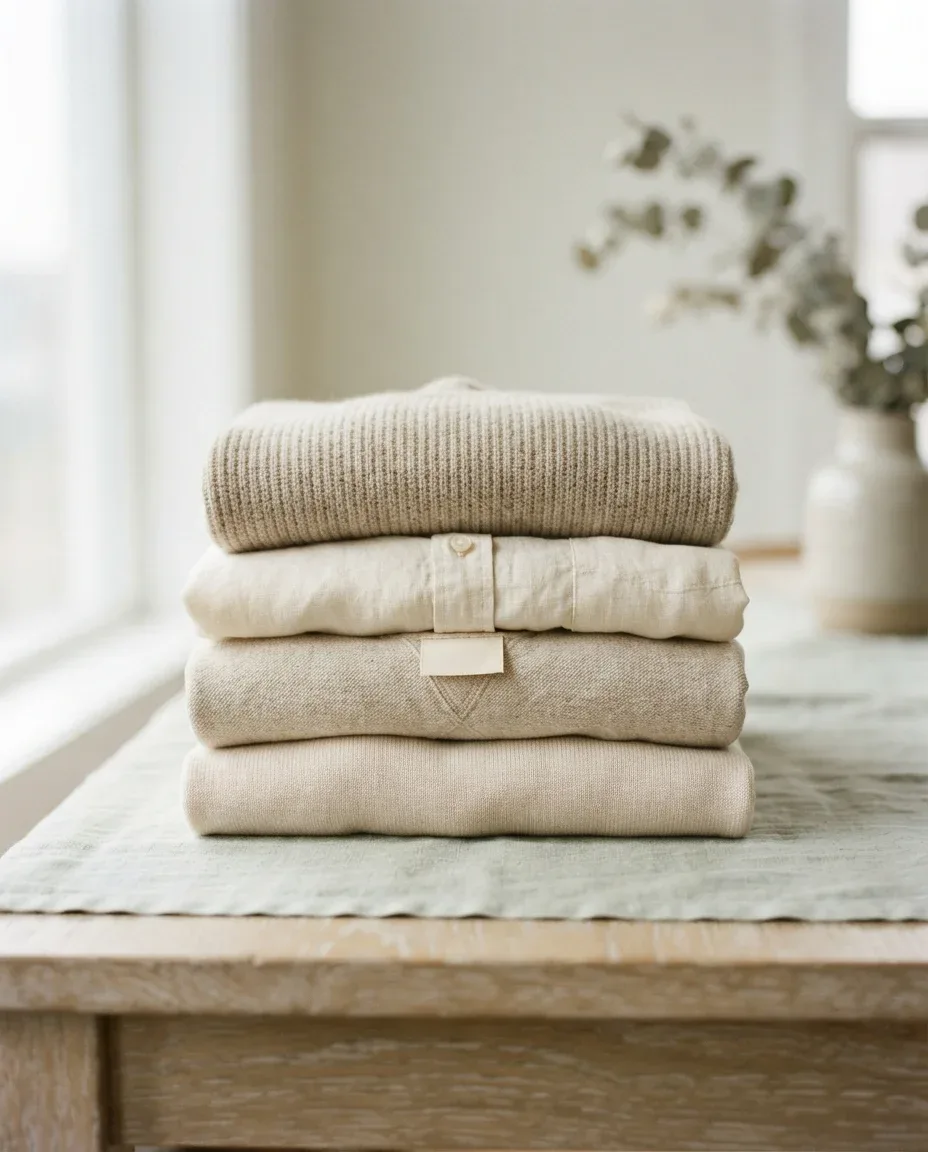
Fiber-content labels are legally required to be accurate: under the U.S. Federal Trade Commission's Textile Fiber Products Identification Act and its rules, garments sold in the U.S. must list fibers by percentage in descending order, and a wrong label is a violation, not marketing. That makes the label the most reliable sentence attached to a garment — more reliable than the price tag's implication of quality. Five fiber names, and one phrase to distrust, carry most of the shopping decision.
This is a digest — a reading skill, not a shopping list, and prices vary by retailer and season.
What does the label have to tell you?
Four things, per the FTC's labeling rules: fiber content by percentage (generic fiber names, or trademarks with the generic name attached), country of origin, the manufacturer or importer's name or registered number, and care instructions under the Care Labeling Rule. Blend ratios matter more than most shoppers think: a "merino blend" can be 20% merino and 80% acrylic, and the descending-order rule lets you check that in two seconds. The first-listed fiber is the majority fiber. That single check kills most misleading hangtag marketing.
Which five fibers do the most explaining?
- Merino wool — fine-grade wool that regulates temperature and resists odor; the Woolmark Company's technical materials document its moisture-handling and natural crimp. A high merino percentage in a knit or base layer is a durability signal.
- Cashmere — undercoat hair from goats, graded by fiber length and thickness; longer, thinner fibers pill less. Label says "cashmere" only if it is, per FTC rules — but the label cannot tell you grade, which is why two 100% cashmere sweaters can differ five-fold in price and lifespan.
- Linen (flax) — strong, cool, stiff until broken in; wrinkles are a property, not a defect. Linen's fiber length makes it durable in plain weaves.
- Cotton, long-staple — label says "Supima" or "Pima" (trademarks for long-staple American cotton); longer fibers mean smoother yarns that pill less than short-staple cotton at the same price.
- Polyester — strong, cheap, shape-stable, and plastic; excellent in blends for stretch and recovery, weak on breathability and it sheds microfibers in the wash, a documented environmental cost per research published in Nature and elsewhere.
What's the phrase to distrust?
"Made with" anything. A label reading "65% polyester, 35% cotton — made with organic cotton" is telling you, in regulated language, that two-thirds of the garment is polyester. The same applies to "made with merino" on a mostly-synthetic knit: the fiber list is the fact, the phrase is the sizzle. The FTC's own enforcement actions against mislabeled bamboo products — rayon derived from bamboo cannot be sold as simply "bamboo" — are a readable map of how this works: when the label and the marketing disagree, the label wins, because it is the part with legal consequences attached.
How do you use the label at the shelf?
A two-step check, in order. First, read the top fiber against the garment's job: breathable fibers for next-to-skin wear, strong plain weaves for outerwear, blends accepted where stretch matters. Second, read the care instructions against your actual behavior — a beautiful dry-clean-only linen has a cost the price tag omits, and the FTC's care data shows ignoring care labels is a leading cause of garment damage. If the fiber order and the price disagree — high listed price on a majority-synthetic garment in a category where naturals dominate — the label just told you what the markup is paying for, and it isn't the material.
For more context, read How to read a clothing label before you buy — Style.