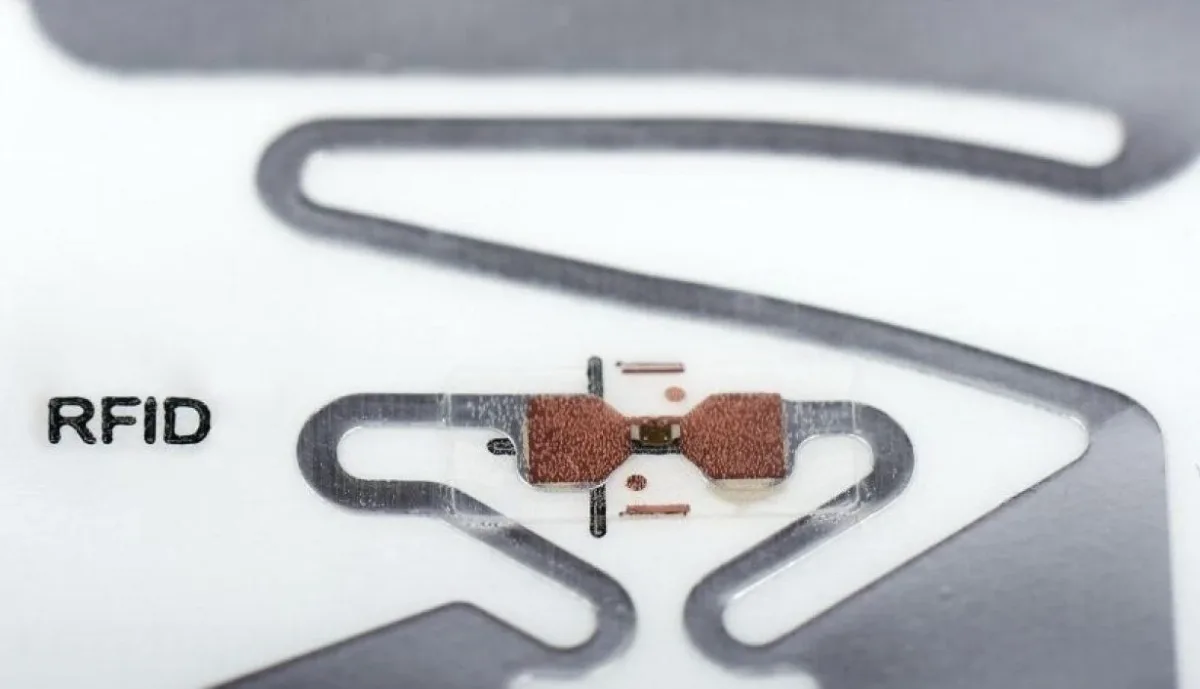
Item-level RFID tagging is a system that embeds a passive radio chip in a garment's price ticket or woven label so a reader can identify that single unit without a hand scan of its barcode. Stores running the technology have reported inventory accuracy above 95%, against roughly 62% in stores relying on manual counts, according to a 2010 survey of apparel retailers including Macy's, Walmart and Kohl's.
How does an RFID tag actually differ from the barcode it's replacing?
A barcode is a printed pattern a scanner has to see; an RFID tag is a chip and antenna that a reader can pick up over radio waves without a direct line of sight. Retail apparel almost always uses passive ultra-high-frequency (UHF) tags — sometimes called RAIN RFID — which carry no battery and are powered by the reader's own signal, according to GS1, the standards body that maintains the numbering system both technologies use.
The tag's chip stores an Electronic Product Code, or EPC, a data structure GS1 defines as a "syntax for unique identifiers assigned to physical objects" that extends the same GS1 keys already printed in barcodes. That continuity matters operationally: a garment's barcode number and its RFID identity trace back to the same underlying record, so switching a store from one to the other does not require rebuilding the product catalog, per GS1's standard.
The practical gain is speed and range rather than a new kind of identifier. A UHF reader can capture tag identifiers "at extremely high rates and at distances well in excess of 10 metres, without line-of-sight contact," per GS1 — meaning a staffer can wave a handheld reader across a rack, or a fixed reader can catalog a bin of stock, in the time a barcode scan would take to process a single folded shirt.
Why did apparel retailers move from pilot programs to full rollouts?
Adoption tracked a fairly ordinary technology curve, from scattered testing to store-wide use, as accuracy data accumulated. At a National Retail Federation panel sponsored by tag maker Avery Dennison, industry figures cited apparel-sector adoption running at 35% proof-of-concept, 22% active piloting, 39% phased deployment and 4% full deployment, alongside a reported 32% year-over-year rise in retailers newly adopting RFID and 42% growth in retailers running proof-of-concept trials, according to WWD's report on the panel.
The figure retailers cared about most was accuracy at the individual stock-keeping-unit level, not just at the category level. Auburn University business dean Bill Hardgrave, who has studied RFID retail deployments, put the stakes plainly at the same panel: "Customers are unforgiving, and if you don't have what they want when they want it, they'll go elsewhere," adding that "inventory accuracy occurs at the sku level. And that's where you have to meet their needs," per WWD.
Lululemon's own numbers illustrated why the shift stuck. The athletic-wear retailer told the panel it had reached 100% in-store, SKU-level inventory accuracy using handheld RFID readers for cycle counts, a level manual counting rarely sustains across a full assortment of sizes and colorways, per WWD's account of the panel remarks from Lululemon's Jonathan Aiken and Adidas's Tobias Steinhoff.
What does running item-level RFID actually require at store level?
The infrastructure sits on top of, rather than replaces, a store's existing point-of-sale and inventory systems. A tag is applied at the source — usually the factory or distribution center — encoded with an EPC tied to the item's existing GS1 product identifiers, per GS1's tagging guidance. From there, stores read that population of tags with handheld devices for periodic cycle counts, the method Lululemon used to hit full SKU accuracy, or with fixed readers mounted at doorways, stockroom entries or point-of-sale counters for continuous tracking, per WWD's reporting on retailer deployments.
What changes operationally is the counting method, not the underlying inventory record structure. A cycle count that once meant a person manually checking racks against a printed list becomes a sweep with a handheld reader that can register dozens of tags in the time a barcode scanner needs for one item — the throughput gain GS1 attributes to radio's lack of line-of-sight requirement. That speed is what let stores move from periodic, error-prone manual counts to the frequent recounts needed to keep pace with size- and color-level detail in apparel, where a single style can carry a dozen or more individual SKUs.
Tag placement also determines how much of the supply chain benefits from a single encoding step. When the EPC is written onto the chip at the factory or distribution center rather than in the store, the same physical tag can be read at every checkpoint the item passes through afterward — inbound receiving, stockroom shelving, sales-floor replenishment and checkout — without re-encoding, because each reader is simply querying the same GS1-keyed identifier, per GS1's tagging guidance. That is the structural reason retailers describe RFID as a supply-chain project rather than a store-technology purchase: the accuracy gain compounds at every point the tag is read, not only at the final count.
Who adopted item-level RFID, and what changed for them?
Early industry-wide coordination came through a voluntary initiative backed by Macy's, Dillard's, Kohl's, Walmart, J.C. Penney, VF Corp., Jockey and Levi Strauss & Co., among others, with brands including Jones Apparel Group and Conair also signed on, according to WWD's 2010 reporting. International retailers named in the same coverage as early adopters included Marks & Spencer, Tesco, Metro and Carrefour. Macy's logistics and operations president Peter Longo said at the time that "it is time for the industry to come together to advance the use of this technology throughout the retail supply chain," per WWD, framing the push as a shared infrastructure problem rather than a single retailer's competitive edge.
Conair's director of technology and engineering, Paul Arguin, described item-level tagging as "definitely where things are heading," telling WWD the company was "already seeing the benefits across the supply chain" as tagged goods moved from manufacturing through distribution to the sales floor. That framing — RFID as a supply-chain-wide identifier rather than a store-only fix — is consistent with GS1's own description of the EPC as an identifier for "physical objects, unit loads, locations, or other identifiable entity," meaning the same tag that speeds up a stockroom count can also be read at a distribution-center dock door or a returns desk without new hardware standards.
By the time Lululemon and Adidas discussed their programs at the NRF panel, the technology had moved from a manufacturer-led coordination effort to a store-operations tool retailers ran themselves, with accuracy — not loss prevention or supply-chain visibility alone — as the headline metric cited to justify the rollout, per WWD's account of the panel.
Frequently Asked Questions
Does an RFID tag replace a garment's barcode?
Not as a separate numbering system. The EPC stored on the chip extends the same GS1 product keys a barcode already encodes, so a store can read either format against the same underlying catalog record, per GS1's tagging standard.
How much more accurate is RFID-based counting than manual counting?
A 2010 survey of apparel retailers found inventory accuracy above 95% at stores using RFID, compared with about 62% at stores relying on manual counts, according to WWD's reporting on that survey. Lululemon later reported reaching 100% SKU-level accuracy using handheld RFID readers for cycle counts, per WWD's account of a 2017 NRF industry panel.
Why can an RFID reader scan a whole rack while a barcode scanner can't?
Passive UHF RFID tags communicate by radio rather than requiring a scanner to see a printed pattern, letting a reader capture tag identifiers at distances beyond 10 meters without line-of-sight contact, per GS1 — the property that lets one reader sweep pass many tags where a barcode scanner processes one item at a time.
For a related technology perspective, read How Item-Level RFID Tags Rewired the Apparel Stockroom.